Bartlett Epoxy Flooring has spent more than 20 years putting down epoxy flooring in Wood Dale offices, shops and garages, and the office jobs are the ones that need the most questions answered before any grinding starts. Pulling carpet off a slab exposes more than bare concrete. It exposes everything that was set into that concrete with carpet in mind.
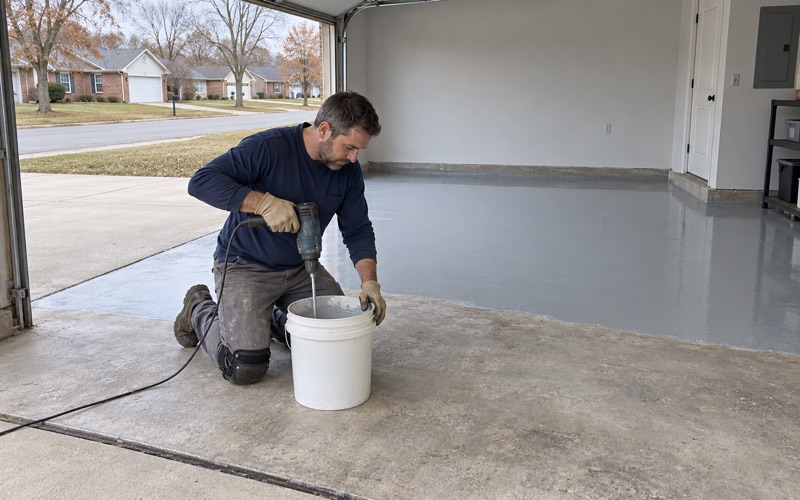
Our method does not change between a single conference room and a full office floor. We open the slab with a diamond grinder or a shot blaster rather than an acid etch, we write a moisture test into the scope before the price is final, and the proposal names the product line, the number of coats and the finished thickness so the floor can be checked against it.
This page covers the part of an office conversion that most coating quotes skip: the floor boxes, the covers on them, and the cleaning water that will reach them every week once the carpet is gone. Some of that work is ours and some belongs to your electrician, and we are clear about where the line falls.
An Office Floor on Wood Dale Road
A logistics headquarters with offices beside its warehouse
Gebruder Weiss moved its USA headquarters to 1020 N. Wood Dale Road, according to the company’s October 27, 2022 release: 16,000 square feet of office space alongside a 45,000-square-foot warehouse. The address sits inside Wood Dale city limits, in Addison Township, DuPage County. The company’s core business is overland transport, air and sea freight, and logistics.
We have not been inside that office, and Gebruder Weiss is not a customer of ours. The release does not describe the office layout, its conference rooms or its floors. We mention it because it shows a building type common on this stretch of road: a large block of finished office space attached to a working warehouse, with two halves that need very different floors.
Offices that take their power from the slab
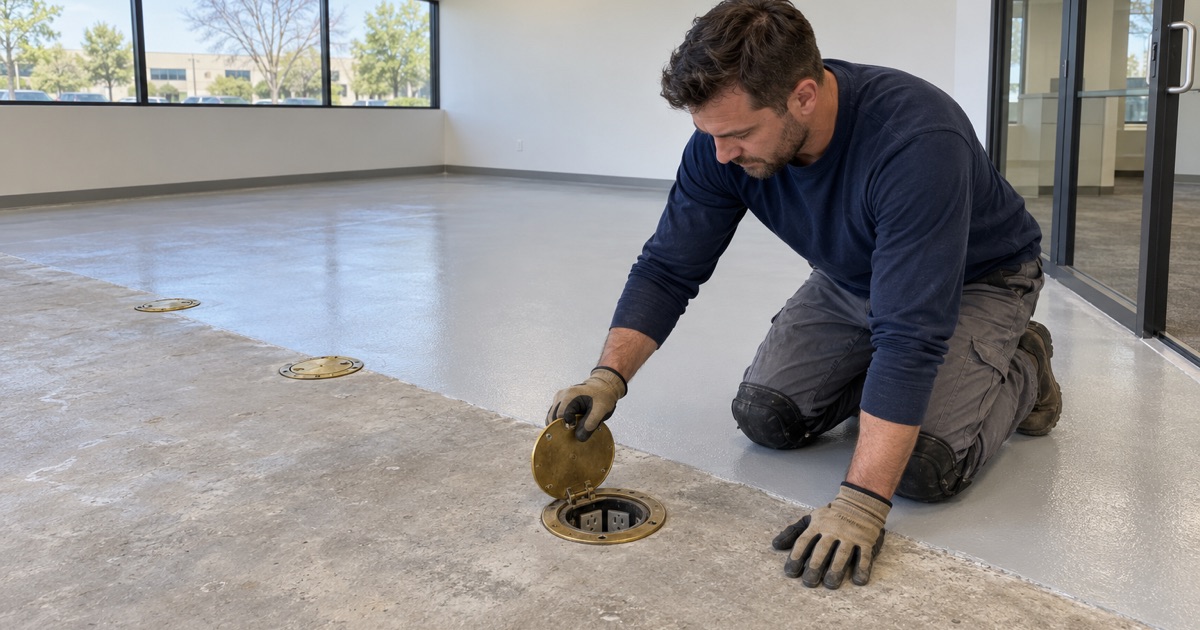
Open-plan offices and conference rooms often get power and data from the floor rather than the walls. A floor box is a housing set into the slab, holding receptacles and data ports, with a cover that sits flush or nearly flush with the finished floor. A poke-through does a similar job through a hole cored in the slab, feeding devices from the space below.
For a coating crew, every one of those devices is an opening in the floor. Each has a flange, a cover and a seam around its edge, and each was set to meet one particular finish. The covers themselves are often carpeted to match the room. Change the finish around the box and you change what meets that flange every day afterward.
Finding every box before demolition
Floor boxes cluster wherever furniture needs power away from a wall: under conference tables, along rows of workstations, at the front of training rooms. In a carpeted office they are easy to overlook because the carpet is cut tight around them. Some only turn up when the carpet is rolled back and the adhesive line around a cover shows.
So the first walk-through on a carpet-removal job is partly a search. We mark every floor box and poke-through on a floor plan before demolition begins, with its location and, where it can be read, its cover type. That way none of them is ground over, flooded with primer or buried under a coat of resin by accident.
Looking for epoxy-flooring closer to Bensenville? See Epoxy-Flooring in Bensenville.
Why a Floor Box Cover Is Listed for Its Finish
What the manufacturer data sheets say
The listing on a floor box assembly is tied to the floor around it. FSR’s FL-500P data sheet says the box is designed for conference rooms, auditoriums and general meeting space “with concrete floors that are covered with carpet.” Its covers are described as “UL Scrub Water Rated for Tile and Carpet Installations.” The box itself is UL and cUL listed.
The same sheet notes that flat black, oak or stainless covers are available for non-carpeted applications. In other words, the maker treats the surrounding finish as part of choosing the cover. A carpet cover sitting in a freshly coated floor is not automatically the right part, even when it fits the opening and looks fine on the day the job is finished.
One cover that is expressly not for bare concrete
A distributor listing for Wiremold’s RFB119 floor box cover assembly says it is UL listed under UL514A for scrub water exclusion, then adds a plain note: “Not for use on bare concrete floor applications.” A cover can carry a scrub-water listing and still be wrong for a particular floor, because the listing assumes a particular installation around it.
The practical reason is cleaning. Carpet is vacuumed. A resin or polished concrete floor is wet-mopped or run with an auto-scrubber, which spreads dirty water across the surface and toward any edge or seam it meets. A scrub-water rating was written for a defined finish and cleaning routine, so swapping carpet for a hard floor changes the conditions the cover was rated against.
What a coating can and cannot do at a box
No floor coating carries a scrub-water rating, and a coating does not make a floor box watertight. The listing belongs to the box and cover as a manufactured assembly. Whether a given cover is still appropriate once the carpet is gone is a question for its maker and a licensed electrician, not for a coating crew.
Our part is narrower and still important. We make sure that question is asked before the floor is coated, and we leave each box in a condition where the right cover can be fitted, opened and serviced later. A floor that looks finished but has covers nobody checked is a problem handed to the next person who needs a plug.
Pulling Carpet for a Coated Floor: Inventory Comes First
The box list goes into the written scope
On an office conversion, our written scope lists every floor box and poke-through we found, by location, with the cover type where it is legible. That list goes to the owner or tenant and to their electrician. If a cover is not suited to a wet-cleaned hard floor, a licensed electrician confirms the right replacement or swaps it. We do no electrical work and do not open devices.
Doing this before scheduling matters. A replacement cover may need to be ordered, and a different cover can use a different trim ring or sit slightly differently in its frame. We want that settled before we decide exactly where the coating edge goes at each box, not discovered after the topcoat has cured around the old part.
Getting the carpet history off the slab
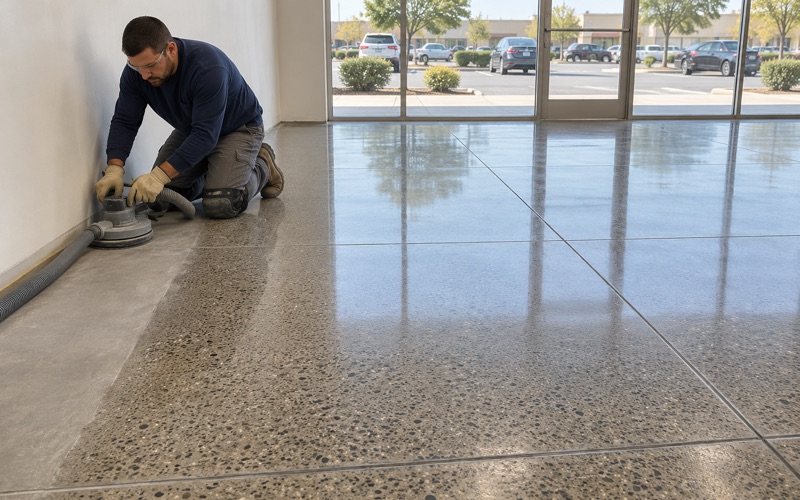
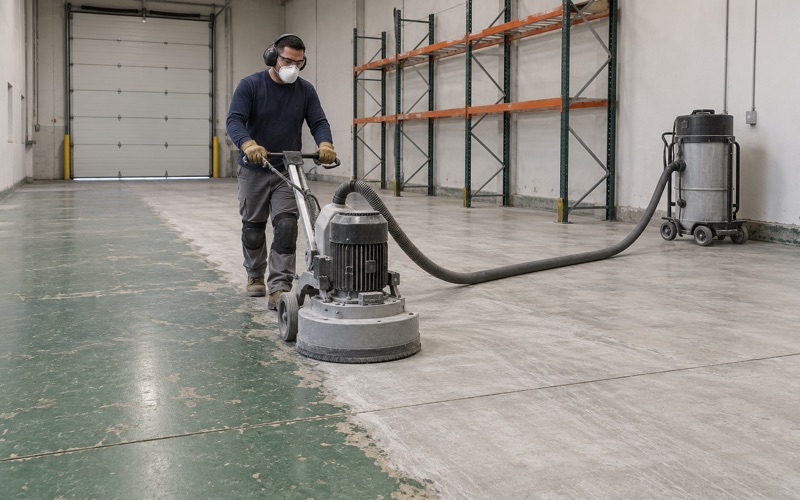
Carpet leaves adhesive, tack strip holes and sometimes leveling patches behind. We remove the adhesive and grind the slab to a concrete surface profile suited to the system, generally in the ICRI CSP 2 to 3 range for a thin film and coarser for heavier builds. The grinder runs with a vacuum attached, so dust is captured at the machine rather than swept around.
During grinding the boxes stay closed and masked, so dust and debris cannot fall into the openings. Cracks, spalls and old patches are mapped as the carpet comes up, and if a section of slab needs repair before it should be coated, we say so in writing rather than burying the problem under a fresh coat of resin.
Moisture testing under old carpet
Carpet hides how a slab handles moisture, since vapor can pass through it without anyone noticing. Before pricing, we test with ASTM F2170 in-situ relative humidity probes or ASTM F1869 calcium chloride kits. If the readings call for a moisture-mitigation primer under the 100% solids epoxy, the proposal says so and prices it, instead of leaving it as a later surprise.
We also explain what the coating warranty leaves out before the job is sold. Moisture vapor transmission is the first exclusion we name, because a slab that has been under carpet for years has never shown anyone what it does once a sealed resin film is bonded to its surface.
Detailing the Coating at the Flange and Keeping Scrub Water Out
Stopping the resin at the flange
We stop the coating at the box flange. Resin is brought up to the edge of the frame and finished cleanly there, never flooded into the opening, across the cover’s hinge or onto the device plate. A coating that bridges a cover to its frame can glue it shut, and a cover that will not open defeats the reason the box exists.
The edge treatment at each box is written into the proposal, so you know how the finish meets the frame before work starts. Where a replacement cover is going in, we coordinate the timing with your electrician so the new part is fitted in its finished position and the coating edge is set to it, not to a cover about to be removed.
Keeping water out of open boxes during prep and cleaning
Water is kept away from the boxes from the first day. We do not wet-grind or rinse near them, and slurry is never pushed toward an opening. If a cover must be open while we work nearby, the device is protected and the area stays dry. Cleanup on our side is vacuum and dry methods until the boxes are closed.
After handover, the floor will be cleaned on a new routine, and that is where scrub water reaches the boxes week after week. We walk the facility manager through it: damp mopping rather than flooding, scrubber passes that keep the squeegee working near each cover, and a quick check that every cover is closed before the machine runs.
Texture, cure and permits in a working office
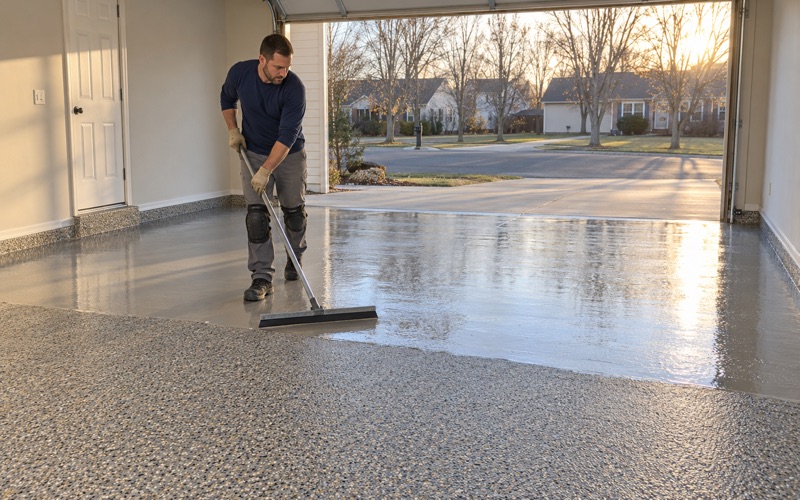
Most office floors want a smooth, cleanable finish, often a polyaspartic topcoat over epoxy. Where slip resistance is needed, we specify it by the broadcast and topcoat used, not as a promise. Cure follows slab temperature and dew point rather than the calendar, and work can be phased into overnight and weekend windows so the office keeps running.
Before any permit issues in Wood Dale, the city requires every contractor to be registered with the Community Development Department, with a certificate of insurance carrying $2,000,000 in public liability coverage naming the City of Wood Dale as certificate holder. We confirm those requirements for the job before it goes on the schedule.
- 20+ Years on Concrete
- Moisture Tested First
- Written Scope and Pricing