Bartlett Epoxy Flooring has spent more than 20 years on epoxy-flooring in Winfield and across the western suburbs, and the garage jobs we plan most carefully are the ones where fuel has been on the floor. Attached home garages and working shops share one physical fact: gasoline vapor is heavier than air, and it gathers low.
That fact shapes how we schedule, ventilate and choose products, because grinding, priming and coating all happen at floor level. A crew on its knees is working in the same layer of air the building code keeps flames out of, so the plan for the room matters as much as the plan for the slab.
What follows is how we approach that in a village whose building codes were updated recently, starting with a working repair shop downtown and ending with the water heater on a platform in a home garage.
A Repair Garage on High Lake Road and the 18-Inch Line
Brach’s Service Center, a working shop downtown
Brach’s Service Center at 27W555 High Lake Road is a repair garage in the middle of downtown Winfield. It handles repairs, scheduled maintenance and tires, and its listed hours run from 6:00 a.m. to 5:00 p.m. on weekdays. We have not been inside its bays, and it is not a customer of ours.
We name it because it is a clear local example of the kind of room the code treats most strictly. A repair garage moves vehicles in and out all day, drains and fills fluids, and keeps fuel close at hand. Any floor coating in a space like that is planned around the building, not just the concrete.
Winfield adopted the 2024 codes
The Village of Winfield adopted the 2024 International Building, Residential, Mechanical, Fuel Gas and Fire Codes as of November 21, 2024, under Ord. 2024-11-19. Contractors must register with the village before working there, and a homeowner doing work on his or her own residence files a letter of intent with the Building Department on Jewell Road.
We have not read the 2024 wording of the garage section or any local amendments, so we quote the 2021 International Building Code below and check the current text with the village before a job is scheduled. Fire code questions go to the Winfield Fire Protection District, which is a separate special district rather than a village department.
Why the code lifts flames 18 inches above the floor
Section 406.2.9.1 of the 2021 code requires ignition sources in private garages, public garages and repair garages to sit not less than 18 inches above the floor surface. The one exception is an appliance listed as flammable vapor ignition resistant, which the code does not require to be raised.
The reason is the vapor itself. Spilled or evaporating fuel does not rise and clear the way warm air does; it settles and spreads along the slab. The code draws a line 18 inches up and treats everything below it as the zone where a pilot light, spark or glowing element has no business being.
Looking for epoxy-flooring closer to Warrenville? See Epoxy-Flooring Services in Warrenville.
Floor Work Happens Inside the Vapor Layer
Grinding and priming at slab level
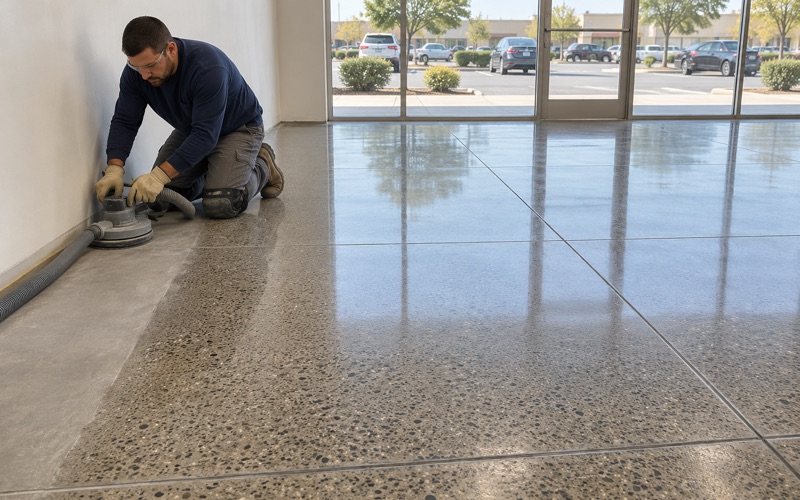
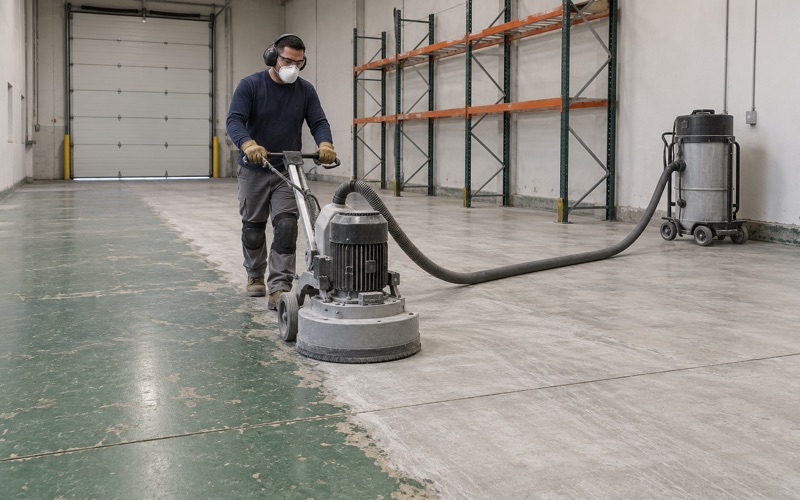
Every coating we install starts with diamond grinding or shot blasting, never an acid etch, so the resin has a real profile to grip. That work happens with the machine head on the concrete and the operator’s hands a couple of feet above it. Priming follows the same way, with rollers and squeegees moving across the floor.
In a garage, that means the whole job sits inside the band of air the code is worried about. A floor that has had fuel spilled on it over the years can still give off vapor when it is warmed, swept or ground, and our crew treats that air with the same respect the code does.
Our own equipment counts as an ignition source
A grinder motor, a dust vacuum, an extension cord connection and a work light on the floor are all possible sparks. We do not set them up as though they were harmless because they belong to the crew rather than the building. Cords are kept off the slab where we can, and connections are made away from where fuel was stored.
We capture grinding dust at the machine with a vacuum instead of washing it toward a floor drain. In a repair shop that also keeps fine dust out of a drain line that may already carry shop fluids, and it leaves the slab clean and dry for priming rather than wet and waiting.
The coating is not fire protection
A finished epoxy or polyaspartic floor is easier to keep clean, and a spill can be wiped up before it soaks into bare concrete. That is a real benefit, but it is a cleaning benefit. A floor coating does not stop fuel from giving off vapor, and it does not change what the code requires about where flames and sparks may sit.
We say this plainly in the proposal because it is easy to oversell. The 18-inch rule, the ventilation and the appliance placement stay the owner’s responsibility under the code, and nothing we put on the slab replaces them. Our job is to coat the floor without adding risk while we do it.
Planning a Coating Job in a Working Garage
Vehicles, fuel and flame out of the room
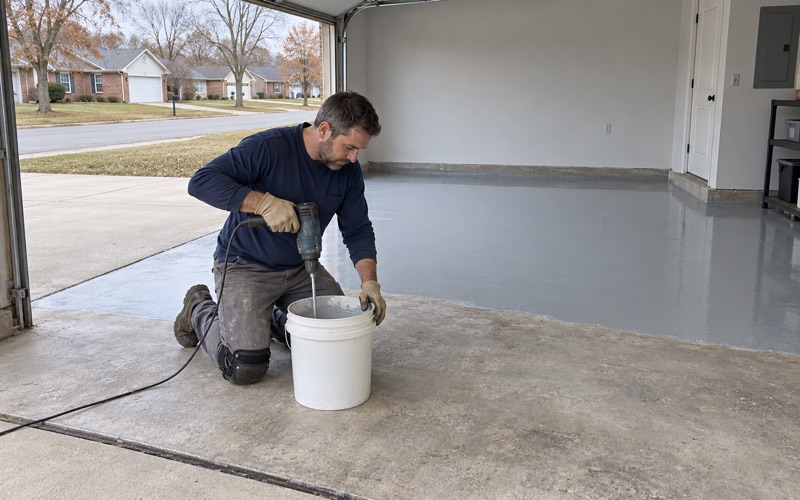
Before we grind, the bays are emptied of vehicles, fuel cans, parts washers and anything else that stores or gives off vapor. Fuel work stops for the duration. Portable fuel-fired heaters and open-flame tools are not run at floor level while we clean or prime, because those are exactly the ignition sources the 18-inch line is written for.
In a home garage this is simpler: cars out, the gas can and mower moved outside, and nothing with a flame left running low in the room. In a shop it takes a conversation with the owner about which bays close and when, because a repair business cannot simply stop answering the phone for a week.
Air moving while we work
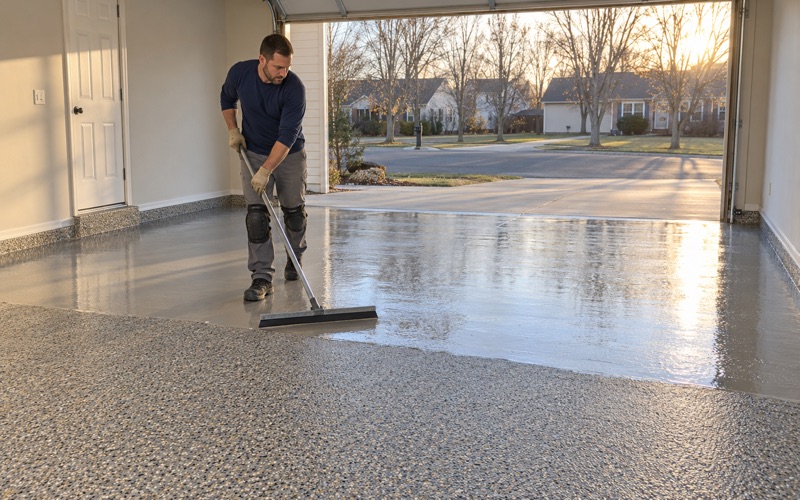
The 2021 code requires repair garages to have mechanical ventilation, controlled at the entrance to the garage. Where a shop has that system, we ask for it to run throughout the job. In a home garage we open the overhead door and set up our own fans to move air across the floor, not just near the ceiling.
Air at slab level matters more than air in the middle of the room. Vapor from old fuel and vapor from a primer both sit low, and a fan blowing at head height can leave the bottom foot of the room almost still. We position air movement to clear the layer the crew is working in.
Lower-solvent products where they will do
We choose products inside the Illinois VOC limits for floor coatings, which bind whoever applies them. Where a garage does not need a solvent-borne primer, we use a 100% solids epoxy, a water-based primer or a high-solids system, which put far less vapor into the very layer of air the code is concerned with.
The proposal names the product line, the number of coats and the finished thickness, so an owner can see what is going down and check the floor against the quote. A moisture test is written into the scope before the price is final, and we map cracks, spalls and old coatings first and say so when a slab should be repaired before it is coated.
Overnight and weekend windows
A repair shop that opens at 6:00 a.m. on weekdays usually has its quietest hours on evenings and weekends. We phase commercial work around operating hours, coating one group of bays while the others stay in use, and we can schedule overnight or weekend windows when a space cannot close.
Cure time sets the order. A bay that has just been coated is not ready for a lift, a jack or a hot tire until the coating has cured, so we work out with the owner which bays can be down together and for how long. The written schedule shows when each bay returns to service.
Water Heaters and Furnaces in a Home Garage
Why the appliance sits on a platform
Most of Winfield’s housing was built in 1980 or later, and where a gas water heater or furnace stands in an attached garage, it usually sits on a raised platform. The 18-inch rule is the reason. The 2021 code also calls for 6 feet of clearance above the floor in private garages unless the appliance is protected from vehicle impact.
We do not move or remove that platform. It belongs to the mechanical installation, and altering it is not floor work. Our coating stops at the platform and runs neatly around its base, so the appliance stays exactly where the code and the installer placed it.
Pilot lights and the primer schedule
A standing pilot or a burner on a water heater is an ignition source, platform or not. Where a solvent-borne primer would otherwise go down near one, we talk with the homeowner about the appliance first, and our default is a low-odor or water-based product in that room so we are not putting solvent vapor near an open flame.
Ventilation runs the whole time, the overhead door stays open, and the crew keeps its own cords and equipment clear of the appliance area. The goal is a finished floor that went down without anyone having to wonder what was drifting toward the burner while the primer was wet.
A floor that is easy to wipe clean
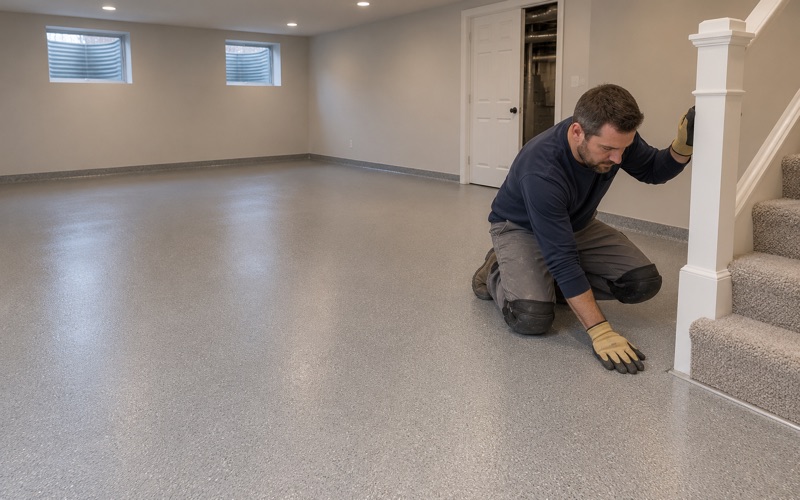
Once the coating is down, a small fuel spill wipes off a sealed surface instead of soaking into bare concrete. That helps an owner keep the floor clean, and a clean floor makes a leak easier to notice. It does not change any of the code requirements above, and we do not describe it as if it did.
Whether it is a repair bay on High Lake Road or a two-car garage at home in Winfield, we would rather plan the job around the air in the room, the appliance on its platform and the vehicles that use it than treat it as just another slab.
- 20+ Years on Concrete
- Moisture Tested First
- Written Scope and Pricing