Bartlett Epoxy Flooring brings more than 20 years of grinding and coating concrete to epoxy-flooring in Western Springs, and part of that experience is knowing where a coating should stop. On most jobs that line is a wall or a doorway. On a gas station lot it is the edge of the concrete pad under the fuel dispensers, a slab the building code wants left bare.
That pad matters to commercial owners weighing a refit and, in a smaller way, to any homeowner who keeps a gas can for the mower. The physics is the same in both places: fueling builds static charge, and that charge needs a route to ground so it cannot spark through the vapor. We coat the floors around that process, never the surface it happens on.
Below we walk through the code sentence behind that rule, the station on Wolf Road it applies to, how we would scope a station interior around it, and what it means for a can filled at the pump. The same commitments run through all of it: a diamond-ground or shot-blasted profile instead of an acid etch, a moisture test written into the scope, and a proposal that names the product, coats and finished thickness.
Western Springs Is Down to One Gas Station
A village that watched its stations close
In October 2012 a Patch community post titled “Western Springs’ Vanishing Service Stations” traced how the number of gas stations in the village had steadily declined. It walked corner by corner through the Red Crown at Central and Hillgrove, the Texaco at Wolf and Burlington, the Skelly at Wolf and Hillgrove and others, most of them later reused as offices, shops or a bank.
Jim Benak’s Shell at 701 Burlington opened in 1949 and stopped selling gas in the 1990s, and by 2012 the building was Benak’s Auto Service. The post’s closing count was blunt: the Mobil at 55th and Wolf was the last gasoline franchise left in town, or in its words, “Today, we have just one!”
5500 Wolf Road today
That remaining station sits at 5500 Wolf Road, an address that geocodes inside the village in Lyons Township, Cook County. A LoopNet listing markets it as a one-story, single-tenant gas station property built in 1978 and offered for sale. Directory listings disagree on the brand, some naming Shell and others Mobil, and we have not settled which is current.
We have not seen the station’s pad, store or plans, and it is not a job of ours. It matters here for a simpler reason. A property listed for sale is often where a new owner starts pricing a refresh, and a refresh is when someone asks whether the concrete under the dispensers could get a fresh color coat too.
What a sale tends to set in motion
A change of ownership often brings rebranding, new signage and interior work, and the floors inside a 1978 building are part of that conversation. Store, back-room and restroom floors can be ground, tested and coated on a schedule that keeps the pumps open. The pad outside answers to a different rule, and that rule is short and specific.
Looking for epoxy-flooring closer to La Grange Park? See Epoxy-Flooring Services in La Grange Park.
Noncoated Concrete Under the Pump: The Code and the Physics
One sentence in the building code
Section 406.7.1 of the 2021 International Building Code is one sentence long: “The vehicle shall be fueled on noncoated concrete or other approved paving material having a resistance not exceeding 1 megohm as determined by the methodology in CEN EN 1081.” That leaves two paths. Leave the concrete bare, or use a paving material that has been tested and approved at that resistance.
The section sits inside the code’s rules for motor fuel-dispensing facilities, which also point to the International Fire Code. The garage-floor section nearby, 406.2.4, defers to it for the surface of a fueling pad, and its asphalt exception covers public parking garages and private carports, not the pad. Which edition the village has adopted for commercial work is a question we put to Village of Western Springs Community Development at 708-246-1800.
Why the pad has to carry static to ground
Fueling a vehicle can build static charge, and charge that cannot drain away waits for a spark gap. Gasoline vapor gathers right at the fill point, the worst place for that spark to jump. The code’s answer is a surface that lets charge leave: bare concrete, or a paving shown to measure 1 megohm or less, so static has a path to ground.
CEN EN 1081 is the European method for measuring the electrical resistance of a floor covering, and the code borrows it to put a number on that path. We do not test or sell any coating against it, and we do not coat fueling pads. An owner who wants something other than bare concrete there takes that question to the building official, not to a floor coater.
What a sealing film would do there
Epoxy, polyaspartic and urethane systems are built to seal concrete: a continuous film laid over the pores. On a garage floor that film is the whole benefit. Over a fueling pad it would sit between the tires, the driver’s shoes and the slab, and we hold no test showing any system we install meets that 1 megohm limit.
The code lists noncoated concrete first and makes any alternative earn its place through a resistance test and an approval. We read that order as the plain instruction it is, and our crews leave the pad alone even when the rest of the lot is getting a facelift.
Coating a Station’s Store, Restrooms and Bays, Then Stopping
Drawing the line before the price
When we scope a commercial property with a fuel island, the first thing marked on the drawing is where the coating stops. The store floor, back room, restrooms and any service bay sit inside the line. The concrete under and around the dispensers sits outside it, and that boundary is written into the proposal so no one on the crew has to guess.
The same proposal names the product line, the number of coats and the finished thickness for each room inside the line. A station owner can walk the store after the job and check what went down against what was quoted, room by room. If a slab needs repair before it should be coated, the proposal says that too.
The store and back room
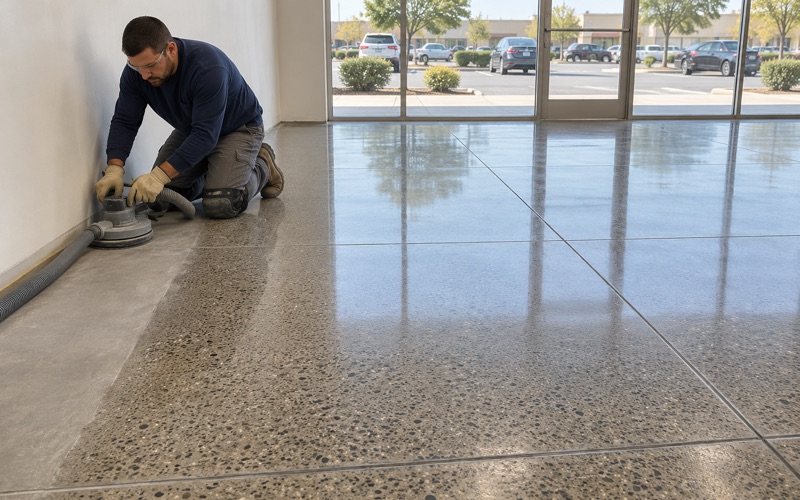
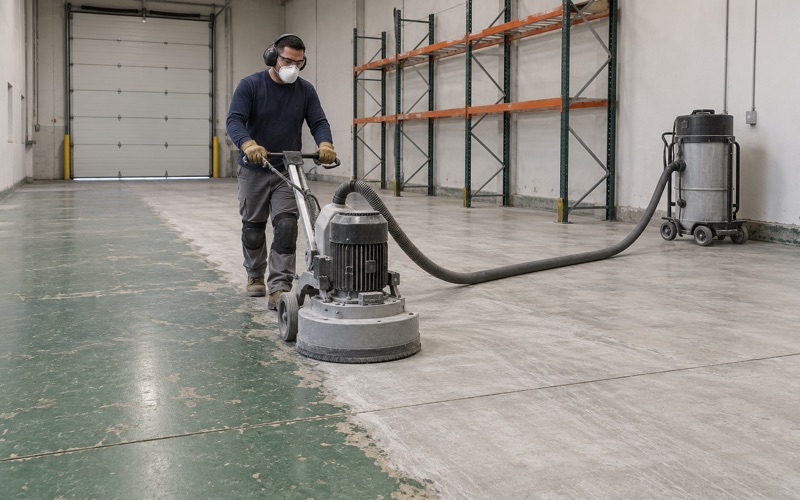
A convenience store floor takes carts, dollies, dropped cases and wet boots, and it usually has to stay open while that happens. We phase the work around operating hours, often overnight, so one zone cures while customers shop another. Every slab is opened with a diamond grinder or shot blaster, with the dust pulled into a vacuum at the machine rather than washed toward a drain.
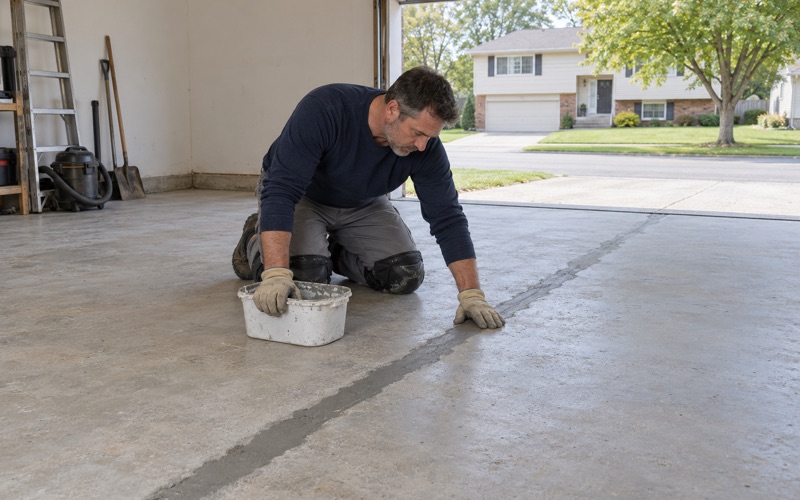
Existing coatings and patched cracks are mapped before a price is final, because a building from 1978 may carry decades of layered floor work. A moisture test goes into the written scope as well. Where an old finish will not let go cleanly, we say so and price its removal by grinding to a CSP 1-3 profile rather than coating over it.
Restrooms and service bays
Restrooms at a fuel stop get mopped hard and often, so we run the coating up the wall as an integral cove base and finish with a fine quartz broadcast for grip. Slip resistance comes from the broadcast and topcoat we specify, not from a slogan, and a finer texture keeps the floor easier to mop.
A service bay, where a building has one, is an interior floor like any other: ground, tested, coated and cured to slab temperature and dew point rather than the calendar. An unheated bay in deep winter is told to wait. Brine and rock salt riding in on tires shape which system we choose there, and hot tire pickup is weighed against the topcoat we pick.
The edge nearest the pumps
Where an interior coating meets a door facing the pumps, it ends at the threshold with a clean, ground-in termination edge, so a later touch-up has no reason to creep outside. The pad stays the noncoated concrete the code describes, and any repair out there is concrete work, not a coating job.
Gas Cans at Home: Fill Them on the Ground
The guidance behind the pump rule
The pump rule has a homeowner version. Safety guidance from the petroleum and fuel-equipment trade groups, API and PEI, says to fill gas cans on the ground: set the container down on the pavement and keep the nozzle touching it the whole time it fills. Contact and ground give static the same way out the bare pad does.
With one station left in the village, a resident filling a can close to home is doing it on the pad at 5500 Wolf Road or driving out of town. In a village where 95.6 percent of occupied homes are owner-occupied, the person carrying that can is usually the one who owns the garage it will sit in.
Why a lined truck bed is the wrong spot
The same guidance says not to fill a container in the bed of a pickup, on a flatbed or on a trailer floor. The truck bed and a bed liner act as insulators, so static can build in the can while fuel flows into it. Plastic liners and car trunks have drawn the same warning.
Lifting the can out and setting it on the pad takes a few seconds and puts it on the same bare concrete the code wants under the car. Keep the nozzle in contact, fill it there, cap it, and only then load it.
Where the can goes once you are home
A garage floor we coat is chosen for brine, rock salt and hot tires, not for handling fuel, and we never present it as a place to pour gasoline. Decanting from a can over an insulating surface repeats the truck-bed problem in miniature, so that task belongs outside, on bare concrete or the ground.
When we quote a Western Springs garage, the proposal covers the slab, the grind and the coating system, and fuel storage stays the homeowner’s call. Jobs over the state threshold get a written contract and the Illinois consumer-rights pamphlet before any grinding, and we name moisture as the first thing the warranty leaves out.
- 20+ Years on Concrete
- Moisture Tested First
- Written Scope and Pricing