Bartlett Epoxy Flooring has spent more than 20 years installing epoxy-flooring in Westchester homes and storefronts on a simple order of work: decide how the floor will be cleaned, then choose a coating that survives that cleaning. In a house or practice with cats, that order matters more than usual, because some of the most common disinfectants are off the table before anyone picks a color.
Our part is the slab and the finish, not the cleaner. We read the concrete and map its damage before quoting, but the first question on a cat household’s job is simpler: what goes on this floor to clean it?
This page walks through why that question comes first around cats, how a topcoat is matched to a non-phenolic cleaner, why a sealed floor rinses clean where bare concrete holds on to cleaner, and what all of it means for a basement litter corner or a back-door mudroom in a Westchester house. The same reasoning holds for a small storefront where cats spend the day.
A Cats-Only Practice on Wolf Road and the Phenol Question
La Grange Park Cat Clinic in the Westbrook Shopping Center
La Grange Park Cat Clinic treats only cats, from a storefront in the Westbrook Shopping Center at 31st and Wolf Road. Its own listing says it opened in May 2010 and explains the choice plainly: “We treat only cats so that they are less stressed by strange smells and sounds.” The name points at a neighboring village, but the address, 3075 Wolf Road, sits inside Westchester village in Proviso Township.
We have no connection to the practice and have not seen its floors or its cleaning routine. It belongs on this page for a different reason. A cats-only practice is a reminder that what cats tolerate shapes a room, and the products used to clean it are part of that. The same logic reaches any Westchester home with a cat in it.
What the Merck Veterinary Manual Says About Phenols
The Merck Veterinary Manual, in its review of phenols used as antiseptics and disinfectants around animals, calls phenols and cresols highly toxic to cats, because cats are deficient in the enzyme UDP-glucuronosyl transferase. Its conclusion is direct: phenol-based disinfectants are best avoided in feline environments, and the manual names the home, the shelter and the veterinary clinic among them.
The same entry notes that cresol is commonly used as a surface disinfectant, which is how the question reaches the floor at all. The manual says nothing about floors or residues, and we do not stretch it. It simply takes one class of cleaners off the list in any room a cat uses, and the floor has to be planned around what remains.
Why We Ask Before We Quote
We are not veterinarians and give no advice on which disinfectant suits your cat; that decision belongs to you or to your vet. What we ask is the product name, how often it goes down, whether it is mopped, sprayed or left to dwell, and how the floor is rinsed afterward. Those answers shape the coating far more than color does.
A homeowner who already avoids phenols for the cat’s sake can usually name the replacement product without looking. That answer goes on the scope sheet beside the moisture reading and the crack map, so the topcoat on the proposal is chosen for that cleaner rather than for floors in general.
Looking for epoxy-flooring closer to Lake Zurich? See Lake Zurich Epoxy-Flooring.
Choosing a Finish for the Cleaner You Will Really Use
Start From the Label on the Shelf
Resin floors are not equally tolerant of every chemical. Coating manufacturers publish resistance charts that rate a cured finish against specific cleaners, concentrations and contact times, and we read those charts against the product you named. A finish that shrugs off a mild neutral cleaner can dull or soften under a stronger disinfectant left to dwell, so dwell time matters as much as the chemical.
If the household or practice switches products later, the floor does not need to be redone, but the new label should be checked against the same chart. We hand over the product line and topcoat name in writing for exactly that reason, so the next person reading a cleaner label has something to compare it with.
Matching the Topcoat to the Routine
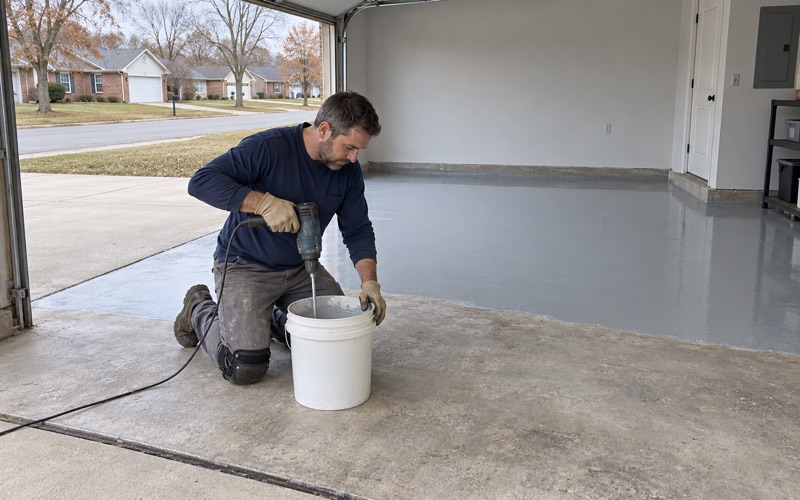
For most basements and mudrooms the choice comes down to a 100% solids epoxy base with either an epoxy or a polyaspartic topcoat. Polyaspartic and polyurea topcoats hold their gloss and resist wear well, and many are rated against a broad range of household cleaners. Urethane cement is a heavier system we keep for floors that see hot water or constant wet cleaning.
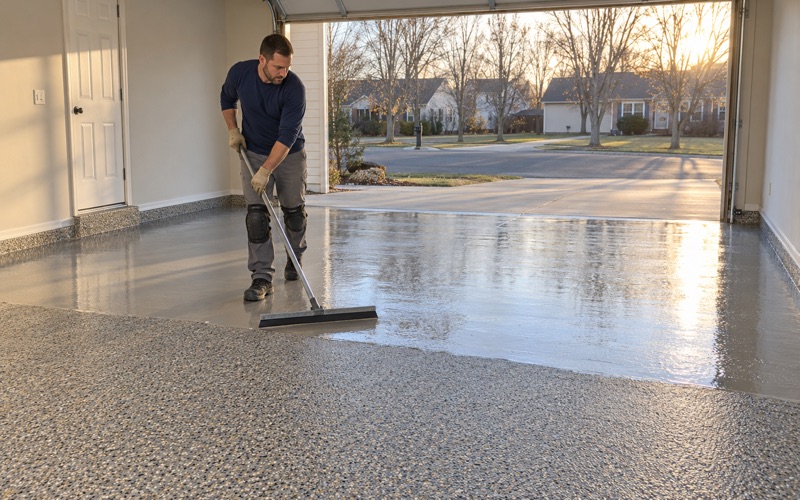
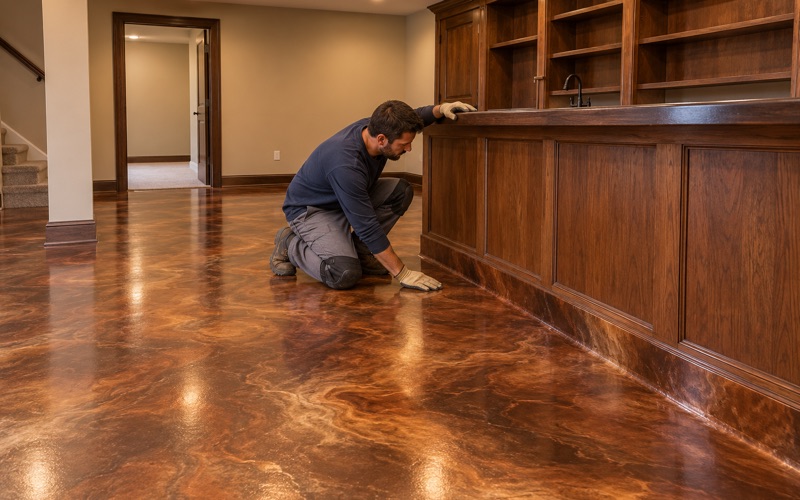
The topcoat is the layer your cleaner actually meets, so that is where the matching happens. A clear coat over a vinyl flake or quartz broadcast takes the mop, the spray and the rinse, while the color layers beneath never see them. Getting the top layer right costs less than recoating a floor that hazed over after its first season of daily wiping.
Written Into the Proposal
Our proposal names the product line, the number of coats and the finished thickness, so the cured floor can be checked against the quote. On a cat household’s job we add the cleaner you named and the maker’s resistance rating for it, which turns a spoken assurance into something you can hold us to.
We also explain what a coating warranty leaves out before the job is sold. Moisture rising through the slab is the first exclusion we name, and damage from a cleaner the topcoat was never rated for is a common second. Both conversations go better at the kitchen table than after a topcoat turns cloudy.
Rinsing to No Film: Sealed Floors Versus Porous Concrete
Where Cleaner Hides in Bare Concrete
Bare concrete is porous. A cleaner mopped across it soaks into the surface pores, settles into shrinkage cracks and gathers in saw-cut joints, and a rinse pass does not reliably lift it back out. Over months that leaves a film of whatever was used, heaviest in the low spots and edges where a damp mop drags and stops.
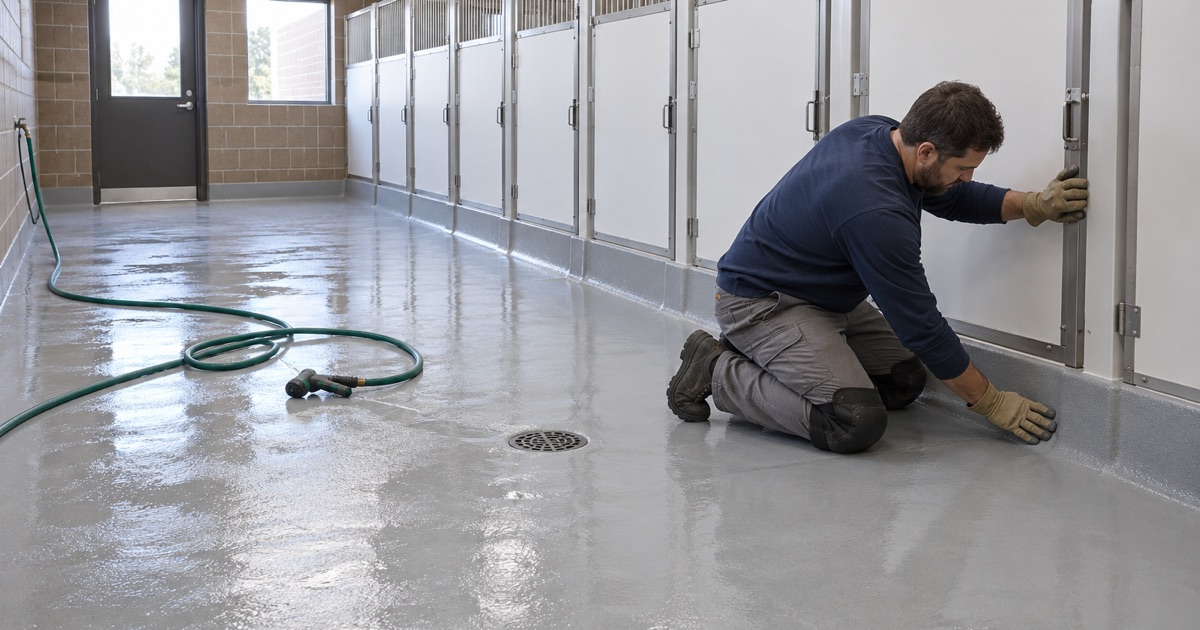
A sealed, seamless resin floor behaves differently. Cleaner sits on the surface instead of soaking in, so a second pass with clean water carries it off and the floor dries without residue. That is the practical case for coating a room cats use: the coating does not disinfect anything or change what a cleaner is, but it lets you rinse to nothing.
Cracks, Spalls and Old Coatings Come First
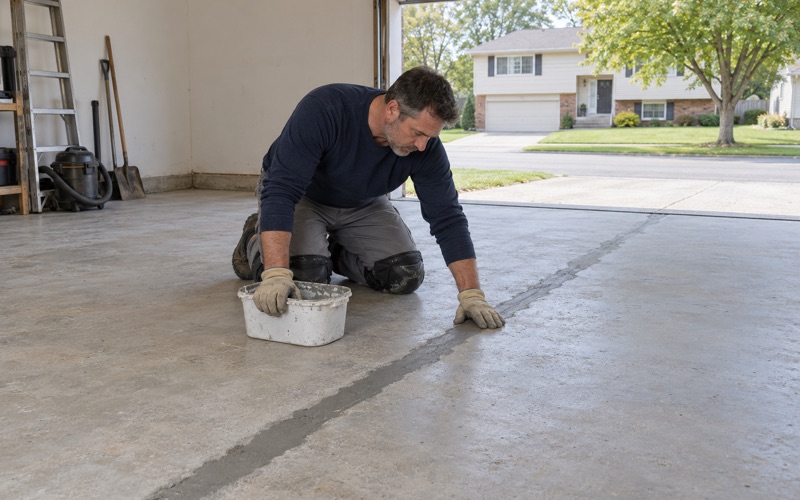
A seamless floor is only seamless if the slab beneath it is sound. Before we price anything we map cracks, spalls and any old paint or coating, and we tell you when a slab needs repair or replacement before it should be coated at all. A crack bridged without repair can reopen under the topcoat and become a fresh place for cleaner to pool.
Much of Westchester went up quickly: the village grew from 4,308 people to 18,092 between 1950 and 1960, and 48.4 percent of today’s housing was built in that decade. A basement slab from those years has had about seventy years to crack, settle and soak up whatever was spilled or mopped on it, which is why the crack map is never skipped.
Opening the Slab Without Acid
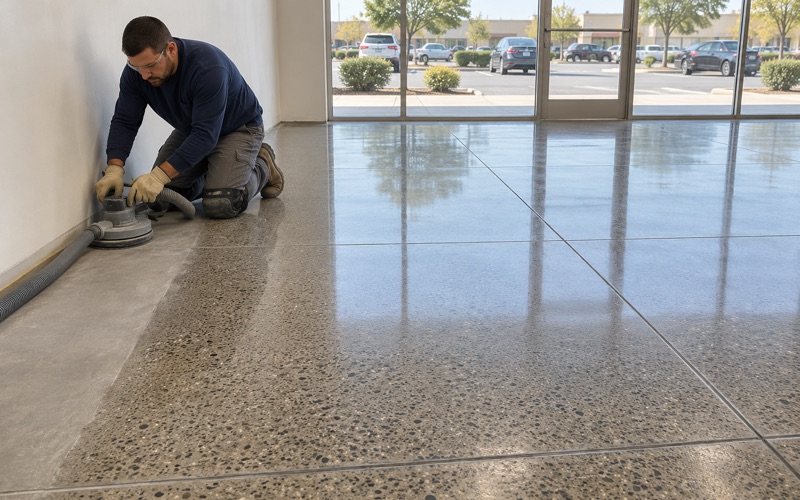
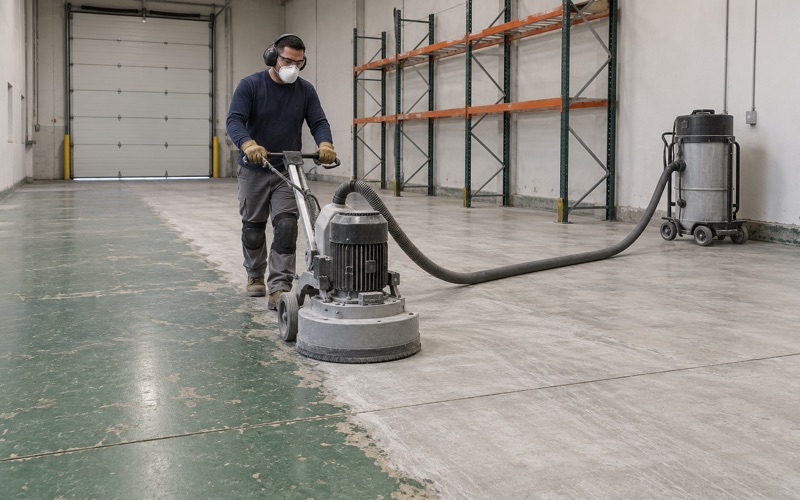
Every slab we coat is opened with a diamond grinder or a shot blaster to a measured ICRI concrete surface profile, never with an acid etch. Acid leaves its own residue in the pores, a poor start for a floor whose whole purpose is rinsing clean. Grinding dust is captured at the machine by a vacuum rather than washed toward a floor drain.
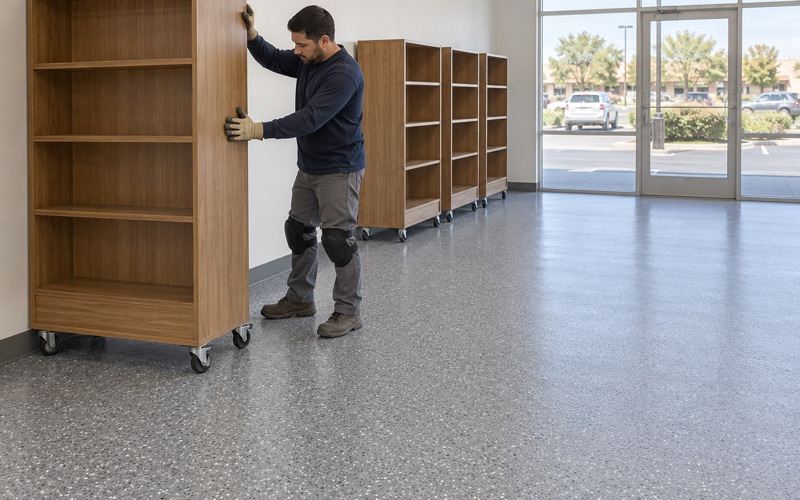
Texture is the other trade-off. Coating makers note that excessive texture can trap dirt and make a floor harder to clean, so a room built around rinsing usually gets a finer quartz or flake broadcast locked under a full clear topcoat. We name the broadcast and the topcoat in writing, so the finish you see matches the finish on paper.
Cat Households: Basements, Mudrooms and Litter Corners
A Litter-Box Corner in the Basement
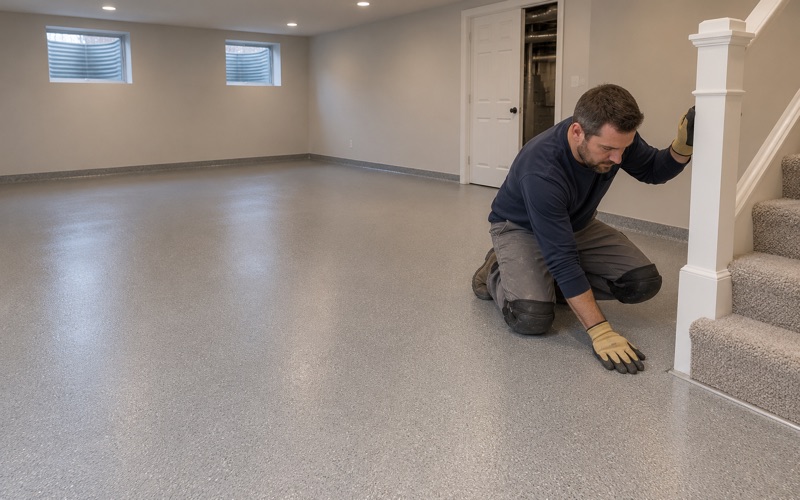
In a cat household the litter box often lives in a basement corner, near the laundry or the furnace, on a slab that has never been coated. That corner gets scooped, spilled on and wiped down more than any other part of the floor, and on bare concrete whatever cleans it ends up in the pores and the nearest crack.
Coating that corner usually means coating the whole room, because a patch leaves an edge where new floor meets old. We run the system to the walls and keep the floor’s fall to any drain intact, so a rinse still has somewhere to go. The box goes back down on a surface that wipes clean without holding anything.
Moisture Comes Before Color
A litter corner is still a basement floor, and moisture is the first thing we read. A moisture test is written into the scope before the price is final, using a calcium chloride test to ASTM F1869 or in-situ relative humidity probes to ASTM F2170. Where the readings run high, a moisture-mitigation primer goes down before the base coat.
We also look for signs of past water, such as efflorescence, tide lines or a sump that runs hard after storms. A coating does not stop seepage or a sewer backup, and we say so before you buy one. Cure schedules follow slab temperature and the dew point spread at the surface, so a cold basement may need heat before the topcoat goes down.
Mudrooms, Salt and Village Paperwork
The mudroom or back-door landing is the other room cats share with everyone’s boots. In winter it takes brine and rock salt off shoes along with whatever cleaner clears them away, so the topcoat is picked to stand up to both. A slab-on-grade mudroom gets the same moisture test as a basement before anything is applied.
Inside the village, permit questions go to the Village of Westchester Community Development and Building Department. We confirm with that office whether a coating job needs a permit and what contractor registration it expects for the year before scheduling. Home jobs over the state threshold also get a written contract and the Illinois consumer-rights pamphlet before any grinding starts.
- 20+ Years on Concrete
- Moisture Tested First
- Written Scope and Pricing