Bartlett Epoxy Flooring has spent more than 20 years on epoxy flooring in Warrenville and across our service area, and the floors we take most seriously are the ones people lie beneath. A coated slab under a raised machine or a lifted car is not a showroom surface. It is the base a jack stand or a crib stack pushes against, and it has to stay put.
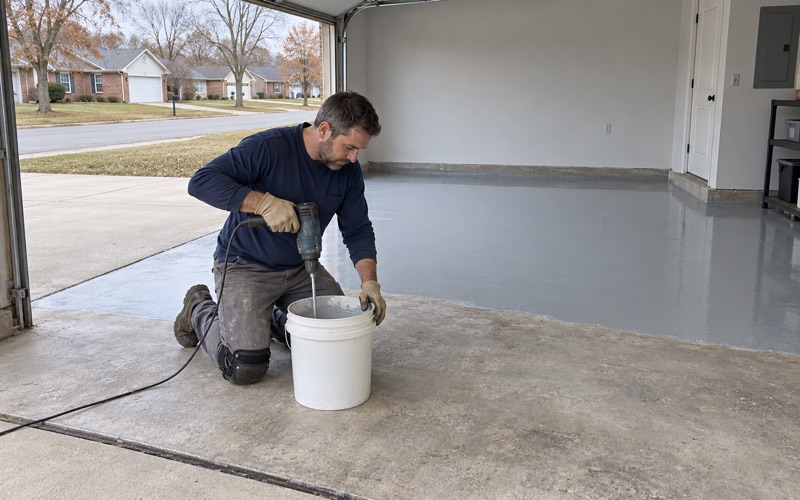
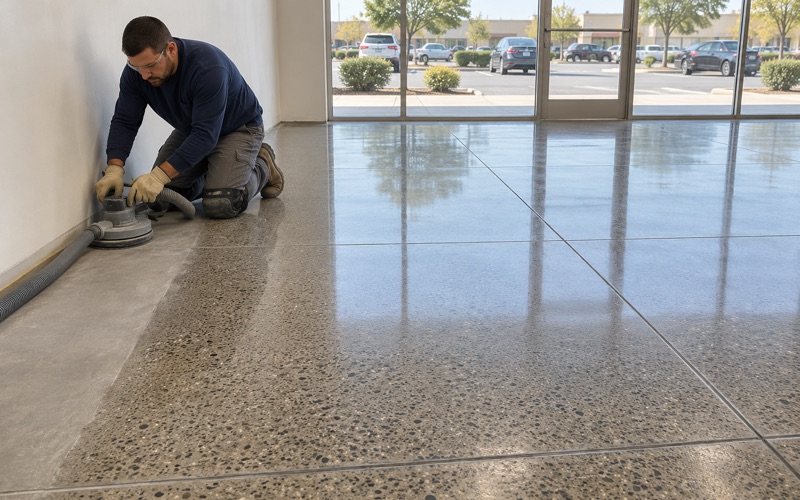
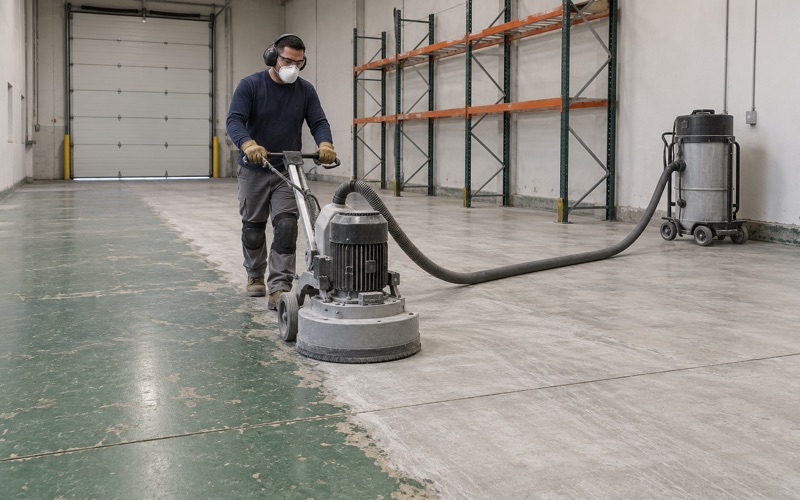
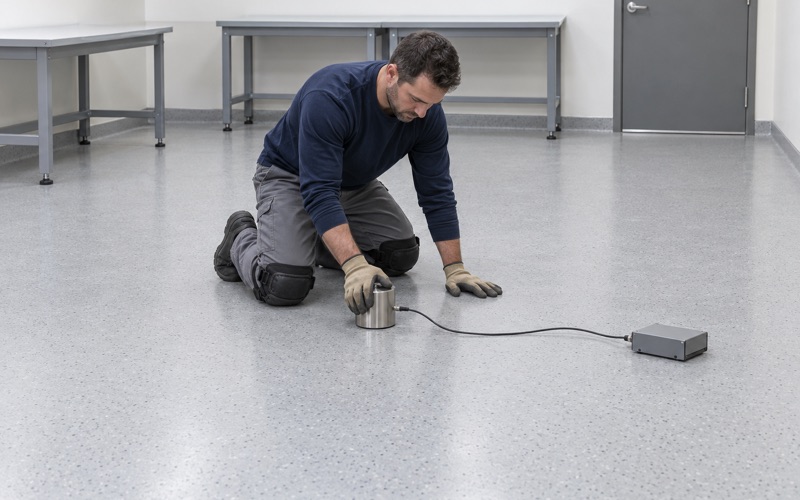
Every job starts the same way. We map cracks, spalls and any old coating, then open the slab with a diamond grinder or a shot blaster rather than an acid etch, so the system bonds to a real ICRI concrete surface profile. A moisture test is written into the scope before the price is final, whether the slab sits in a shop or under a two-car garage.
The proposal then names the product line, the number of coats and the finished thickness. That matters more than usual on a floor that carries blocking, because thickness and texture are the two numbers that decide how a support zone behaves, and you should be able to check both against the quote once the floor is down.
Construction Equipment Repair on Talbot Avenue
Warrenville has very little heavy industry, which makes the exceptions worth reading closely. One of them shows exactly what a floor is asked to do when the machine being repaired is a bulldozer.
One of Only a Few M-2 Parcels
In July 2025, city staff brought a request for 3S286 Talbot Avenue before the Plan Commission and Zoning Board of Appeals. The applicant sought special uses for a truck repair shop and a heavy industrial use in the form of a construction equipment repair shop. Staff described the 2.46-acre site, zoned M-2 General Manufacturing, as one of only a few such properties within the city.
The applicant clarified that the intent was to repair construction equipment including bulldozers and excavators, with all repairs inside the existing 10,365-square-foot industrial building. Staff recommended approval. We have not read the City Council’s final action, and we have no relationship with the property, its owner or any business there. We use the request as an example of a floor type, nothing more.
What Indoor Repair of Heavy Machines Implies
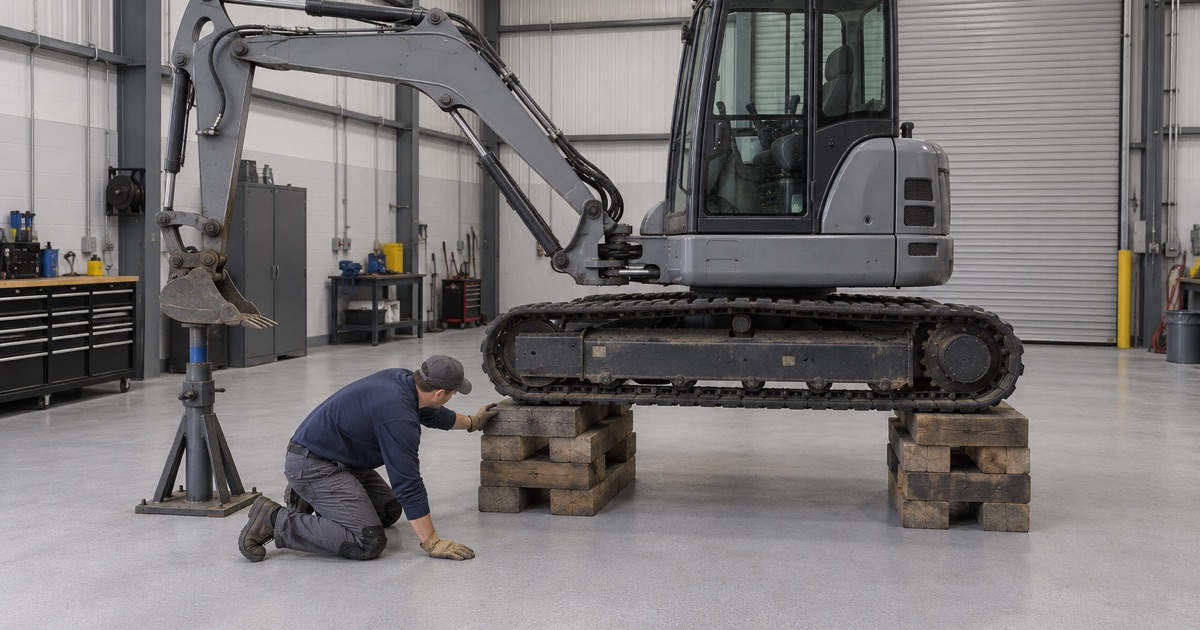
Repairing a bulldozer or an excavator indoors means lifting parts of it: a blade, a bucket, or one end of the machine raised so a mechanic can reach what sits underneath. Once something is in the air, the question stops being the machine and becomes whatever holds it there, and whatever that holding equipment stands on.
That is the territory this page covers. Not paint color, not chemical spills, but the patch of floor beneath a raised machine, where a person’s safety depends on supports that cannot slide, sink or tip. Most coating sales talk never reaches that patch of floor, and it is the one we plan first.
Blocked or Cribbed: The Rule Behind the Stands
OSHA’s construction standard, 29 CFR 1926.600, says heavy machinery, equipment or parts held aloft by slings, hoists or jacks shall be substantially blocked or cribbed to prevent falling or shifting before employees work under or between them. Bulldozer blades, end-loader buckets and dump bodies are to be fully lowered or blocked when being repaired or not in use.
That is the construction-industry rule, written for job sites. We are not saying it governs a fixed repair shop, and we do not certify anyone’s compliance with it. We cite it because it names the principle cleanly: a jack lifts, but blocking holds, and the blocking needs something solid underneath it to do its job.
Looking for epoxy-flooring closer to Wood Dale? See Wood Dale Epoxy-Flooring.
Why the Floor Is Part of the Blocking
A crib stack is only as stable as the surface under its bottom layer. That turns the coating from a finish into a component of the support, and it changes how we specify it.
A Flat, Firm Level Surface
One heavy construction contractor’s cribbing and blocking procedure, revised in October 2025, defines blocking as providing a solid foundation for a machine that prevents unexpected or unwanted movement. Its own examples are jack stands, or blocks placed on a solid concrete floor under a machine. The floor appears in the definition itself, not as a footnote.
The same procedure says cribbing or blocking must be positioned on a flat, firm level surface, with the ground clear of any debris that could keep the load from resting evenly. The crib stack is to be level before the load goes on. It is one company’s procedure, not a regulation, but it describes plainly what a support zone asks of a floor.
Smooth Surfaces Are the Warning Sign
The procedure also bans blocking that is round, triangular or has a smooth surface, because a support that can roll or slip is not a support. A high-gloss coating under a crib stack puts a smooth face at the very bottom of the stack, the one interface nobody inspects when they check the timbers.
It also tells crews to inspect for signs of settling, slippage, cracking, crushing or shear failure. On a coated floor, settling and slippage can begin in the coating itself if it is soft, thick or not yet fully hardened. We would rather design that failure out of the floor than rely on a mechanic spotting it mid-job.
What We Look at Before Quoting a Shop
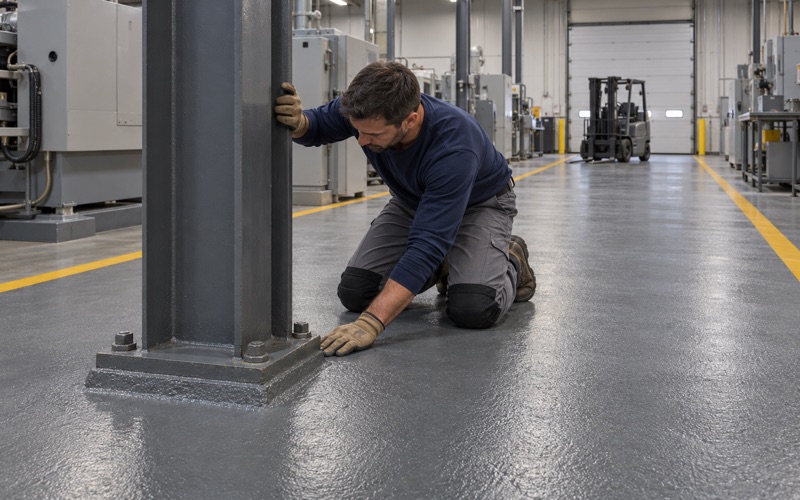
On a shop floor we ask where machines get lifted and where stands and cribbing go down, then mark those areas on the slab map beside the cracks and spalls. A support zone sitting over spalled or broken concrete is a repair job first, and we say so before any coating is discussed, including when a section should be replaced.
We also confirm the moisture result in that area. A coating that loses bond over damp concrete can soften or lift, and under a loaded stand that is not a cosmetic problem. If the slab tests wet, the scope changes before the price is final, not after the first coat is already down.
Support Zones: Hard, Thin, Textured and Fully Cured
The areas where stands and cribbing sit get a different system from the aisles around them. Four properties decide it, and each one shows up in the written proposal.
Hard and Thin, Not Soft and Thick
In a support zone we favor a thin, hard system, typically a 100% solids epoxy over a ground profile, rather than a thick self-leveling build. A deep resin layer puts more material between the stand’s foot and the concrete, and a thick film that has not reached full hardness can yield under a loaded stand.
The goal is a coating that adds grip and cleanability without changing the base. The concrete still does the holding; the coating should sit on it tightly enough that a stand feels the slab, not a cushion. Where a gouge appears later, we patch it flush rather than leaving a lip or a hollow for a stand to find.
Broadcast Texture Under the Stands
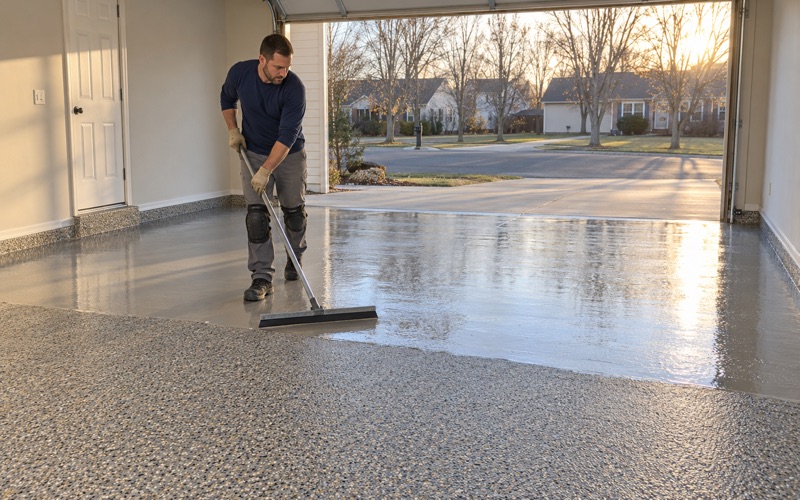
Texture is specified, not promised. In support zones we broadcast quartz aggregate into the wet coat and lock it in with the topcoat, which gives the floor a gripping face a polished film cannot offer. The proposal states the broadcast and topcoat, so the texture underfoot matches the written scope.
We keep that broadcast texture even and level, with no feathered edge where a crib could rest half on aggregate and half on bare film. A crib stack is supposed to be level before it takes load, and an uneven edge under one corner works against that from the bottom up. The zone should also be swept clean before any stack goes down.
Full Cure Before Any Load
Walk-on time is not full cure. A floor can feel dry and look finished long before the resin reaches full hardness, and a stand set down in that window can print into the film or creep. We keep support zones empty until full cure, and that schedule follows slab temperature and dew point rather than the calendar.
In a winter shop whose doors open for equipment, the slab can run well below the air reading. We check the dew point spread at the surface instead of counting days. When conditions will not support a proper cure, we tell the owner to wait rather than hand back a floor that only looks ready for a load.
Jack Stands on a Coated Home Garage Floor
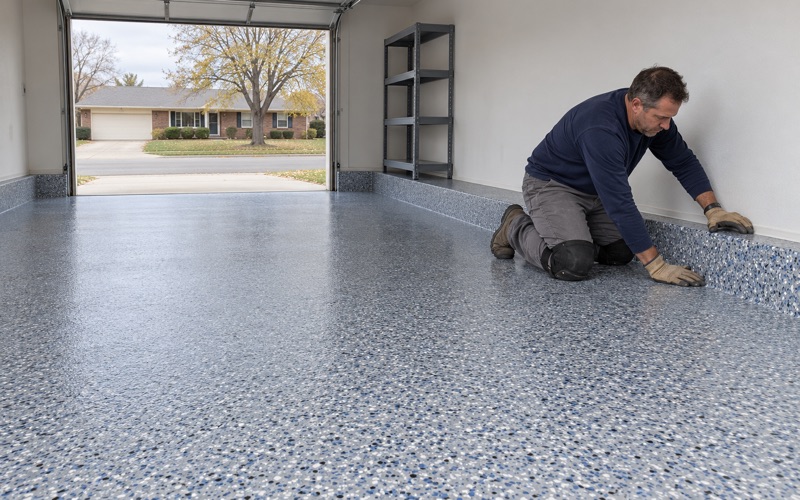
Most Warrenville customers will never lift an excavator, but plenty lift a car. The city is largely owner-occupied, about 74.6 percent of occupied homes, and the same support logic scales down to a garage.
The Residential Version of the Shop Problem
A car on jack stands is a small version of the Talbot Avenue question. The stand’s foot is small, the load is real, and someone is underneath. The spots where you place stands deserve the same thought as a shop’s support zone, scaled to a sedan or a pickup rather than an excavator.
Winter adds a second factor. The garage systems we install are chosen to stand up to the brine and rock salt that ride in on tires all season, and wear tends to show first where the car sits, which is often exactly where the stands go. We keep the texture intact in those spots so the base stays consistent.
Full Cure First, Then Stands
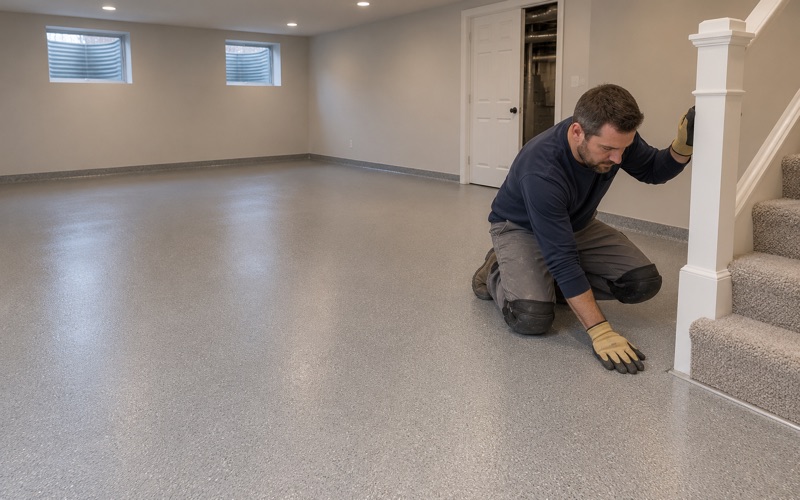
We give garage customers separate dates: when the floor is ready for walking, when it is ready for parking, and when it is ready for jack stands. The last one is the full-cure date. A stand set on a film that is still hardening is how a new floor picks up permanent footprints, and a soft film is the wrong base under a lifted car.
An unheated Warrenville garage in deep winter is often told to wait for spring, because a cold slab slows the cure and the dew point can sit too close to the surface temperature. Waiting costs time. Rushing risks a floor that never reaches the hardness a stand needs underneath it.
Stands on Texture, Never on a Mat
Set stands directly on the textured coating, never on a rubber mat, carpet scrap or plywood laid over the floor. A mat adds a soft, compressible layer, the same thing the shop guidance tries to keep out from under blocking. If you want a defined work spot, we can broadcast heavier texture in that bay.
None of this makes a lift safe by itself. A coating cannot replace correct stands, rated for the vehicle, used on a level floor with the wheels chocked. What we control is the base: a ground, tested slab, a hard coat with real texture, and a cure that is finished before any load goes on it.
- 20+ Years on Concrete
- Moisture Tested First
- Written Scope and Pricing