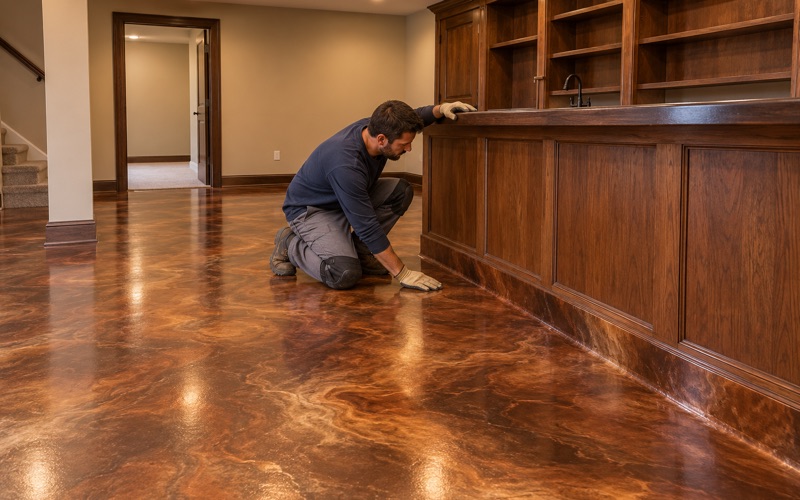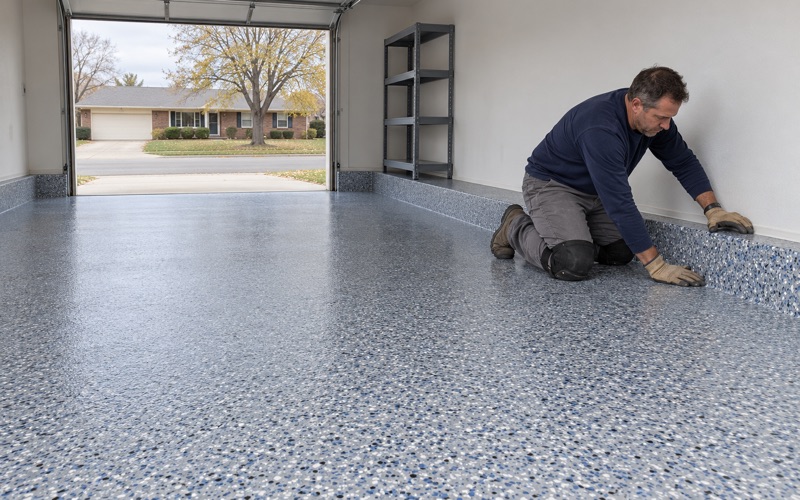
Bartlett Epoxy Flooring handles epoxy flooring in Summit with more than 20 years in the trade, and the first question we ask on any garage, basement or shop floor is what it will carry once we leave. In plenty of garages and shops, that list includes bagged cement mix and mortar kept by the wall for the next patch job.
That bag matters more than most people expect. Cement is one of the few building materials on a garage shelf that is itself a hazard once it is wet, and a coated floor does nothing to change that. How it is spilled, cleaned up and scraped off decides whether both the floor and the person working on it come through intact.
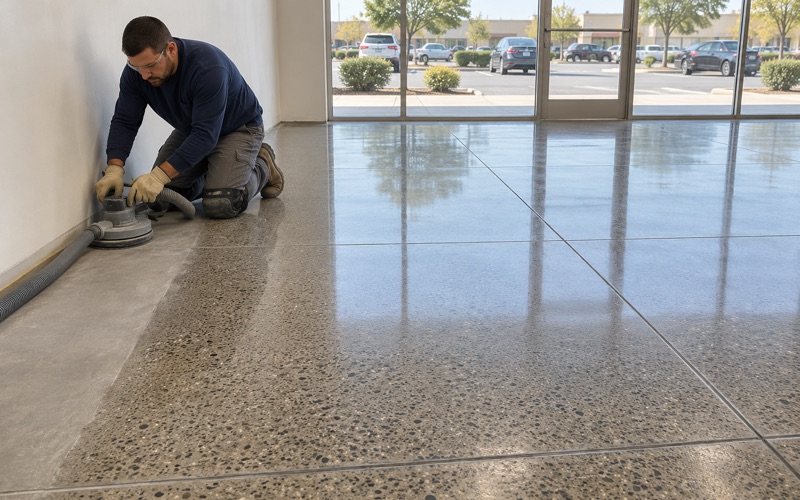
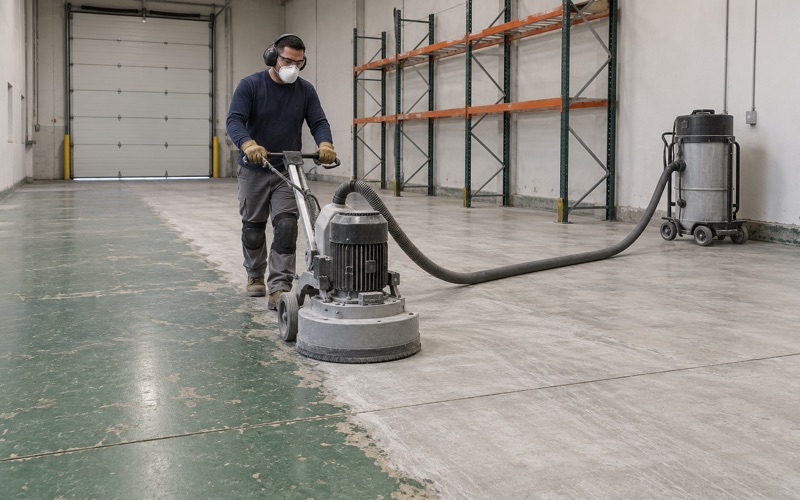
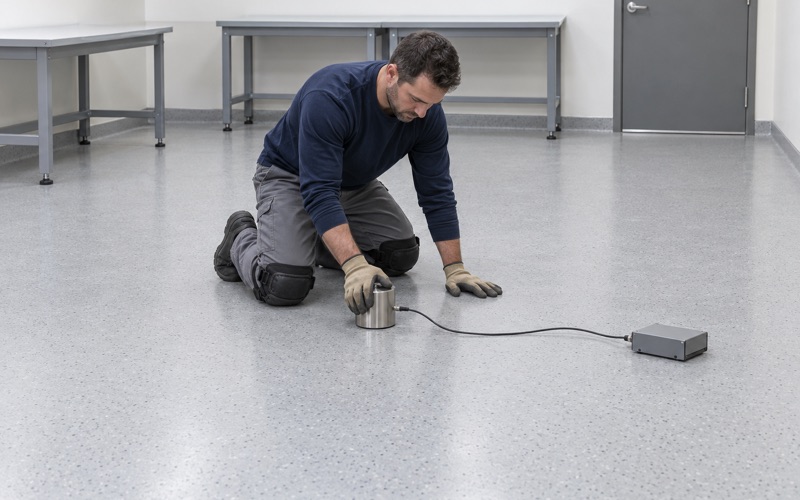
Our own work starts with the slab. We open it with a diamond grinder or shot blaster instead of an acid etch, test it for moisture before the price is final, and write the product line, coat count and finished thickness into the proposal. This page covers what comes after, when cement and a finished floor share the same room.
A Cement Terminal on West 59th Street
The Amrize Terminal Inside the Village
Summit handles cement in bulk. EPA’s facility report for 8001 West 59th Street lists an air-program record under the name Amrize Cement Inc. with an Operating status, and the coordinate on that record falls inside Summit village. The same report also carries the Holcim (US) Inc. name for the site. Directories list Amrize Cement in Summit Argo as a distributor of cement powder.
We have no relationship with Amrize or Holcim, and we have not seen how the terminal floors its own buildings. We mention it because it makes portland cement a local material rather than an abstract one, and because the maker’s safety data sheet is the clearest source we know for how cement behaves around a floor.
pH 12 to 13 Means a Burn Hazard
Amrize’s safety data sheet for portland cement, issued May 30, 2025, gives the product a pH of 12 to 13. It carries the signal word Danger and states that the cement causes severe skin burns and eye damage and may cause an allergic skin reaction. The sheet also notes that symptoms of skin contact may be delayed. We quote it here rather than paraphrase it.
That delay is the practical problem on a floor job. Someone kneels in spilled mortar, feels nothing for a while, and keeps working. The same sheet says eye wash facilities and an emergency shower must be available when handling the product, which shows how seriously the maker treats contact. None of that is a reason to fear a patch job, only to plan it.
What a Coating Does Not Change
A resin floor makes cement easier to see and easier to collect, because the surface is sealed and smooth rather than porous. It does not make the cement any less caustic, and it does not protect the skin of anyone handling it. The handling rules are the same on a coated floor as on bare concrete.
What the coating does change is the cost of a careless cleanup. A slurry left to harden on a glossy topcoat grips it, and getting it off without marking the film takes patience. Fresh mortar wiped up in the first few minutes usually leaves little behind. Planning for cement before it spills is far cheaper than removing it afterward.
Looking for epoxy-flooring closer to Lemont? See Epoxy-Flooring in Lemont.
Dry Cleanup for Cement Powder and Mortar Spills
Powder Comes Up Dry
When a bag splits or a scoop overshoots, the instinct is to reach for a hose. On cement powder that is the wrong move: water turns a dry spill into a caustic slurry that spreads across the floor, runs into joints and edges, and starts to set wherever it pools. We tell customers to take powder up dry instead.
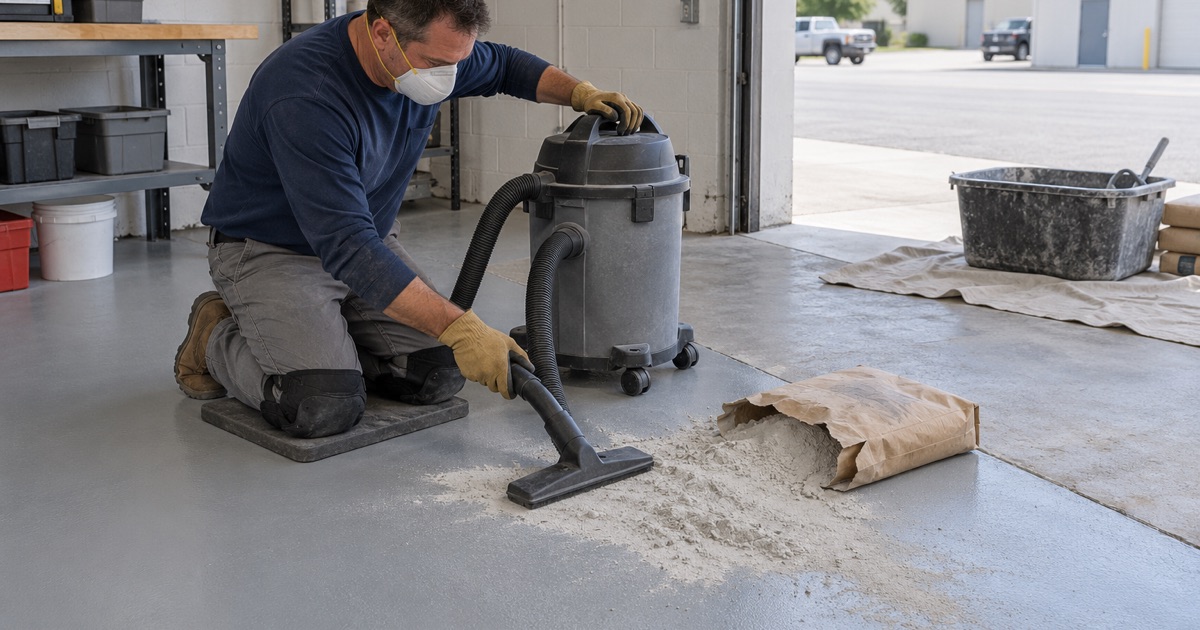
A vacuum, or a scoop and dustpan, handles most spills on a coated floor. The maker’s sheet asks that airborne dust be kept to a minimum, so a push broom that throws powder into the air is not the tool either. Once the bulk is up, a damp wipe cleans off the residue the sheet says to remove, without flooding anything.
Mortar That Has Not Set Yet
Spilled mortar or grout is a different case, because it is already wet. The goal is to collect it as a mass before it thins out. A flat scraper or putty knife lifts the bulk into a bucket, and rags or absorbent pads pick up what remains. A shop vacuum handles the last grainy bits once the wet bulk is gone.
Work from the outside of the spill inward so the edge does not grow. A last pass with a damp cloth takes off the gray film, and that cloth goes in the bucket with everything else. Gloves stay on the whole time, since the mortar is just as alkaline on a rag as it is on the floor.
Keep It Out of the Floor Drain
The portland cement data sheet asks users to avoid discharge into drains, water courses or onto the ground. A garage or basement floor drain is exactly where a hosed-out slurry ends up, and cement that sets inside a trap or line is not a problem a plunger solves. The cleanup methods above exist partly to keep it out of there.
In Summit that drain often matters more than usual. The village’s own hazard plan says sewer and rainwater share one combined sewer, and residents have dealt with basement flooding in heavy storms, including July 2023 and July 2025. Keeping cement out of a drain a basement depends on is simple, cheap insurance. We read basement slabs here for signs of past water before quoting them.
Mixing Patch Mortar and Self-Leveler Off the Coating
A Mixing Board or Drop Cloth as the Station
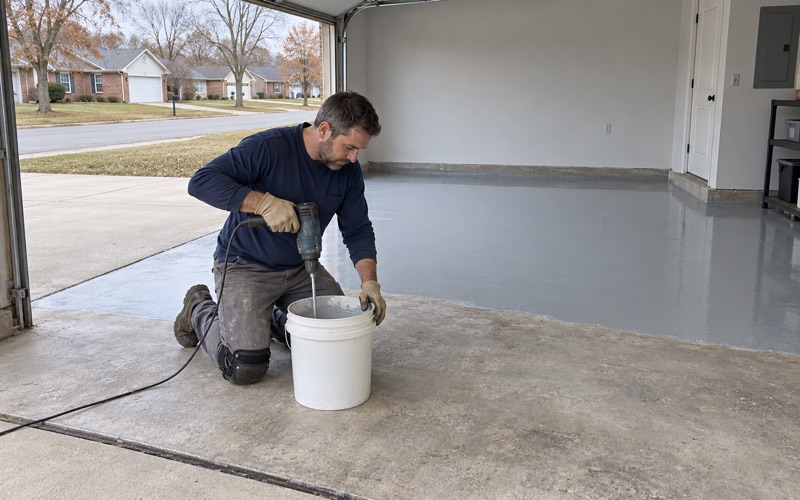
Patching a step, setting a post or leveling a low spot often happens after the floor is coated, and mixing is where most spatter starts. We suggest mixing patch mortar, grout and self-leveler on a board or heavy drop cloth set down away from the finished surface, not in a bucket standing directly on the topcoat.
A paddle mixer on a drill throws droplets well past the rim of the bucket. A tarp that runs a few feet beyond the mixing spot catches them, and it can be folded up and carried out when the work is done. Any splash that lands outside it gets wiped while it is still wet. Plastic sheeting works, but a canvas cloth stays put better underfoot.
Kneeling Pads for Trowel Work
Trowel work keeps knees and forearms close to the material for long stretches. Anyone kneeling to finish a patch should be on a pad, never with knees resting in wet cement, because a burn may not be felt until later. Gloves and long sleeves do the same job for hands and arms.
Pads help the floor too. A knee or boot dragged through fresh mortar spreads it across the coating in a wide smear, and a pad gives the person a fixed, clean place to work from. Moving the pad with the work, rather than shuffling across, keeps the mess inside the repair area. Foam garden kneelers are cheap and wipe clean.
Repairs That Come Before the Coating
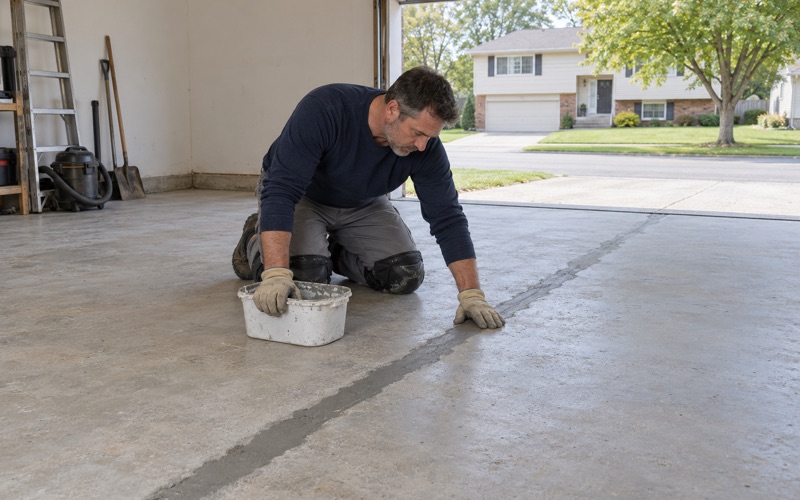
The best time to fix a slab is before any resin goes down. We map cracks, spalls and failing old coatings at the first visit, and when a slab needs repair or replacement before it should be coated, we say so in writing. Old coatings that are lifting come off completely rather than being covered over. Those repairs are part of the scope, not a surprise after grinding starts.
In Summit that walk-through almost always means older concrete. More than half of the village’s housing was built before 1960, and only 46 units went up in the 1980s, so the work here is on existing slabs rather than new pours. Most of Summit also sits in the Des Plaines River floodplain, so a basement slab gets its moisture test before anything else.
Hardened Spatter: Scrape It, Don’t Dissolve It
Why Acid Is the Wrong Tool
Many of the concrete dissolvers sold for removing set mortar are acid-based. Amrize’s data sheet states that portland cement reacts violently with strong acids and lists acids among its incompatible materials. Pouring one onto a lump of set cement on a garage floor invites exactly the reaction the maker warns against. If that reaction happens on a coated floor, the coating sits right in the middle of it.
The coating is no happier about it. A topcoat chosen to stand up to brine and rock salt is not automatically chosen for acid, and a dissolver left to work on spatter can dull or etch the film around it. If a spatter will not come off mechanically, that is a call for us, not for a stronger chemical.
Cutting and Scraping Without Gouging
Hardened spatter comes off mechanically. A sharp scraper held at a low angle often pops small drops off a glossy topcoat, because cement does not soak into a sealed surface the way it does into bare concrete. Larger lumps can be broken with a chisel tapped sideways, not straight down, so the blade does not bite into the film.
Expect some loss of gloss where a lump sat. A light scuff and a fresh topcoat over that spot usually bring it back, and that is a much smaller job than repairing an acid burn. If spatter has dried across a wide area, we can look at what will lift cleanly and what should simply be recoated.
Planning Cement Work Around a New Floor
If a mortar job is already on the calendar, such as new steps, a curb or a block wall in the garage, it is best done before the floor is coated. Fresh cement work needs time to cure before any coating goes over it, and we test new patches for moisture the same way we test the rest of the slab.
Where that order is not possible, set up the station, the pads and the cleanup tools before the first bag is opened. Almost a third of Summit’s housing is in two- to four-unit buildings, so the person mixing may be a tenant or a hired hand rather than the owner. A short written note on dry cleanup and no acid helps protect the floor either way.
- 20+ Years on Concrete
- Moisture Tested First
- Written Scope and Pricing