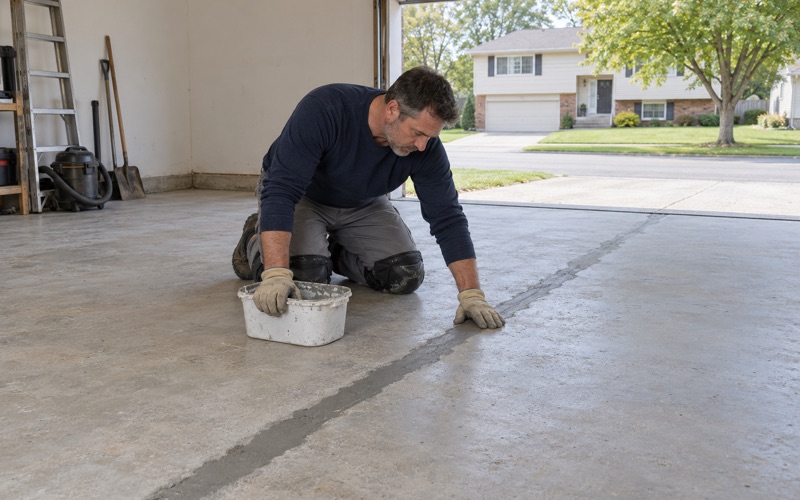
Bartlett Epoxy Flooring brings more than 20 years of slab preparation and resin work to epoxy flooring in River Grove, and on garage jobs one question now comes up early: is an EV charger going in? The answer changes the order of work. A charger, its conduit and anything bolted to the slab belong in place before the floor is coated, not after.
We are a floor crew, not an electrical contractor, so we do not install chargers or pick where they go. What we do is plan the coating around the electrician’s work: we ask for the charger location, the conduit route and any pedestal or bollard before we schedule grinding, and we build the job sequence from those answers.
Every slab still gets the same opening: a diamond grinder or shot blaster rather than an acid etch, a moisture test written into the scope before the price is final, and a proposal that names the product line, the coat count and the finished thickness. The charger only changes what happens around it, and when.
Triton College is training the people who wire these chargers

Two new programs on the River Grove campus
Triton College, whose campus at 2000 N. 5th Avenue sits inside the village, announced two programs on April 2, 2026. One is an Electric Vehicle Charger Installation and Maintenance program, where students assemble and install charging units, test them for faults and study the National Electrical Code alongside electrical theory and safety. The other is a 13-credit Hybrid and Electric Vehicle Repair Service Technician certificate.
The charger course runs in a lab the college describes as equipped with the latest hardware from charger manufacturers. We have not seen that lab or its floor, and Triton is not a customer of ours. The programs matter here for a simpler reason: more people locally are learning to put chargers on garage walls, and the code they study has something to say about the floor.
The code’s floor line: 18 inches up
National Electrical Code section 625.50, as it is commonly quoted in plan-check documents and electrical trade press, says the connector of an indoor charger is stored at least 18 inches above the floor, unless the equipment is listed and marked for another location. Outdoors the figure is 24 inches above grade, and some adopted editions add a 48-inch maximum height.
Which edition and local amendments apply to a given River Grove garage is the electrician’s question, not ours, and we have not checked it. What the rule tells a floor crew is plain enough: the connector is meant to live up off the slab, in its holster, rather than lying on the coating we just put down.
What a coated floor does not add
A resin floor is not part of the electrical installation. It adds no shock or ground-fault protection, and we do not describe any coating as making a garage safer for charging. The protection lives in the charger, the circuit and the electrician’s work; our job is the slab under it. That line keeps the two trades honest about who answers for what.
We also do not treat Triton’s programs as an endorsement of anything we do. The college trains installers; our part begins after the installer has set the charger, the conduit and the anchors, and ends with a coated slab that leaves them undisturbed.
Looking for epoxy-flooring closer to Cary? See Cary Epoxy-Flooring.
Charger first, coating second
On a garage where a charger is planned, we schedule the coating last among the trades. Charger first, coating second is the whole idea, and it is far easier to follow than to undo.
Conduit on the wall, not across the slab
The circuit for a garage charger has to get from the panel to the mounting spot somehow. When the conduit runs on or in the wall, the floor never enters the conversation. When someone proposes chasing it across or into the slab, a finished coating gets saw-cut, patched and recoated in a strip that rarely matches the rest.
So we ask for the electrician’s route before we grind. If a chase in the slab is truly the plan, it gets cut, filled and cured before our diamond grinder opens the surface, and then the whole floor is profiled and coated as one piece. A trench cut after the topcoat is the version we work hardest to prevent.
Pedestals, bollards and wheel stops
Some owners mount the charger on a pedestal instead of a wall, and some add a bollard or wheel stop so a bumper cannot nose into it. Each of those is fastened to the slab. Placed before the coating, its anchors sit in prepared concrete and the coating is detailed around its base.
Drilled afterward, each hole goes through a finished film, and a hammer drill can chip the coat around the bit. We would rather have the anchor holes made and sealed first, before the slab is profiled, so the coating closes up to them cleanly and moisture or brine has no raw edge to work under.
Cracks, repairs and permits in the same pass
Before any of that, we map the cracks, spalls and old coatings across the garage. If the area under a planned pedestal is cracked or spalled, that repair belongs ahead of the electrician’s anchors, and we say so plainly when a slab needs repair or replacement before anyone should coat it.
Replacing a slab section is a different permit conversation than coating one, so we check with the Village of River Grove Building Department before the job is scheduled. In River Grove any remodeling valued over $100 needs a building permit, concrete work included, and contractor licenses there run on the calendar year.
Keeping the cord and connector off the finished floor
A holster and a cord hook
Once the charger is live, the habits around it decide how the floor ages. A holster keeps the connector from dangling or lying on the slab, and a hook or reel keeps the cord off the path the tires take. Both put the hardware where the 18-inch storage line already says it belongs.
Charger-accessory sellers and electrical contractors make the same practical point: driving over a charging cable, even slowly, compresses its conductors and can wear the insulation over time, and a cable across the floor is a trip hazard. That is their advice about the cable, not a rule, but it lines up with what is good for the coating too.
Winter slush and a dropped connector
In a River Grove winter, tires carry in slush loaded with brine and rock salt, and it pools where the car stops, which is often right beside the charger. A connector left on the floor sits in that melt. The same vendors note that dropping a connector on concrete, leaving it in standing water or letting it collect garage dust degrades its contacts and seals.
A dropped connector can also chip a thin coat at the impact point. A heavy cord dragged back and forth across one line scuffs a topcoat into a dull track. Keeping both up off the floor is one of the cheaper ways to keep a new floor looking new.
A garage system built for salt and cold
Under the charger the floor is still a garage floor, so the system is chosen for the brine and rock salt that ride in all winter. That often means a 100% solids epoxy base with a vinyl flake or quartz aggregate broadcast and a polyaspartic or polyurea topcoat, with the slip-resistant texture set by the broadcast and topcoat we specify rather than promised in general terms.
Cure follows slab temperature and the dew point spread at the surface, not the calendar. An unheated River Grove garage in deep winter is told to wait, and if the charger install lands in January, that can mean the electrician works now and we come back when the slab is warm enough to cure properly.
The electrician picks the spot, and we plan the floor around it
Location is an electrical decision
Where a charger goes depends on the panel, the circuit, the car’s charge port and the code’s height rules, and those are the electrician’s calls. We hold no electrical license and never relocate a charger to suit a coating plan. If the location changes, our schedule changes with it.
What we bring to that conversation is the floor’s side of it: where a pedestal base would need a coating detail, where a wall-mounted unit keeps the slab clear, and whether the drip line from a parked car lands near the outlet. The electrician weighs that, and the decision stays with them.
Older garages in an older village
River Grove’s housing stock leans old: of 4,573 units, 1,086 were built in the 1960s and 767 in the 1950s, and only 180 have gone up since 2000. A garage that old can carry decades of oil, patching and old paint, and some have been coated once already.
Loose patches and old coatings come off with the grinder before anything new goes down, and we tell you if the slab underneath needs more than a coating. The order stays the same as on a newer garage: charger hardware and slab repairs first, profile and coating last.
When a slab has taken water
River Grove is a river village with a recorded flood history, and its own hazard plan lists floods in 2008, 2010, 2011 and 2013 among other years. The village has also warned that surcharged street sewers can send water into basements of homes without flood control systems.
So when a garage job comes with a basement floor too, we read that slab for past water first. A coating does not stop seepage, a backup or a sump that cannot keep up, and moisture is the first exclusion we name when we explain what a coating warranty leaves out.
Dust, fumes and putting the charger back in use
Garage prep beside a newly mounted charger makes fine concrete dust, the kind nobody wants inside a new piece of electrical equipment. We capture grinding dust at the machine with a vacuum rather than rinsing it toward a floor drain, a sump or a storm inlet, and we keep the charger covered while the grinder runs.
Products are chosen inside the Illinois VOC limits for floor and industrial coatings, which bind the person applying them, and the garage is ventilated through the cure. Once the topcoat is hard enough for traffic, the cord goes back on its hook and the connector back in its holster.
- 20+ Years on Concrete
- Moisture Tested First
- Written Scope and Pricing