Bartlett Epoxy Flooring has spent more than 20 years on epoxy-flooring in Northlake and the rest of our service area, and the floors we think about hardest here are the ones where vehicles get worked on. A repair bay asks something specific of its floor: when a line weeps or a pan drips, somebody has to notice it before a mechanic walks through it.
That is a visibility problem as much as a durability one. A floor that hides a fresh drip also hides it from whoever is responsible for keeping the workroom clean, and in a shop that answers to a safety inspector, the floor becomes part of the housekeeping picture whether anyone planned it that way or not.
We build shop floors to make fluids obvious and easy to wipe dry. Every slab is opened mechanically, tested for moisture before the price is final and quoted with the product line, coat count and finished thickness written down. What follows explains why a public garage, a private shop and a home garage all end up wanting the same kind of surface.
Northlake’s Fleet Garage and the Agency That Inspects It
Northlake keeps its own vehicle repair in house, and that makes the city’s garage a clear example of how a floor rule reaches a public shop. The facts below come from the city and the state. We have no relationship with either, and we have not seen the garage floor.
Public Works on Palmer
The City of Northlake Public Works Facility at 100 W. Palmer houses administration, street and parkway maintenance and vehicle repair services. According to the city, its 13 employees maintain about 47 miles of city streets along with parking lots, storm sewers, water mains, parkways and the city fleet itself, so the trucks that do that work come home to one building for service.
The site has a long history in that role. State Fire Marshal records list it as the Municipal Garage, owned by the City of Northlake, and show that its two gasoline tanks, one of 6,000 gallons and one of 4,000 gallons, were removed on March 4, 1998. The facility’s tank status is recorded as closed.
Illinois OSHA and the State Plan
A private shop in Illinois answers to federal OSHA, but a city garage does not. Illinois OSHA runs a state plan that covers all state and local government workers in the state, from a city clerk to a mechanic changing brakes on a dump truck. Federal OSHA keeps authority over private-sector employers, and federal workers fall outside the state plan.
The state plan received initial approval on September 1, 2009, and Illinois adopted all OSHA standards in 29 CFR Part 1910, the general industry rules, along with several other parts. In practice that means a public works mechanic is protected by the same walking-working surface text that applies in a private service bay.
One Rule, Two Enforcers
The split matters for anyone managing a public building, because the agency changes while the wording does not. A floor that supports the housekeeping language in a private garage supports it in a municipal one, and a floor that works against it does so in both settings.
None of this is something a coating changes. We hold no OSHA license or certification, a floor finish confers no compliance on its own and nothing we install shifts who inspects a workplace. What a floor can do is make the daily housekeeping the rule asks for easier to carry out, shift after shift, by the people who actually do it.
Looking for epoxy-flooring closer to Franklin Park? See Franklin Park Epoxy-Flooring.
Clean, Dry Where Feasible, Free of Leaks and Spills
The housekeeping language that governs a repair bay is short, and it is worth reading exactly rather than by reputation. Much of what people believe OSHA says about shop floors is either stronger or vaguer than the actual text.
What 29 CFR 1910.22(a) Says
The walking-working surface rule opens with housekeeping. Places of employment, passageways, storerooms and service rooms are to be kept in a clean, orderly and sanitary condition, and the floor of each workroom is to be maintained clean and, to the extent feasible, in a dry condition.
The next paragraph lists hazards a surface must be kept free of: sharp or protruding objects, loose boards, corrosion, leaks, spills, snow and ice. In a vehicle repair bay, leaks and spills are the entries that come up every shift, because every vehicle on a lift or a stand is a possible source.
Why Where Feasible Fits a Repair Bay
Nobody expects a working shop floor to stay bone dry every minute. Coolant gets drained, a transmission line gets opened and a wet truck rolls in after a storm, and the rule’s wording acknowledges that a workroom cannot always be dry.
What the wording does ask is that wet stays temporary. The practical question for a floor is how fast a crew can find the fluid, wipe it and get the surface back to dry. That depends heavily on what the slab is finished with, which is where a coating decision starts to matter.
Where the Floor Helps and Where It Stops
A finish cannot fix a leaking vehicle, replace absorbent and a spill kit or stand in for a supervisor walking the bays. Those remain the shop’s own procedures, and we say that plainly before any proposal is signed.
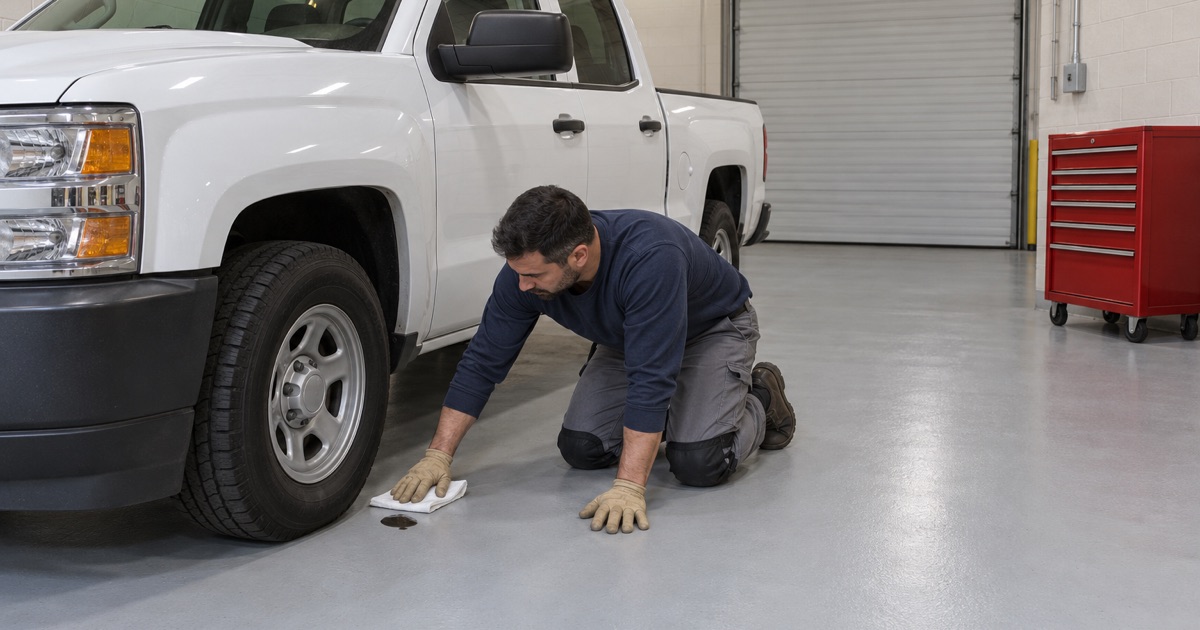
What the floor contributes is speed. A surface that shows a drip the moment it lands and lets a rag lift it in one pass turns the housekeeping language into a quick habit rather than a weekly scrubbing project. That is the outcome a shop manager is really paying for.
Why a Light, Sealed Floor Shows a Leak
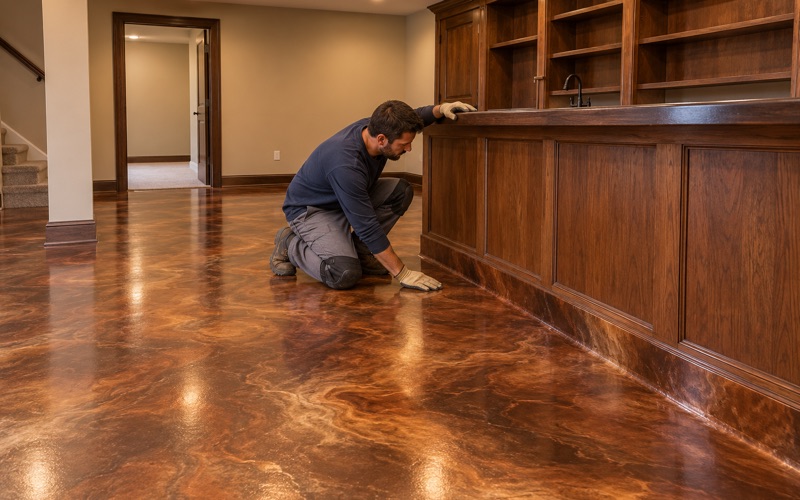
Three properties decide whether a shop floor reveals a fresh leak or hides it: the color of the surface, whether the concrete is sealed and how much texture sits on top. Each one is a choice made in the proposal, not an accident of the product.
Color Is a Detection Tool
Bare gray concrete is close in tone to many automotive fluids once they spread, and a slab that has gone dark with age hides fresh drops even better. A light-colored floor works the other way: a new drip of oil, coolant or brake fluid reads as a distinct spot against a pale field.
That contrast is why we often suggest a light gray or tan body coat for repair areas, with a contrasting color only where markings are wanted. A technician scanning the floor before pulling the next vehicle in should be able to spot a new drip from across the bay.
A Sealed Surface Keeps Fluid on Top
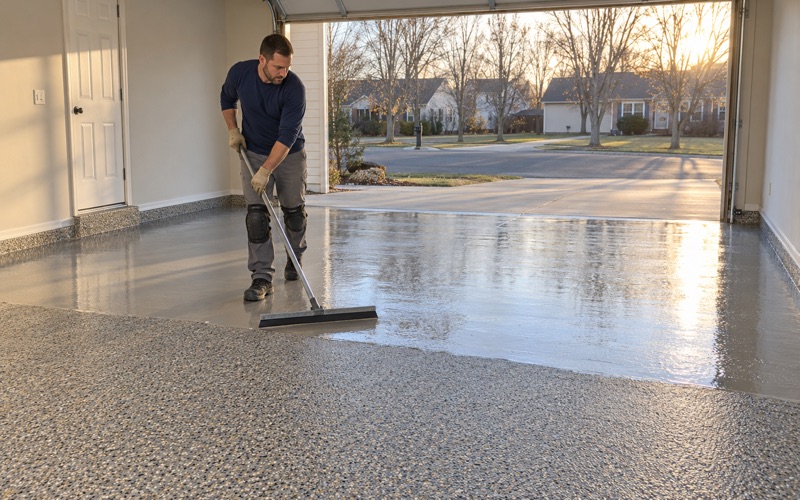
Open concrete is porous, so fluid on a bare slab starts moving into the surface before anyone reaches it with a rag. A 100% solids epoxy body coat closes that surface, and a polyaspartic or polyurethane topcoat over it gives a film that fluid sits on rather than in.
On a sealed floor, the cleanup is a wipe and a quick check that the spot is dry. That is the point where the rule’s language about keeping a workroom clean and free of leaks and spills stops being a goal on a poster and becomes a two-minute task.
Texture Without Hiding the Drip
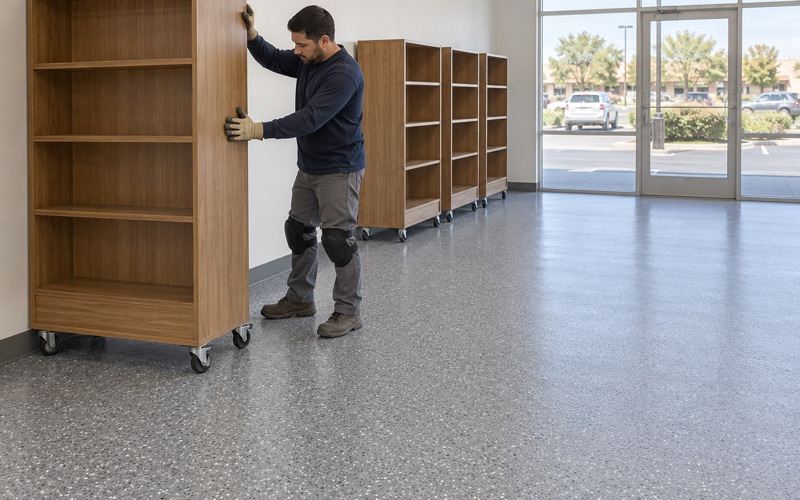
A perfectly smooth floor that gets wet is its own problem, so shop floors need some grip. We specify slip resistance by the broadcast and topcoat used, typically a fine quartz aggregate broadcast locked under the topcoat, rather than promising traction as a slogan.
The texture is kept light on purpose. A heavy aggregate profile traps fluid in its valleys and fights the mop, while a fine broadcast holds a boot without hiding a drip or snagging a shop rag. The floor stays walkable and quick to wipe dry.
Coating a Working Shop, Public or Private
The finished floor is only as good as the preparation underneath it and the schedule it is installed on. In a working garage, both have to fit around vehicles that still need repair while the job is underway.
Preparation and Moisture Come First
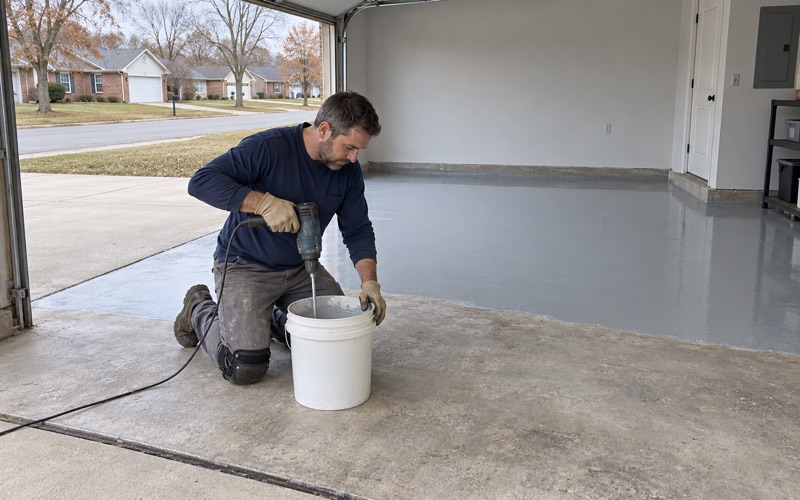
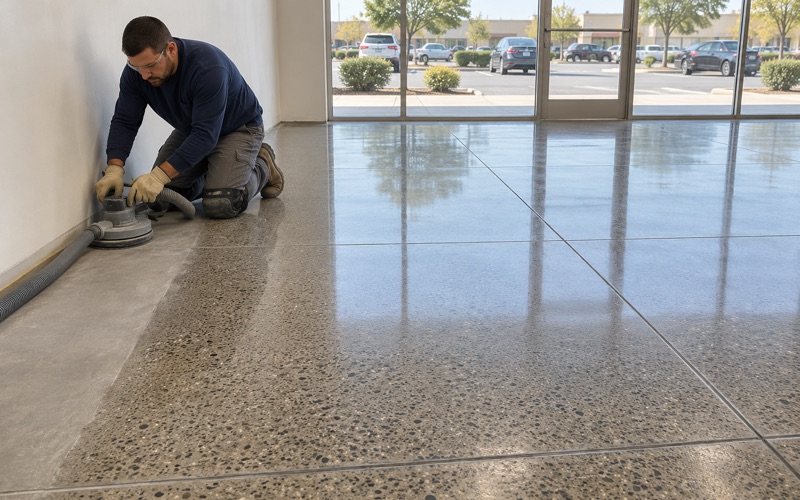
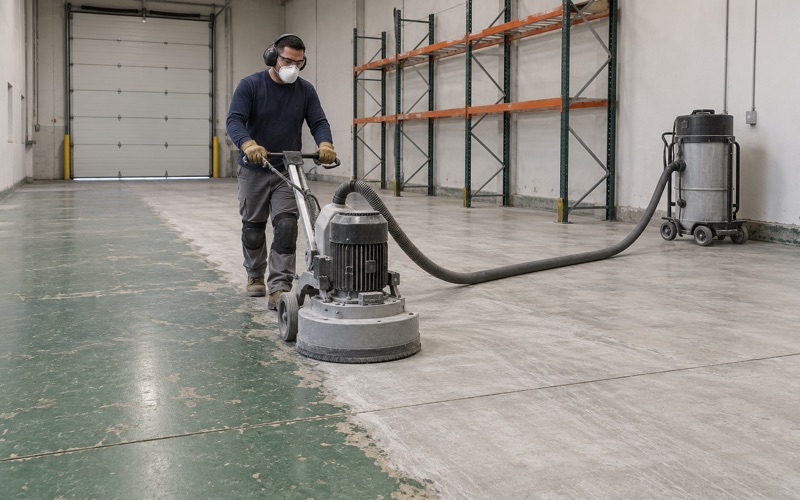
Every slab we coat is opened with a diamond grinder or a shot blaster to the ICRI concrete surface profile the product calls for, never an acid etch. Grinding dust is captured at the machine with a vacuum rather than rinsed toward a floor drain or an inlet.
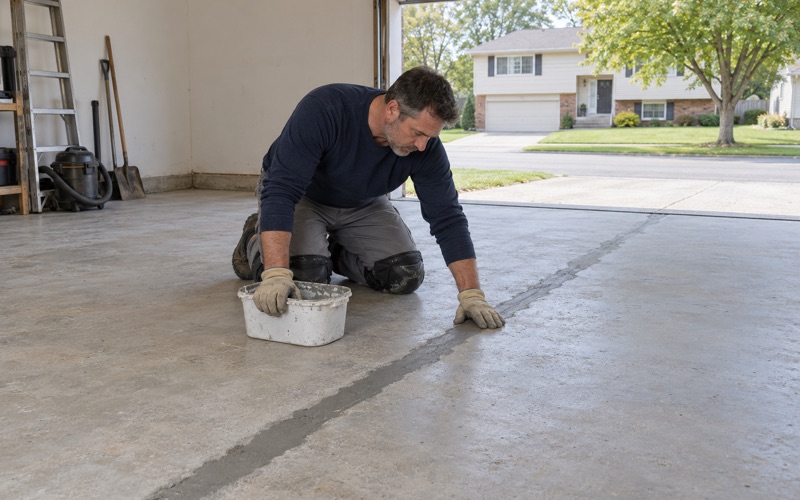
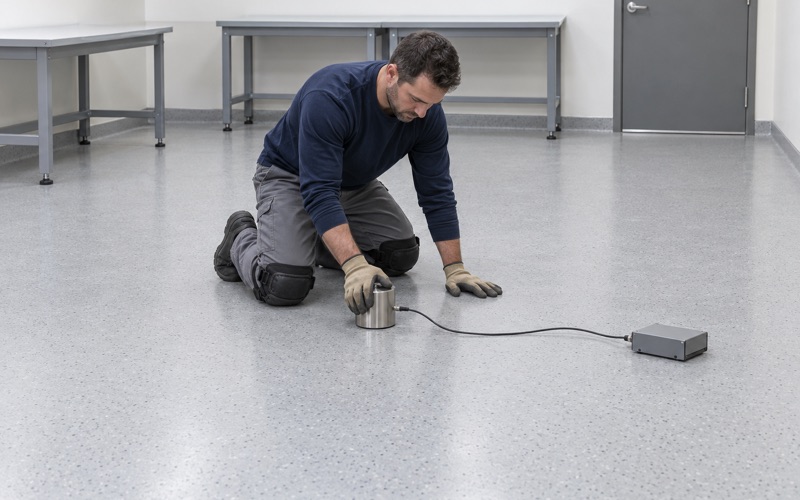
Before the price is final, a moisture test goes into the written scope, often ASTM F2170 in-situ relative humidity probes or an ASTM F1869 calcium chloride test. Cracks, spalls and old coatings are mapped at the same visit, and we say so when a slab should be repaired before anything goes on it.
Scheduling Around a Shop That Cannot Close
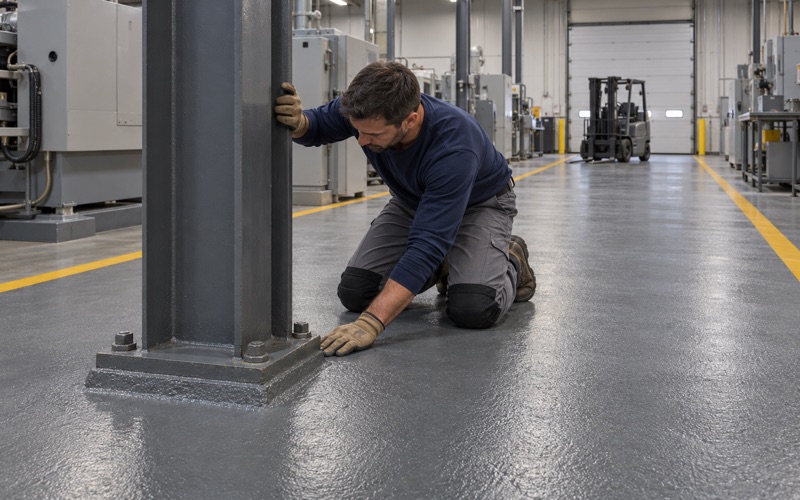
A fleet garage, a dealer service department or an independent shop rarely shuts down for a week. We phase the floor bay by bay, using overnight and weekend windows, so part of the building stays in service while another section cures.
Cure schedules follow slab temperature and the dew point spread at the slab surface, not the calendar. A cold slab under an open overhead door in January cures slowly and can develop amine blush, so when conditions are wrong we say the floor should wait rather than coat it anyway.
The Same Logic in a Home Garage
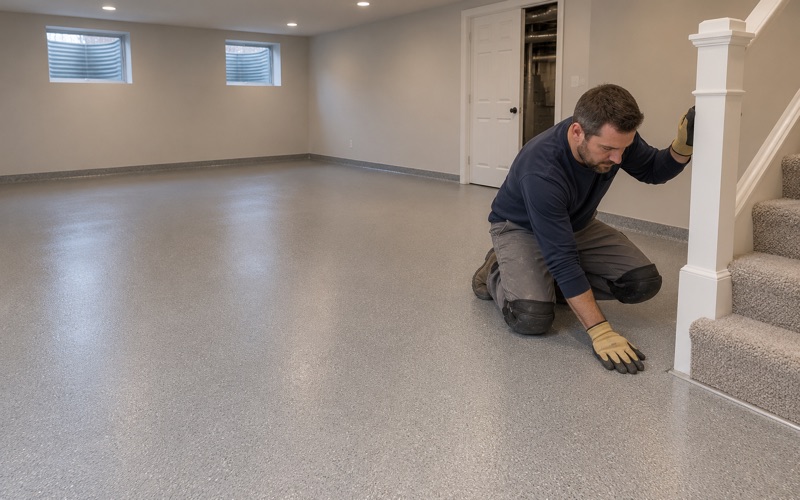
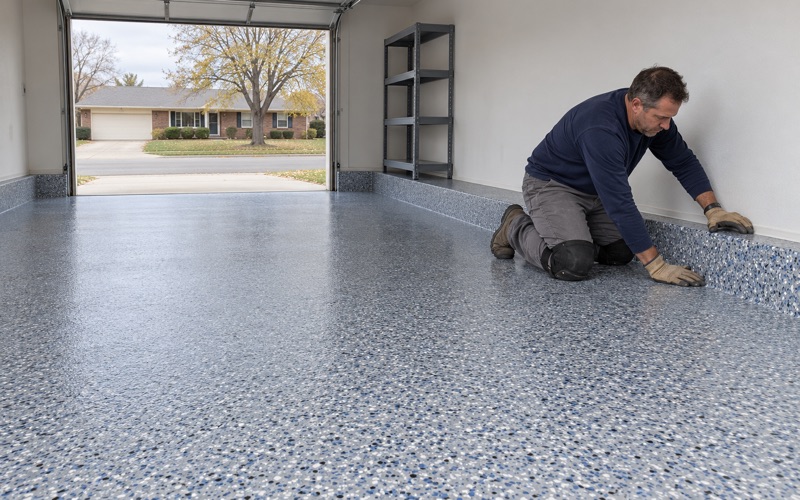
A homeowner working in a personal garage is not covered by an OSHA rule, but the reason for a light, sealed floor is the same. A slow leak from a car or a snowblower shows up in days instead of months, and it wipes off the surface instead of sitting unnoticed under the vehicle.
Northlake’s housing leans older, with 1,799 of its 4,526 units built in the 1950s, and many early homes were finished by their own owners. We test what is already on a garage slab, whether floor paint, a kit epoxy or patch compound, before any grinder runs.
Every contractor working in Northlake registers with the city through a $100 annual license, a $10,000 bond and a certificate of insurance naming the city. We take care of that registration before the job goes on the schedule.
- 20+ Years on Concrete
- Moisture Tested First
- Written Scope and Pricing