Bartlett Epoxy Flooring brings more than 20 years of experience to epoxy flooring in Norridge, and we start every job with a question many bids skip: what will actually sit on this slab? In a repair shop or a home garage, the answer often includes a used car battery waiting to go back, and a cracked case puts sulfuric acid on whatever is underneath.
That matters because a floor coating is not containment. It can be built to show a spill quickly and to clean up well after one, but the job of holding acid belongs to a lipped tray or a closed container, and we say so in the proposal rather than letting a glossy floor imply otherwise.
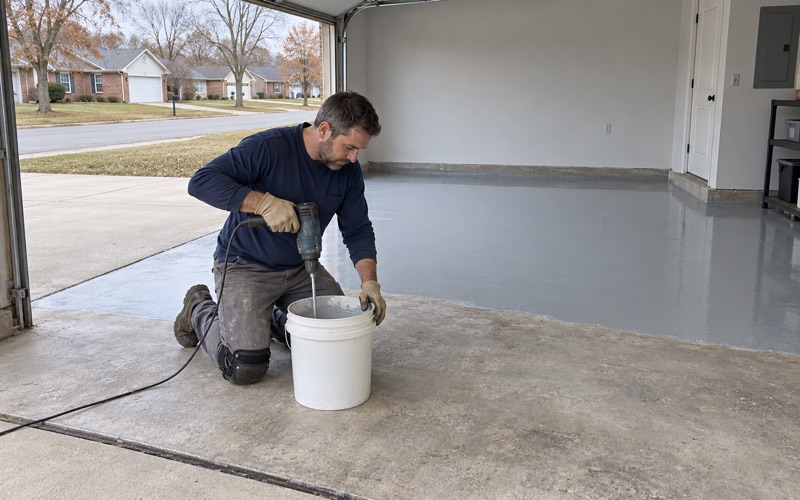
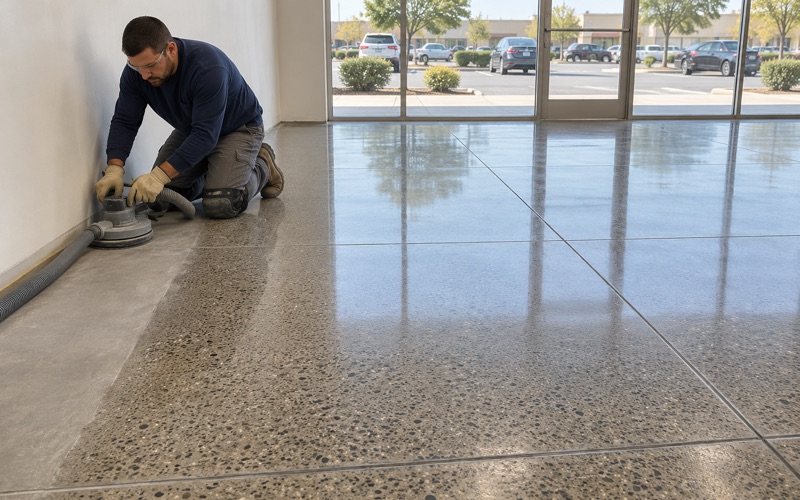
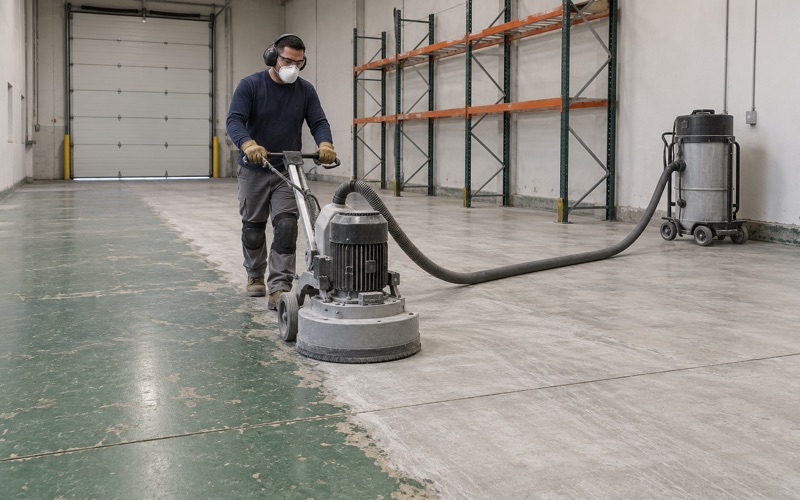
Every slab we coat is opened with a diamond grinder or a shot blaster, never an acid etch, and the written scope includes a moisture test before the price is final. The proposal also names the product line, the coat count and the finished thickness, so an owner can hold the finished floor up against the quote.
A Montrose Avenue Shop and Illinois’ Take-Back Rule
A Muffler Shop That Is Also a Battery Store
Iggy’s Custom Muffler at 7230 W. Montrose Avenue, inside the village, lists brake work, oil changes, auto electrical, tune-ups, radiator repair and muffler work. Its listing also calls it a car battery store, and a shop that sells batteries takes on a legal duty that shapes what ends up standing on its floor.
We have not been inside Iggy’s, and it is not a customer of ours, so we cannot say how it stores batteries or what its floor looks like. We use it because it is a real, checkable example of the kind of business the Illinois rule reaches, and the floor questions that follow apply to any shop doing the same work.
One Old Battery for Every New One
Under 415 ILCS 5/22.23, part of the Illinois Environmental Protection Act, a lead-acid battery retailer must accept used lead-acid batteries from customers at the point of transfer, in a quantity equal to the number of new batteries purchased. In plain terms, the store takes one old battery for every new one it sells, and it must post a notice telling customers so.
The practical effect is accumulation. A shop that swaps batteries all week collects the old ones as it goes, and they stay on the premises until someone hauls them away. A knowing violation is a petty offense carrying a $100 fine, which is small, but the stack of returned cores is not.
Where Returned Batteries Are Allowed to Go
Since September 1, 1990, the same section has barred a retailer from disposing of a used lead-acid battery except by delivering it to a battery wholesaler or its agent, a battery manufacturer, a collection or recycling facility that accepts lead-acid batteries, or a permitted secondary lead smelter. Dumpsters and scrap piles are off the table.
So the batteries wait for a pickup on someone else’s schedule. Between deliveries they sit somewhere on the shop floor, and that waiting area, not the service bay, is where the floor decisions on this page come into play. We are flooring people, not a waste hauler, and we do not handle or recycle batteries.
Looking for epoxy-flooring closer to La Grange? See Epoxy-Flooring in La Grange.
Where Returned Batteries Wait and What a Cracked Case Leaves
Staging on a Working Shop Floor
In a typical shop, returned batteries collect near the counter or along a wall, close to where the new ones are sold and installed. That spot sees foot traffic, hand trucks and the occasional dropped tool, and it is often the least-considered part of a coated floor because nobody thinks of it as a work area.
A battery that came out of a car because it failed may also be cracked or swollen, or damaged as it was pulled. Stood directly on the slab in a row, a single leaker can wet its neighbors’ bases and the floor between them before anyone notices the stain.
What Battery Acid Does to Concrete and Worn Coatings
Battery electrolyte is sulfuric acid, and acid attacks the cement paste that binds concrete together. On a bare or sealed-only slab the result is an etched, sandy patch that keeps absorbing whatever lands on it next. On a coated floor that has worn through at the traffic line, the acid finds the exposed concrete first and undercuts the edges of the coating around it.
A sound, well-bonded resin system holds up far better than bare concrete, which is why shops coat in the first place. It is still a floor finish, not a vessel, and we never sell one as something that can sit under standing electrolyte for days without consequence.
The Federal Rule for a Battery That Leaks
The federal universal-waste rule for small quantity handlers, 40 CFR 273.13(a)(1), says a handler must contain any universal waste battery that shows evidence of leakage, spillage or damage. The container has to be closed, structurally sound and compatible with the contents of the battery, which for a lead-acid unit means acid-compatible.
Spent lead-acid batteries can also be managed under a different federal part, and we have not checked which one applies to any particular Norridge shop; that is a question for the shop and its hauler. What the rule makes clear is the principle: leaking batteries go in a closed container, and the floor is not the container.
Trays, Containers and a Topcoat That Shows the Mark
A Lipped Tray Does the Holding
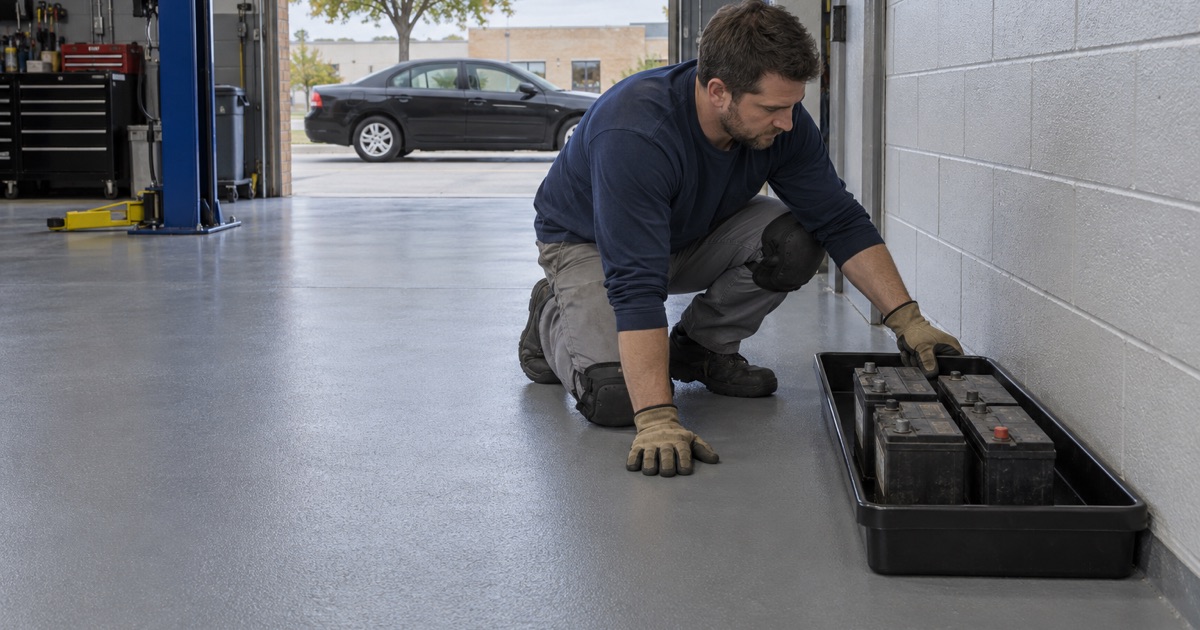
The arrangement we recommend in a shop is simple: returned batteries stand upright on a lipped, acid-resistant pallet or tray, and any battery that shows a crack or a wet base moves into a closed, compatible container. The tray catches the drip, the container handles the leaker, and the coated slab stays a floor.
We do not sell trays or containers, and nothing we install replaces them. When we coat a shop floor, though, we ask where battery staging will sit, check that the area is flat enough for a tray to rest without rocking, and leave room to sweep and inspect around it.
A Light Topcoat That Shows an Acid Mark
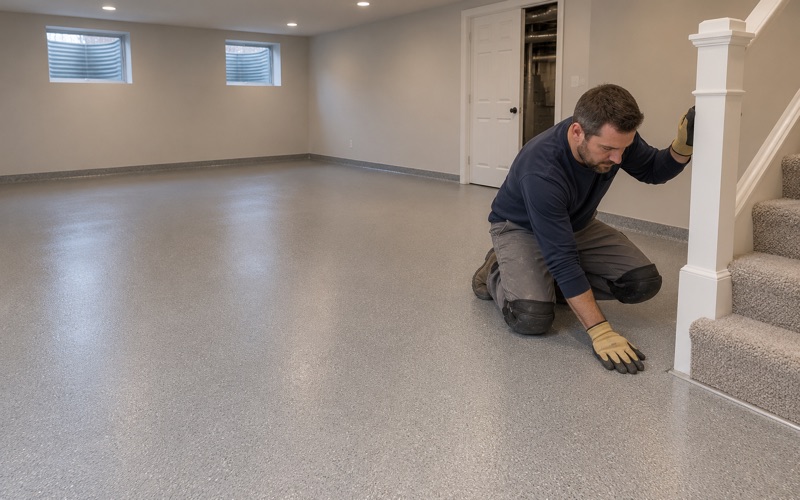
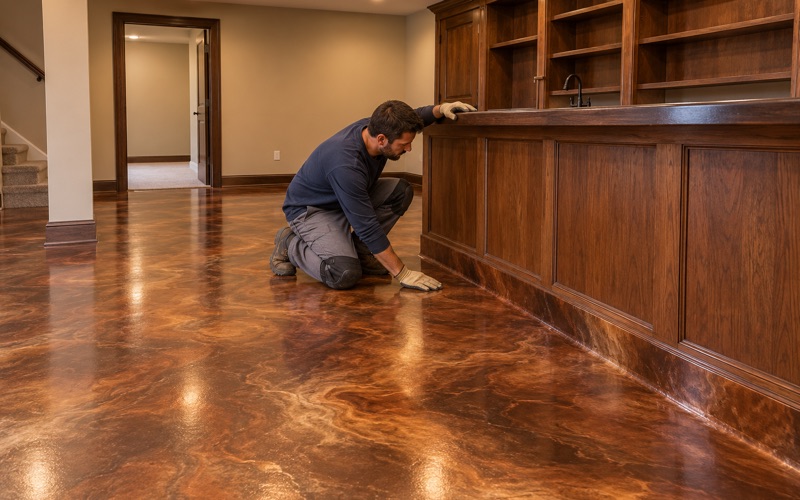
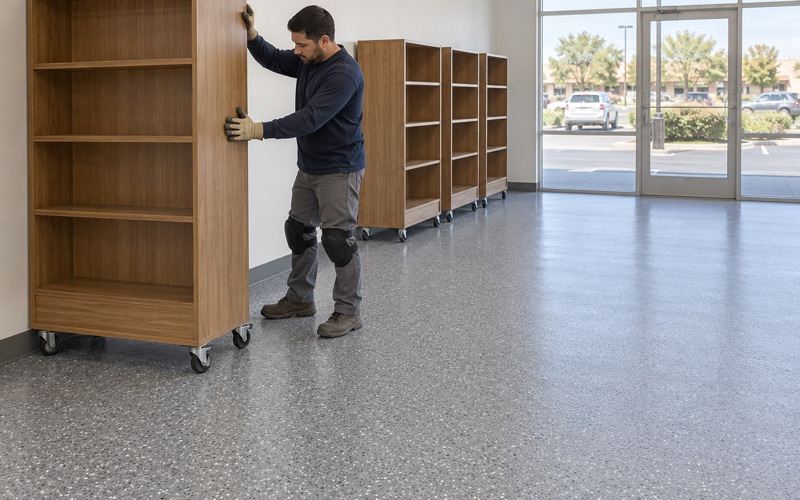
Color is a practical choice here. A light, solid-color topcoat shows an acid etch, a drip trail or a dull spot quickly, while a dark or heavily flecked floor can hide one much longer. Around battery staging we steer owners toward a plain, light field even if the rest of the shop carries a vinyl flake broadcast.
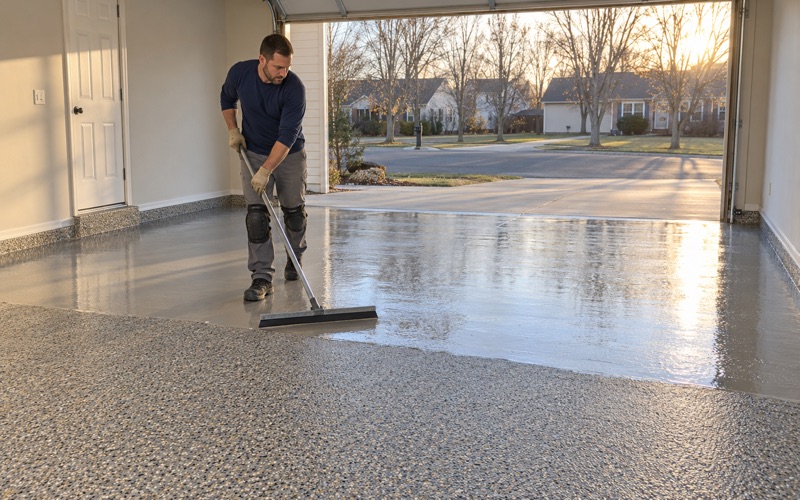
When a mark does show up, the spill is contained and neutralized according to the battery maker’s safety data sheet before anyone rinses it. A polyaspartic or polyurea topcoat over 100% solids epoxy gives a surface that cleans up well afterward, and a quartz aggregate broadcast can add slip resistance where the area gets wet, specified by the broadcast and topcoat rather than promised as a slogan.
Coating a Slab That Has to Stay Open
A repair shop rarely closes for a week. We phase shop floors around operating hours, working bay by bay in evening and weekend windows where a business cannot shut its doors, and the cure schedule for each section is set by slab temperature and dew point rather than by the calendar.
Grinding dust is captured at the machine with a vacuum, not washed toward a floor drain, a sump or a storm inlet, which matters in a shop where the drain may already see fluids. Cracks, spalls and failing old coating are mapped first, and if a slab needs repair or replacement before it should be coated, we say so in writing.
The Old Battery in Your Own Norridge Garage
A Village of Single-Family Houses
Norridge, incorporated in 1948 when a local improvement association headed off an effort by Chicago to annex the area, is a village of owner-occupied houses. With Harwood Heights it forms an enclave inside Chicago that is sometimes called the Island Within a City. Census figures put 82.4 percent of occupied units in owner hands, and 3,971 of those owner-occupied homes are single-family detached houses.
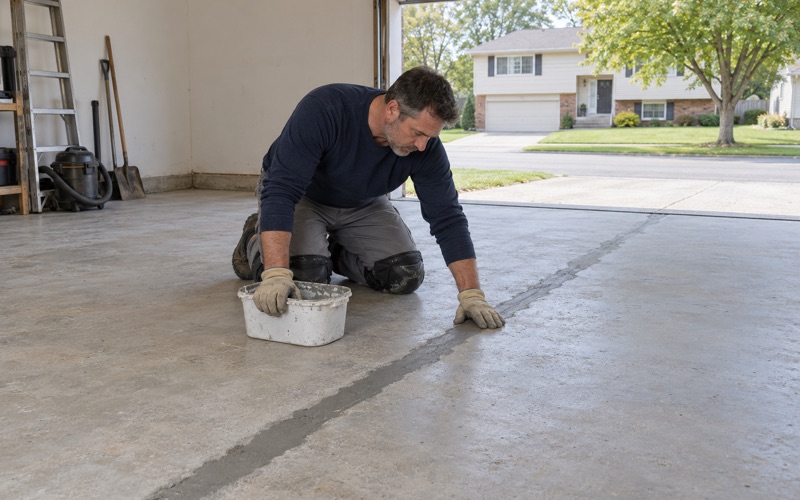
Most of the village’s housing dates from the 1950s and 1960s, and a garage slab poured with a house of that age has had decades to crack, settle and soak up whatever leaked onto it. That garage is where the homeowner version of this problem lives: a replaced car battery set on the floor until the next trip back to the store.
Where to Set a Replaced Battery Down
If you change your own battery, the take-back rule works in your favor: the retailer selling you the new one has to accept the old one, one for one. Until you return it, keep it upright on a plastic tray or tub with a lip, away from the car’s path and off the coated floor, and never stack anything on top.
If the case is cracked or the base is wet, put it in a closed container that will not react with acid and get it back to the store promptly. Check the spot where it stood: on a light topcoat an etch mark is easy to find, and catching it early keeps a small blemish from becoming a recoat.
Permits, Moisture and Winter in a Norridge Garage
The Village of Norridge Building Department requires a permit for construction, remodeling or upgrading of property, and it registers contractors for garage work among other categories. We check permit and registration questions with the department before a job is scheduled, including whether a slab is being coated or replaced, because a replaced pad is a separate concrete permit.
Before the price is final we run a moisture test, such as an ASTM F1869 calcium chloride test or ASTM F2170 in-situ relative humidity probes, and we explain up front that moisture is the first thing a coating warranty excludes. Home jobs above the state threshold get a written contract and the Home Repair: Know Your Consumer Rights pamphlet before grinding starts.
Garage systems are chosen to stand up to the brine and rock salt that ride in on tires all winter, and an unheated garage in deep winter is told to wait for warmer slab temperatures rather than coated on a date. Products are picked inside the Illinois VOC limits for floor coatings, which bind whoever applies them.
- 20+ Years on Concrete
- Moisture Tested First
- Written Scope and Pricing