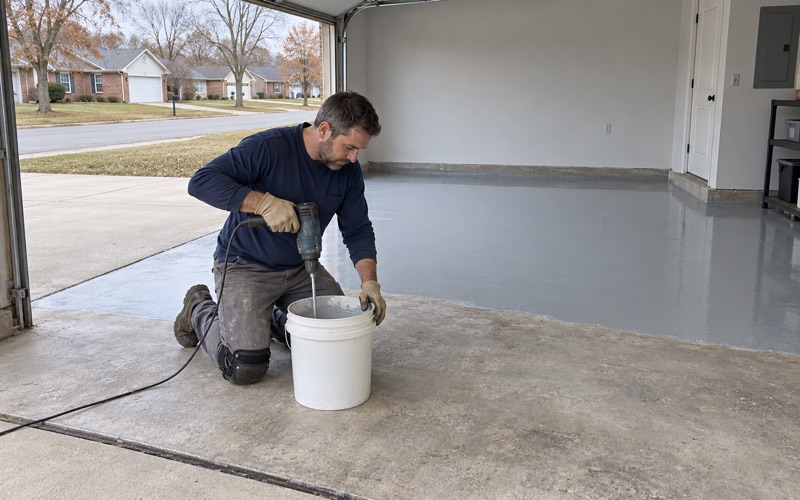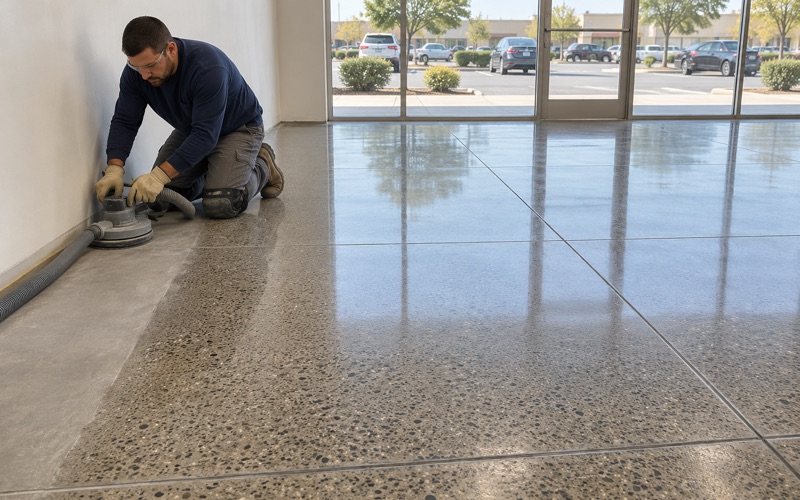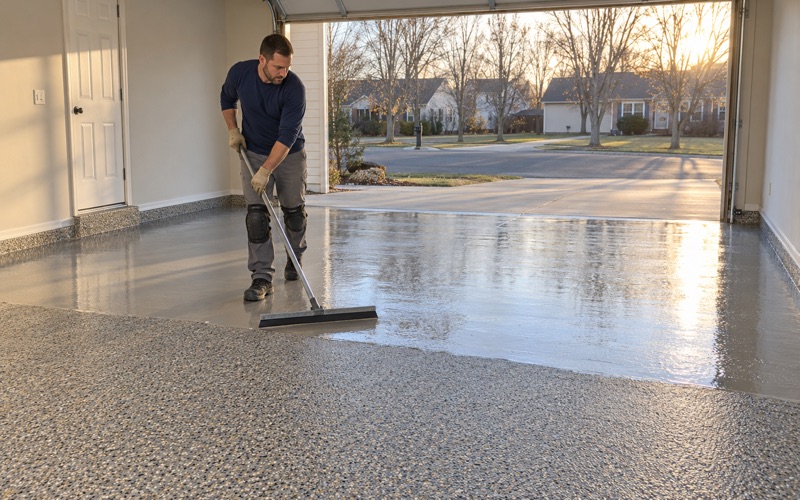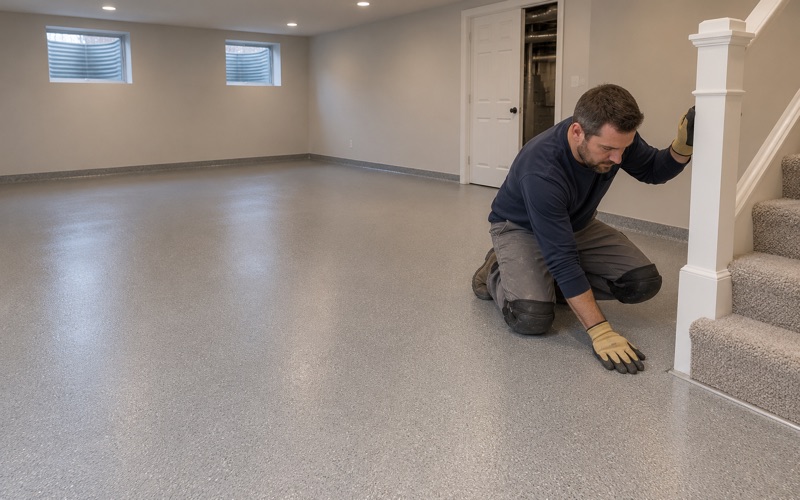
Bartlett Epoxy Flooring handles epoxy flooring in Lyons with more than 20 years in the trade, and much of what we see here is older concrete under a new plan. A shop slab changing hands, a warehouse taking a new tenant, a garage floor that has outlived its last coating: each one starts with what is already on the slab, not with a color chart.
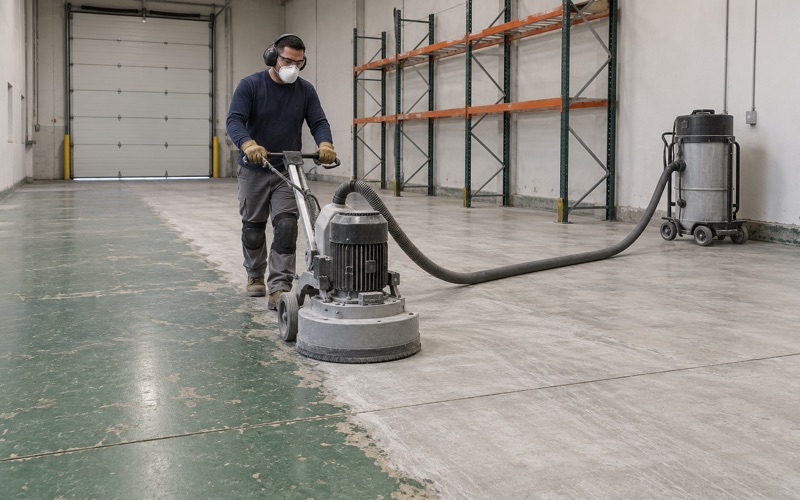
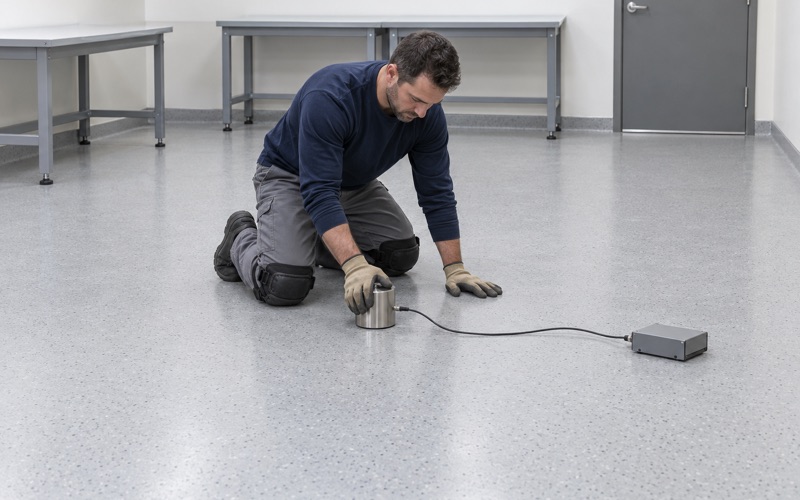
Every slab we take on is opened with a diamond grinder or a shot blaster rather than an acid etch, so the resin has a real profile to bite into. Before any grinding, we map cracks, spalls and old coatings, and we tell an owner plainly when a floor needs repair or replacement first. A moisture test goes into the written scope before the price is final.
On commercial floors, one more item belongs on that map: the sealant sitting in the slab joints. In an older industrial building, that material can predate a federal change in what went into caulk, and removing it is part of the floor job. The sections below explain why we ask the owner about sampling before our grinders touch it.
An Industrial Building on 47th Street, Back on the Market
The Record at 8001 West 47th Street
The north side of Lyons along W. 47th Street is working ground, and 8001 West 47th Street shows how long it has been. A state underground storage tank record names Browning Ferris Industries of IL as the buyer on December 31, 1967, and lists ten tanks for gasoline, diesel, used oil and heating oil, all removed in 1993 and 1994.
The tank removals show the site has already been through one round of work on its fuel storage, and the record lists its status as closed. That history concerns underground tanks, not the floor, and it says nothing about the joints. It does confirm a long industrial history on the parcel.
That record says who held the property, not when the building went up, and we do not know its construction year. What it does establish is an industrial site in use since at least the late 1960s, which is the window where the age of the materials in the floor joints starts to matter.
Two Units, Three Possible Uses
In 2026 the building is marketed again through CBRE: 60,577 square feet on 8.42 acres, split into a unit of about 40,024 square feet and one of about 19,554. The listing offers both from March 2026 for tractor repair, warehousing or light manufacturing, with drive-in doors 14 feet high and clear heights from 14 feet 6 inches to 18 feet.
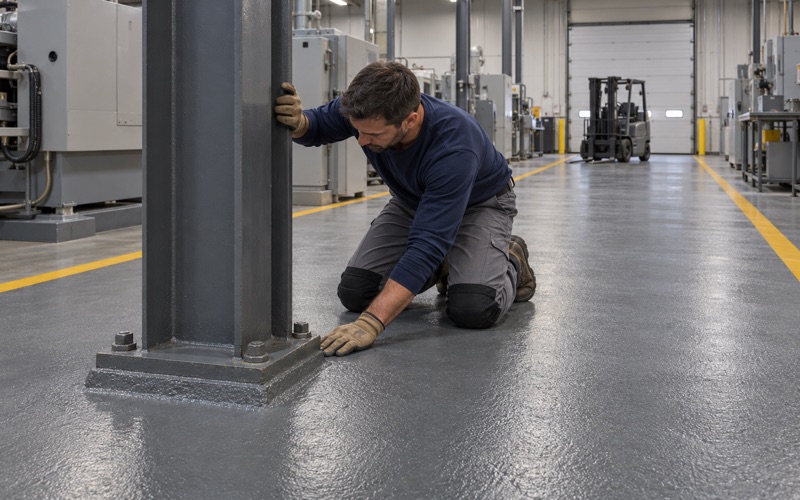
Each of those uses asks something different of the slab. A tractor bay sees diesel, hydraulic fluid and heavy tires, a warehouse sees forklift wheels and pallet drag, and a light manufacturing line may bring coolant or solvent. Whichever tenant arrives, the old floor is commonly ground and recoated before move-in, and the joints come along with it.
Why We Start With the Joints
We have no connection to the owner, the broker or any future tenant at 8001, and we have not inspected the building. We use it because it is a plain local example of a question that applies to many older shop and warehouse floors in Lyons: what is in the joints, and who decides how it comes out.
Owners preparing a building like this for a tenant can budget the coating and overlook the joints. We would rather raise the sealant question on the first walk-through, when it is easy to answer, than at the moment a router is in the first saw cut.
Looking for epoxy-flooring closer to Deerfield? See Epoxy-Flooring in Deerfield.
Old Joint Sealant and the 1978 Line
Sealant Comes Out When a Floor Is Redone
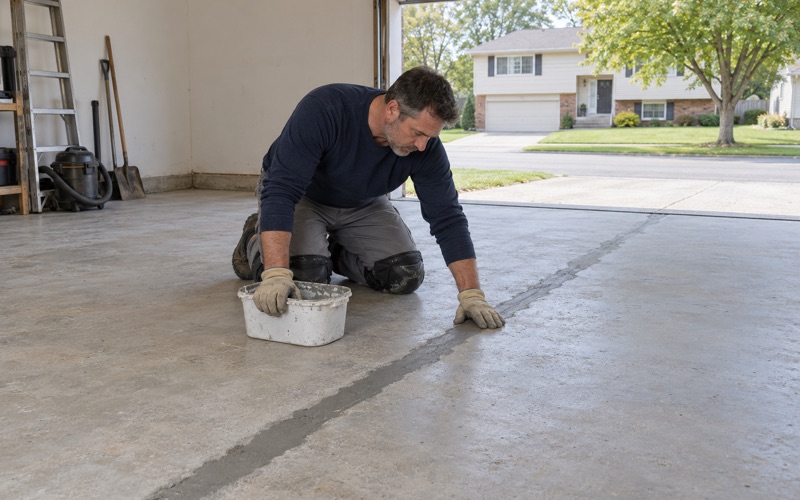
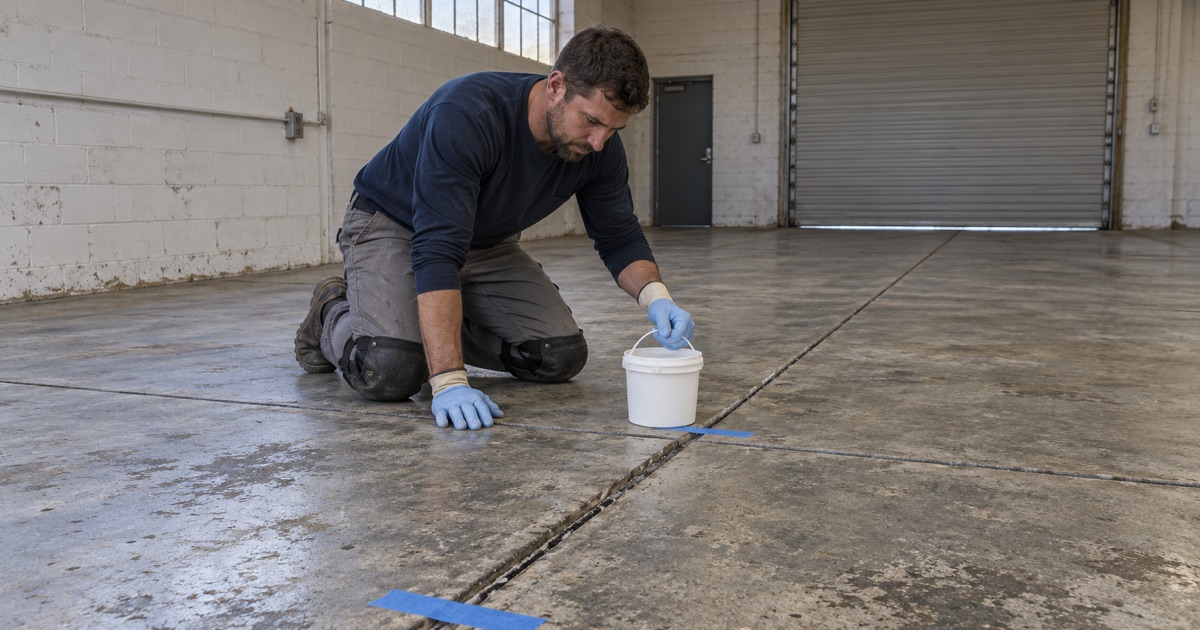
Saw cuts and construction joints in an industrial slab are often filled with a sealant to keep debris and liquids out of the gap. After decades of traffic, that sealant hardens, cracks and pulls away from the joint walls. A new coating cannot bond to it, so the old material is routed or ground out before the floor is profiled.
That step is easy to overlook in a quote because it looks like housekeeping. On a building of the right age, it is the part of the job most likely to disturb something regulated, which is why our walk-through notes the condition of the joints along with the cracks and spalls.
PCBs in Caulk Until 1978
The U.S. Environmental Protection Agency’s 2009 guidance for contractors, Handling PCBs in Caulk During Renovation, states that PCBs were not added to caulk after 1978. Before then, some caulk contained them, and EPA names buildings built between 1950 and 1978 as ones where owners may want to consider air testing.
The same guidance says caulk that is peeling or deteriorating may be tested to find its PCB content. That is the sentence that matters on a floor job. Brittle joint sealant in a pre-1979 building is exactly the material a re-flooring crew is about to remove, so the time to ask the question is before removal, not after.
What a Date Does and Does Not Settle
A date is a reason to ask, not an answer. A slab poured decades ago may have been resealed since, or may still carry its first joint material. Nothing at 8001 West 47th Street has been tested that we know of, and we make no claim about what its joints hold.
We are a flooring contractor, not an environmental firm, and PCB sampling is not a service we offer. Sampling is the building owner’s call, and the analysis is done by a testing laboratory. EPA’s guidance notes that its regional PCB coordinators can direct owners to labs that run it.
Sample Before the Grinder: Soft Caulk, Brittle Caulk
Hand Tools on Soft, Flexible Caulk
EPA’s guidance draws a line by the condition of the caulk. Where it is still soft and flexible, hand tools can cut it out with, in the agency’s words, no dust and no heat. That kind of removal is slow on a large slab, but it keeps the material in pieces rather than in the air.
On an old shop floor, soft sealant is less common. Joints that have taken forklift wheels and pallet jacks for years tend to come out hard, cracked and crumbling, which is the condition EPA treats as needing added precautions. Few owners know which kind they have until someone probes a few joints.
Electric Tools on Brittle Caulk
For hardened or brittle caulk, EPA says electric tools generate heat, which can volatilize the PCBs, and dust, requiring added protective measures. A joint router or a diamond grinder running down a saw cut is exactly that kind of tool. It is also the tool most crews reach for, because hand-picking hundreds of feet of hard joint is rarely practical.
Our grinders run with vacuum capture at the machine, and we never rinse grinding dust toward a floor drain or sump. That habit is good practice on any slab, but it is not a substitute for knowing what is in the joint before the router starts. Dust collection controls how much reaches the room; it does not change what the dust is.
Fitting the Sample Into the Schedule
When an older building is being prepared for a new tenant, the joints can be sampled during the walk-through stage, weeks before move-in. A lab result arriving after the grinders are on site stalls a crew and a lease date at once, while a result in hand lets the owner plan removal and disposal as part of the floor scope.
Our written proposal then names the product line, the number of coats and the finished thickness, and it says which joint work is ours and which waits on the owner’s results. Shop and warehouse jobs are phased around operating hours, with overnight and weekend windows when a space cannot close.
Containment, Disposal and the Floor That Follows
Containment When the Caulk Is Suspect
For interior removal of PCB-containing caulk, EPA’s guidance describes plastic sheeting over floors and fixed surfaces, sealed ventilation, and cleanup with an industrial HEPA vacuum and wet mopping. Those measures are set by whoever manages the removal under the owner’s plan. Our part is to schedule around them and not to start grinding until the area is released.
EPA also warns that removal can create dust from the surrounding contaminated substrate, not only the caulk itself. On a floor, that substrate would be the concrete at the joint edge, which is one reason the joint question is settled before the whole slab is profiled.
50 Parts per Million and 40 CFR 761.62
Disposal follows the lab number. Under the guidance, caulk at or above 50 parts per million PCBs is PCB bulk product waste regulated under 40 CFR 761.62, which points to a state-permitted solid waste landfill or a risk-based approval. Contaminated surrounding materials are a separate category, PCB remediation waste under 40 CFR 761.61.
That is why we do not mix joint debris into our ordinary grinding waste on a building whose sealant is unknown. Whatever the result, the owner and the receiving facility decide how that debris is handled, and our prep follows that decision rather than leading it.
A Coating Is a Floor, Not a Fix
Once the joints are cleared, the slab is ground or shot blasted to a profile, moisture tested and coated in a system matched to the tenant’s use. For a bay that will see diesel and hydraulic fluid, we often specify 100% solids epoxy with a quartz aggregate broadcast for traction and a chemical-resistant topcoat.
What a coating will not do matters just as much. A resin floor is not PCB remediation, it does not seal in anything left in a joint, and it is never a substitute for the owner’s testing and disposal decisions. We explain those limits, along with what the warranty excludes, before a job is sold.
We also check with the Village of Lyons Building Department on permit and contractor-license requirements before scheduling, since the village issues its own contractor license application. Products are chosen inside the Illinois VOC limits for floor and industrial coatings, and cure schedules follow slab temperature and dew point, which in an unheated bay in deep winter can mean waiting.
- 20+ Years on Concrete
- Moisture Tested First
- Written Scope and Pricing