Bartlett Epoxy Flooring has spent more than 20 years putting down epoxy flooring in Lake Zurich and the surrounding suburbs, and laboratory rooms are among the floors where small details carry the most weight. A lab floor is judged less by how it looks on the day it cures than by how easily a technician can clean every inch of it on an ordinary weekday. That standard decides where the coating goes, how it meets walls and cabinets, and what it has to survive.
Our work starts with the slab, not the resin. We open the concrete with a diamond grinder or a shot blaster rather than an acid etch, and we run a moisture test as part of the written scope before the price is final. The proposal names the product line, the coat count and the finished thickness, so a facilities manager can hold the installed floor up against the quote.
This page covers what that means in a working lab: the federal guidance labs plan their rooms around, the floor hidden under benches and casework, the coved edges at walls and cabinet bases, and the spill cleanup a resin system has to take week after week. We also explain before the job is sold what a coating warranty leaves out, and moisture is the first exclusion we name.
A Food-Testing Lab on Oakwood Road and the Manual Behind It
Chemistry and Microbiology in the Industrial Park
Merieux NutriSciences, a food-safety testing company, lists a Lake Zurich lab at 95 Oakwood Road offering chemistry and microbiology services, open Monday through Friday from 8:00 a.m. to 5:00 p.m. The address geocodes inside the village limits, in Ela Township of Lake County. It is a useful example of the kind of room this page is about.
We want to be clear about what we know and what we do not. The lab is not a customer of ours, and its floors, its room layout and the biosafety level it works at were not something we read. What we can describe is how a food microbiology room is typically planned, and what that planning asks of the concrete under it.
What Biosafety Level 2 Asks of a Room
Biosafety in Microbiological and Biomedical Laboratories, the BMBL 6th edition published by the CDC and NIH in 2020, sets out practices and facility features for each biosafety level. Biosafety Level 2 is the second of its four tiers. Its facility list is short, and a striking amount of it is about cleaning.
Section D, item 4, reads plainly: the laboratory is designed so that it can be easily cleaned. Carpets and rugs in laboratories are not appropriate, and the spaces between benches, cabinets, and equipment are accessible for cleaning. Those three lines, on page 42, do more to shape a lab floor than any product brochure.
Guidance, Not a Product Mandate
The manual names no floor material for Biosafety Level 2, and it is guidance rather than a statute. Nothing in it calls for epoxy, urethane or any other resin by name. What it describes is a performance outcome, a room that can be cleaned completely, and the floor is simply one of the surfaces that has to deliver it.
That is why we talk about the floor in terms of reach and continuity rather than labels. A seamless resin floor is one common way to meet the cleaning goal, sealed concrete and sheet goods are others, and the right answer depends on the room. Our job is to make sure whatever goes down leaves no place a mop cannot follow.
Looking for epoxy-flooring closer to Hinsdale? See Epoxy-Flooring in Hinsdale.
Under the Benches: Continuous Floors and No Toe-Kick Voids
Why the Space Under Casework Matters
On a lab floor, the clause about reaching the gaps around casework does real work. Casework is often set on bare concrete or on a strip of old tile, and the floor coating stops at the cabinet face. That leaves a dark band of untreated slab behind the toe kick where a spill can run and sit.
Bare concrete is porous, so liquid that reaches it soaks in rather than wiping up. A hollow toe-kick void is worse, because it is a closed pocket nobody can see into without pulling a panel. Neither one is accessible for cleaning in any practical sense, which is the whole point of the guidance.
Running the Floor Continuously
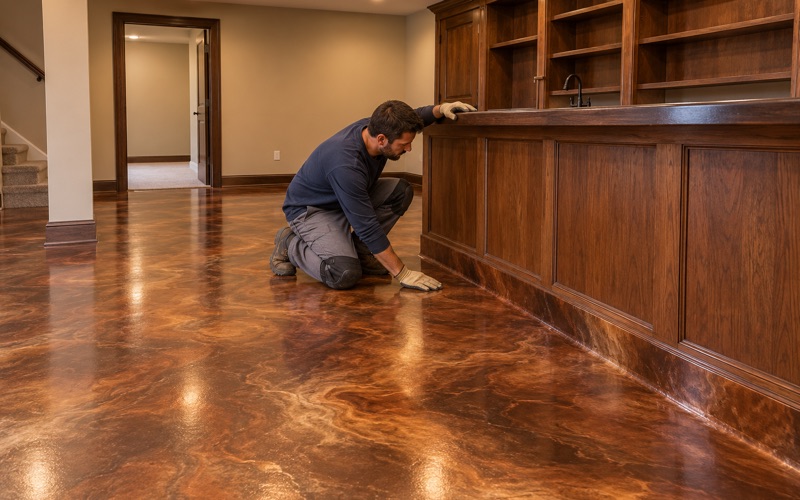
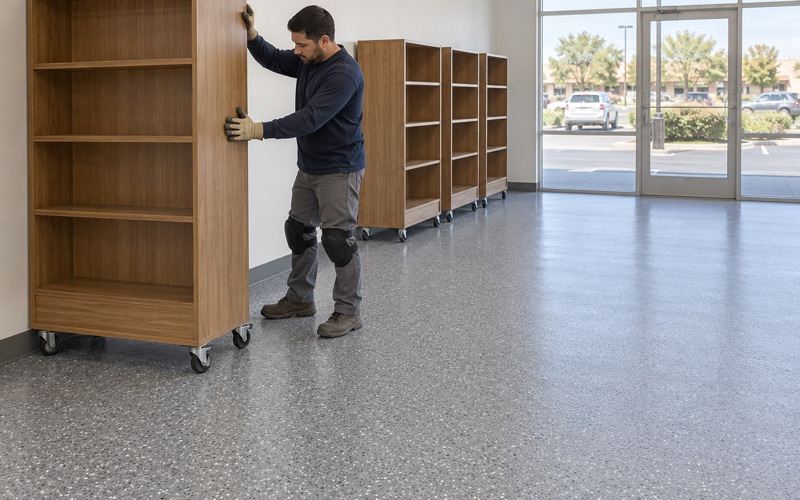
Where the schedule allows, we coat the room before casework goes in or while it is pulled, so the resin runs unbroken under and between the cabinets. Mobile benches and equipment stands then sit on a sealed surface, and a technician can roll them aside and clean beneath. The floor becomes one continuous membrane instead of a patchwork with gaps at every cabinet line.
When fixed casework has to stay, we plan the edge instead of ignoring it. The coating is carried tight to the cabinet base and finished so nothing is left between the floor and the cabinet but a sealed joint. We map those edges with the cracks, spalls and any old coatings before pricing, so the scope shows exactly how each one will be handled.
Coves at Walls and Cabinet Bases
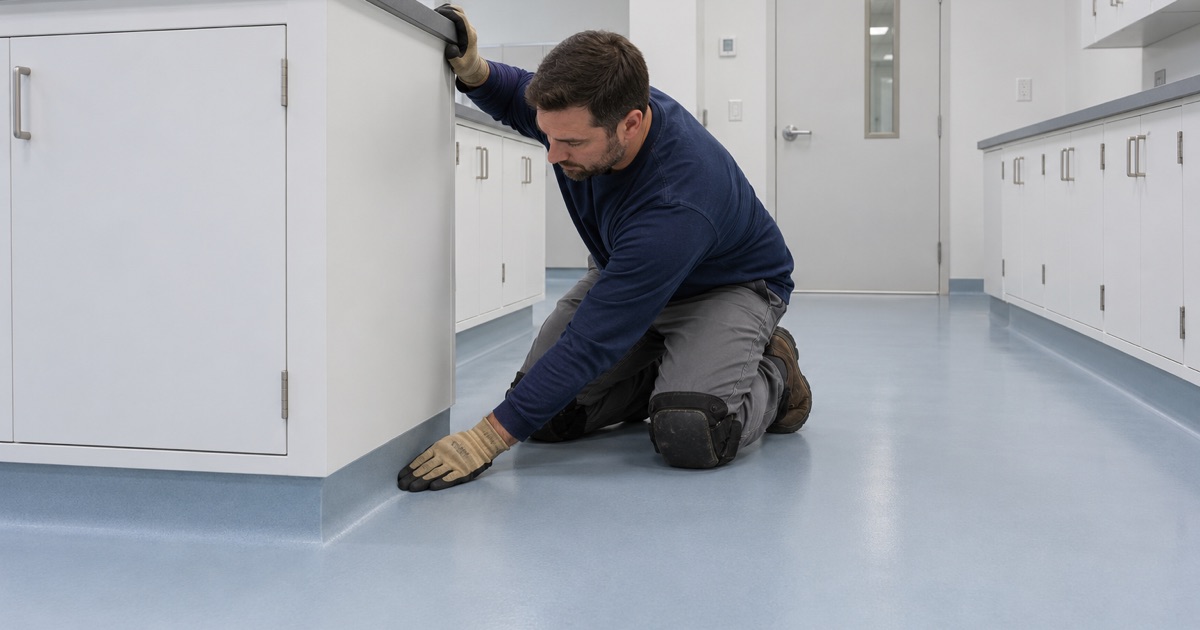
A floor that stops in a hard 90-degree corner at the wall leaves a seam where residue collects. An integral cove carries the resin up the wall a few inches in a smooth radius, so the mop or squeegee rides around the corner instead of into it. The same detail at cabinet bases removes the toe-kick void entirely.
Food-service codes point the same way. FDA Food Code 6-201.13 addresses coved floor and wall junctures in food establishments, and the same logic carries over to a room that handles food samples. We build the cove from the same system as the field floor, troweled and sealed, so it is one surface rather than a glued-on trim piece.
Spills, Disinfectant and What the Floor Has to Take
Cleaning Up Where the Spill Lands
BMBL standard practice A.14 for Biosafety Level 2 says work surfaces are decontaminated after any spill or splash. Spills are contained, decontaminated and cleaned up by trained staff following a spill procedure posted in the lab. On the floor, that means disinfectant applied right where the liquid landed and left for its contact time.
A floor that softens, stains or loses gloss under that routine stops being easy to clean. Before we name a system, we ask for the disinfectants and solvents the room actually uses, including the bleach dilution or quaternary product on the spill cart. The topcoat is then chosen to take that chemistry, not a generic list.
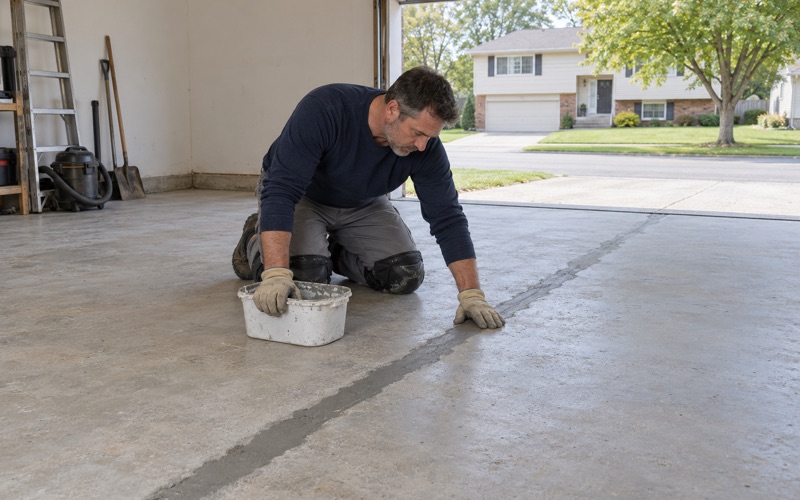
Seams and pinholes matter here too. A disinfectant that pools in a crack or a gap at an old joint reaches bare concrete and stays there, so we fill cracks and detail joints before the body coats go down. The finished floor is inspected for pinholes before the lab gets it back.
Benchtops Versus Floors
The manual describes benchtops that are impervious to water and resistant to heat, organic solvents, acids, alkalis and other chemicals. It sets no such list for floors. We treat the benchtop language as a sensible benchmark for the floor beneath, since whatever drips off the bench ends up there.
For chemistry rooms, that usually points toward 100% solids epoxy under a chemical-resistant urethane or polyaspartic topcoat, or urethane cement where hot water and heavier exposure are expected. A quartz aggregate broadcast can add grip near sinks without leaving deep texture that holds residue. We specify the broadcast and topcoat that create the slip resistance rather than promising it.
Why Carpet and Loose Mats Are Out
The guidance calls carpets and rugs not appropriate, and the reason is practical: fibers hold whatever lands on them and cannot be decontaminated in place. Anti-fatigue mats at benches raise a smaller version of the same question, so we suggest asking whether each one can be lifted and cleaned. A sealed floor underneath makes that lifting worthwhile.
The same thinking applies to transitions. Where a lab meets a carpeted office corridor, we end the resin at a sealed threshold at the doorway, so the cleanable floor covers the whole lab and the carpet stays on the office side. A clean edge there also keeps tracked-in dirt from building up at a seam.
Installing a Lab Floor in Lake Zurich
Moisture and the Slab Under the Lab
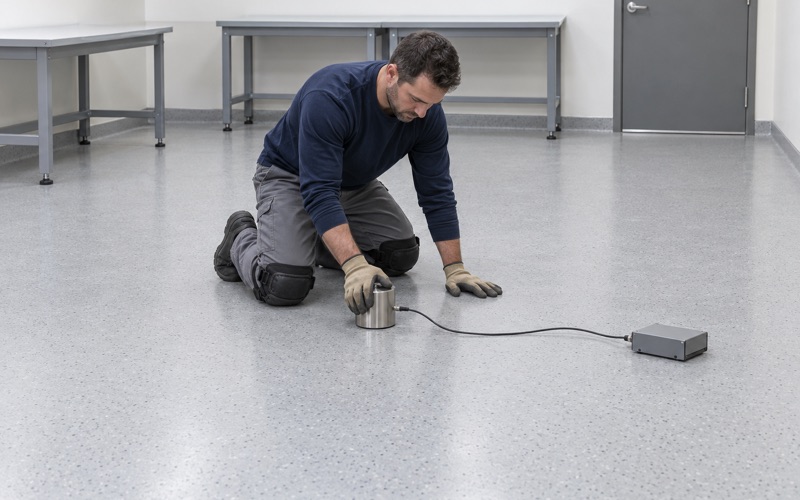
A resin floor in a lab is only as good as its bond, and moisture coming up through the slab is a leading reason a coating lifts. During the site visit we set ASTM F2170 in-situ relative humidity probes or run ASTM F1869 calcium chloride tests, depending on the slab. Where readings run high, a moisture-mitigation primer goes into the scope rather than being discovered later.
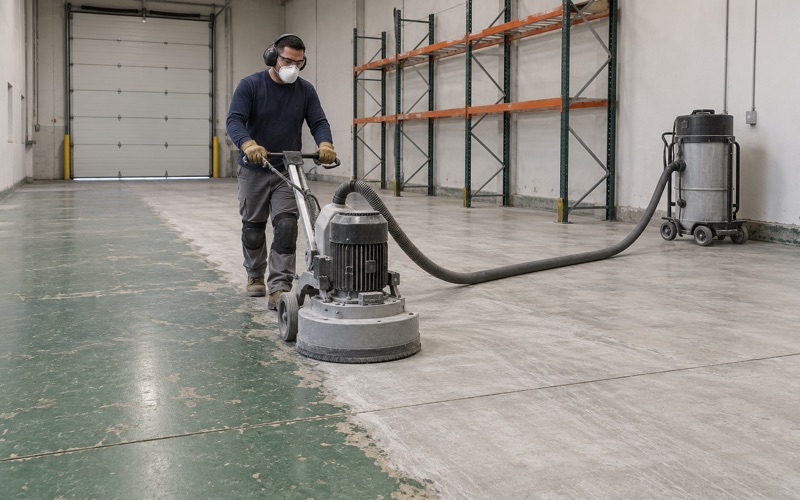
Grinding produces fine concrete dust, which has no place near sample prep. We capture it at the machine with a vacuum and keep it out of drains and sinks, and we seal off the work area from rooms that stay in use. Cure schedules follow slab temperature and dew point, so the return-to-service date is set by the floor, not the calendar.
Working Around a Weekday Lab Schedule
A lab that runs Monday through Friday rarely wants to close for a week. We phase the work room by room, using overnight and weekend windows so benches can be cleared, the floor installed and the cure completed before staff return. The sequence is written down ahead of time so the lab can plan sample intake around it.
Product choice also follows the rules that bind the installer. We pick coatings inside the Illinois VOC limits for floor and industrial coatings, and in an occupied building a low-odor system often makes the overnight window workable. That choice is made before the schedule is promised, not after.
Permits and Who Signs Off
Some commercial floor work in Lake Zurich needs a permit from the village’s Building and Zoning Division of the Community Services Department. Applications go by email to the permit desk, and most take up to 15 business days to process, so we build that lead time into the start date. For a lab, we also coordinate with whoever owns the posted spill procedure so the new floor’s care instructions match it.
Lake Zurich has been a village since 1896, and its industrial park holds a working mix of testing, production and service tenants. A Lake Zurich mailing address does not always mean the village itself, so we check the parcel before naming which village reviews the permit. It is a small step that keeps a lab project from stalling at the counter.
- 20+ Years on Concrete
- Moisture Tested First
- Written Scope and Pricing