Bartlett Epoxy Flooring offers epoxy flooring in Justice backed by more than 20 years of grinding, patching and coating concrete that has already lived one working life. A warehouse floor that carried another company’s racks is not a blank surface. We read it as a record before any resin is mixed, and that reading sets the prep, the price and the order of work.
Our proposals name the product line, the number of coats and the finished thickness, so a building owner or tenant can hold the finished floor against the quote. Every slab is opened with a diamond grinder or a shot blaster rather than an acid etch, and a moisture test sits in the written scope before the number is final. Old patches, spalls and cracks are mapped first.
When a slab needs repair or replacement before it should be coated, we say so plainly. A coating hides nothing for long, and on a re-racked warehouse floor what it gets asked to hide is the last tenant’s anchor hardware. This page walks through how we handle that, from the first walk of the floor to the day the new racks go up.
A 1984 Flex Building on Industrial Drive Becomes a Warehouse
A Sale and a Business License
Justice is a village in Cook County, established in 1911, and its industrial park is a small-shop place. The village’s own hazard plan says there are no major industries here, and that the park holds several truck repair shops and body shops. That scale matters, because a change of use in a park this size tends to arrive one used building at a time.
8721 Industrial Drive is a clear example. The 13,000-square-foot flex building there was built in 1984, has three drive-in doors, and sold on February 18, 2026 for $1,400,000. On April 27, 2026, the Justice Village Board agenda carried a motion to approve a business license for Fashion Footware, Inc. to operate a warehouse for an e-commerce business at that address.
What the Record Does Not Say
We have no relationship with Fashion Footware, the building owner or any rack installer, and we have not seen this slab. The agenda shows the motion, not the vote, and nothing we read says the warehouse has opened. We use the address because it shows, in public records, exactly the kind of handoff that brings a used floor to a coating contractor.
Directory listings put Ability Plastics, a plastics and engraving supply business, at the address before the sale. Whatever that tenant stored or ran there, the next one inherits concrete carrying four decades of other people’s decisions. An e-commerce warehouse generally wants long rack runs and clear picking aisles, and that layout rarely lines up with the old one.
Why the Floor Comes Up Now
A change of tenant is the easiest moment to deal with a floor. Ideally the building is empty, nothing new is anchored yet, and the rack plan has not been drilled. Once the racks are bolted in place, every patch, grinding pass and coat has to work around steel uprights and base plates, and some of the slab cannot be reached at all.
It is also the moment the floor’s condition is most visible. With the old racks gone, every stub, hole and stained base-plate footprint is out in the open, and the person signing the lease or the purchase can see what the last occupant left. That visibility is worth using before the new racking covers it again.
Looking for epoxy-flooring closer to Winfield? See Epoxy-Flooring in Winfield.
What the Last Tenant’s Racks Leave in a Slab
Cut Anchor Stubs and Empty Holes
Pallet rack is anchored through its base plates into the slab, and the rack design engineer sets the number, size, depth and placement of those anchors. RMI Rack Safety describes two anchors per base plate as typical unless the engineering drawings say otherwise. When a damaged column is replaced, RMI notes, the installation team cuts the previous anchors at the floor level.
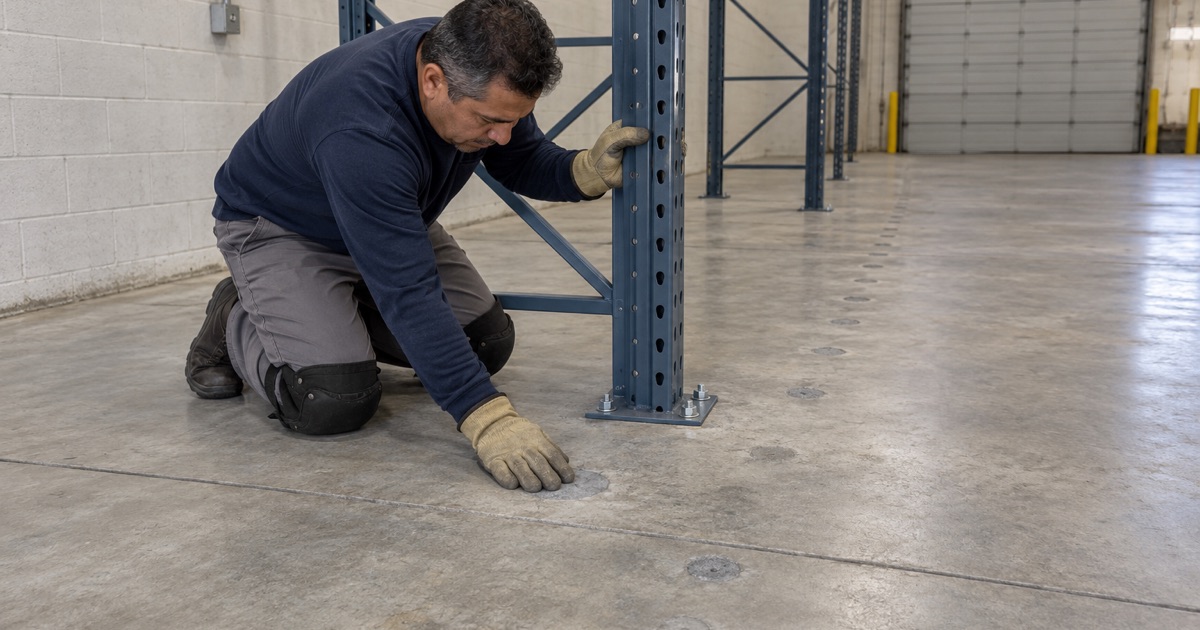
So a used warehouse slab tends to carry its history as hardware. Some anchor stubs are sheared at the surface, some are cut a little proud, and some were never cut at all. Between them sit empty anchor holes from racks that were moved or pulled, and patches of varying age where someone filled a hole with whatever was on the truck that day.
Why a Coating Cannot Simply Go Over Them
A stub left even slightly proud telegraphs straight through a resin coat. It becomes a raised bump that catches pallet-jack wheels, chips the coating around it, and keeps chipping as traffic hits it. An open hole does the opposite: the coating sags into it or skins over it, leaving a weak spot that a wheel or a dropped pallet breaks through, after which the hole fills with debris.
Old patches are their own question. A cementitious patch that has gone soft or a fill that shrank away from the hole edge will not carry a coating any better than the empty hole did. During our walk-through we tap, scrape and mark each one, and a patch that fails that check comes out and gets redone rather than coated over.
Mapping the Floor Before We Price It
Every stub, hole, patch, crack and spall goes onto a floor map before the proposal is written. That map is what the price is built on, because a slab with forty cut anchors and a slab with four hundred are different jobs. It also becomes something the new tenant’s rack engineer can use when laying out the anchor pattern for the new racks.
The same walk covers moisture. A warehouse slab poured on grade decades ago may have no vapor retarder under it, so we put a moisture test in the written scope, using ASTM F2170 in-situ relative humidity probes or ASTM F1869 calcium chloride testing as the floor warrants. Moisture is also the first exclusion we name when we explain what a coating warranty leaves out.
Grind the Stubs, Fill the Holes, Then Coat
Grinding Flush
A rack dealer’s disassembly guide puts the step simply: cut or grind the rest flush with the floor, then fill the holes. We take stubs down with a diamond grinder until the steel sits level with the concrete around it, then keep going until the cut face is below the surface plane, so the patch can cap it.
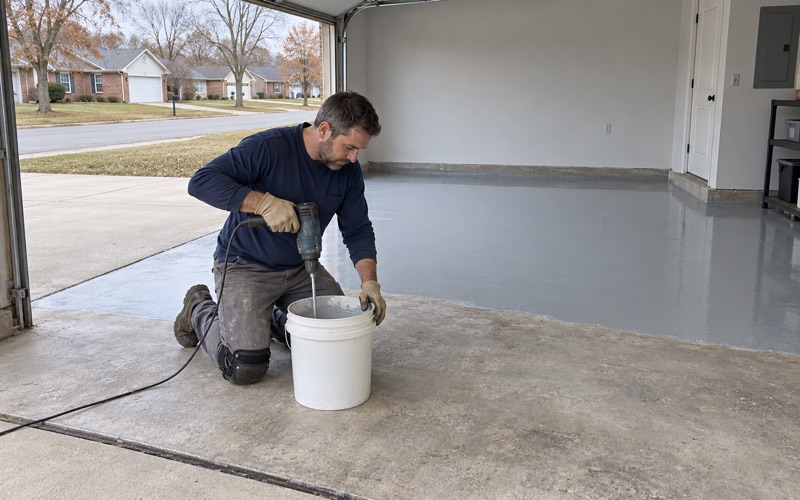
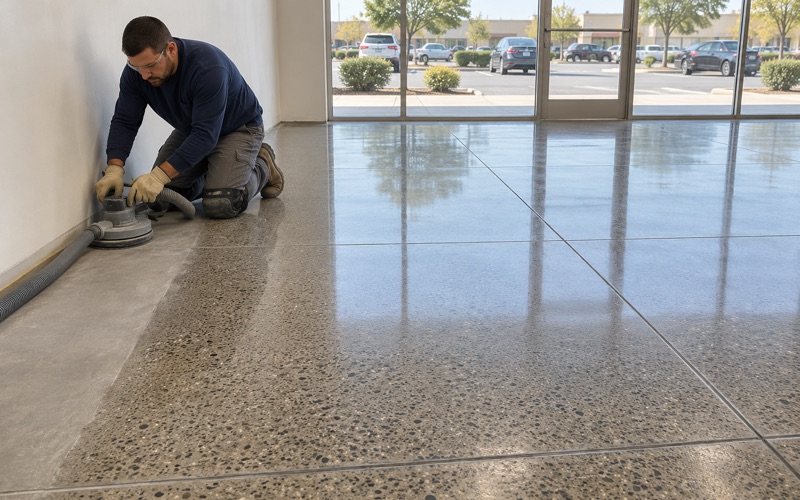
That grinding happens in the same pass that opens the whole slab. Every floor we coat is prepared with a diamond grinder or a shot blaster to a measured ICRI concrete surface profile, never an acid etch, because an etch does nothing to a steel stub and leaves too little profile for the resin to grip. Dust is captured at the machine by vacuum.
Filling Every Hole
Each empty hole is vacuumed out, checked for depth, and filled with an epoxy or cementitious patch suited to the coating going on top. On a warehouse floor we lean toward a rigid, fast-curing epoxy patching mortar, struck off flush and ground again once it cures so it reads as part of the slab rather than a dimple under the film.
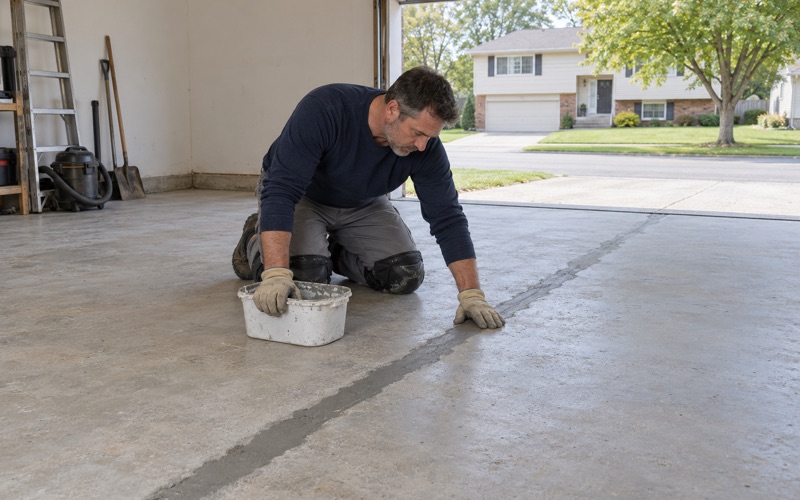
Old patches that passed the tap test stay, but they still get ground so the coating bonds to fresh material. Anything that crumbles is chased out to sound concrete. Where the map shows a cluster of holes close together, the concrete between them is checked too, because a fill can be sound while the web of slab around it has cracked.
The Coating Itself
Once the scars are flush, the system is chosen for warehouse traffic: a 100% solids epoxy body coat, a quartz aggregate broadcast where pallet jacks turn and picking carts run, and a topcoat matched to that wear. Slip resistance comes from the broadcast and topcoat we specify, written into the scope rather than promised as a slogan.
Cure follows slab temperature and the dew point spread at the surface, not the calendar, and an older flex building with drive-in doors can run cold near the openings in winter. Products stay inside the Illinois VOC limits for floor and industrial coatings, which bind whoever applies them, and the whole schedule is set around the tenant’s move-in date.
The Rack Engineer Sets the Anchors, and the Order Is Agreed
New Anchors in Sound Concrete
We do not design racking, and a coating does nothing to hold an anchor or add capacity to one. The new layout belongs to the rack engineer, who decides where each base plate lands and how it is anchored. RMI points out that anchoring near an expansion joint or free slab edge raises the risk that the concrete there will fail, and that clearance is the engineer’s call.
What we can do is make the engineer’s job easier. Our floor map shows where the old holes and patches are, so new anchors can land in sound concrete clear of them. RMI mentions extra holes in new rack components for the same reason: to avoid interference with the original anchor locations. A patched hole is a good finish surface, but it is not where a new anchor belongs.
Permits Before Anyone Drills
The rack dealer’s guide notes that some jurisdictions review design drawings and require a rack permit for a new location, so the tenant’s installer should confirm what Justice asks for. On our side, the Village of Justice Building Department at 8748 W. 82nd Place requires every contractor to be insured, licensed and registered with the village before a permit issues.
Non-sewer contractors working under a permit carry a $10,000 permit bond that runs on a February 1 to January 31 licensing year. A 3-part permit application listing every contractor is required for building work other than plumbing and electrical, and concrete work needs a permit and a plat of survey, so patching scope is confirmed with the department before we schedule.
Coat First or Rack First
The last decision is order, and it is one line in the schedule agreed with the rack installer rather than left to chance. Either the floor is coated first and anchors are drilled through the cured film, or the racks go in first and the coating stops at a clean cut line around each base plate.
Both work when everyone knows which one is happening. Where a building cannot close, we phase the coating around operating hours, with overnight and weekend windows. What does not work is finding out on move-in day that the anchor plan changed, so we ask for the final rack drawing before the last coat goes down.
- 20+ Years on Concrete
- Moisture Tested First
- Written Scope and Pricing