Bartlett Epoxy Flooring handles epoxy flooring in Franklin Park with more than 20 years in the trade, and the floors we think hardest about here are the ones that sit under food: grocery aisles, butcher-counter back rooms and the garage freezers families fill at home. On a store sales floor, a coating is judged less by its gloss than by what a mop can reach.
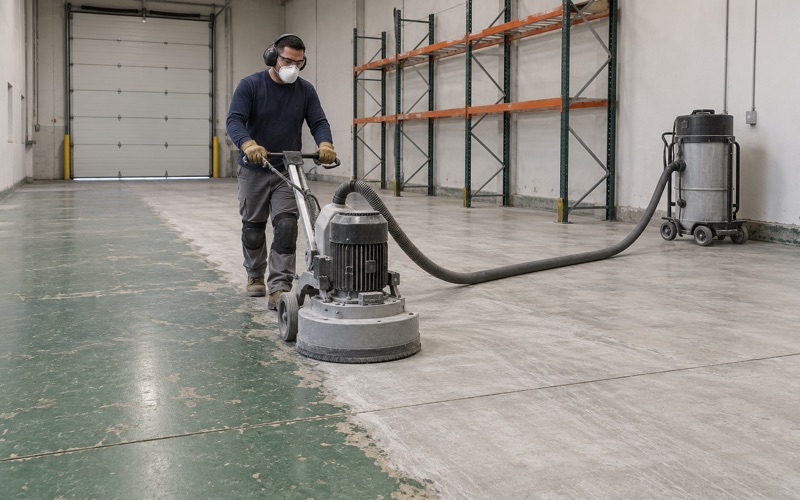
Every slab starts the same way. We open it with a diamond grinder or a shot blaster rather than an acid etch, so the coating has a real profile to grip, and we map cracks, spalls and old coatings before anything is priced. The written proposal names the product line, the number of coats and the finished thickness, so the owner can hold the floor up against the quote.
What follows is about one specific job a floor does in a food store: staying cleanable underneath the cases that rarely move. It is a narrower question than slip resistance or chemical resistance, and it is the one a grocery owner can settle with the right finish and a cleaning routine that actually reaches.
A Grocery, Butcher Counter and Farmers Market on Grand Avenue
Franklin Park is a village in Cook County, in Leyden Township, with 18,467 residents at the 2020 census. It was named for Lesser Franklin, a real estate broker who bought acreage when the area was mostly farming fields.
One Store, Four Kinds of Food Business
Amish Farmers, at 9711 W Grand Ave, Unit B, describes its stores as one place that incorporates a grocery store, a traditional butcher shop, a buffet-style restaurant and a farmers market. Its own page lists vegetables and fruits, dairy, fresh meats and bakery goods, and it is open Monday through Saturday, 9:00 a.m. to 6:00 p.m.
A customer review quoted on that page mentions cold cuts, smoked salmon, sausages and a refrigerated section. We have not seen the store’s cases or floors, and we have no relationship with the business; we use it here because it puts a butcher counter and a grocery sales floor under one roof, which is exactly where two parts of one food code section meet.
Kitchen Side and Sales-Floor Side
In a typical butcher shop or buffet kitchen, the floor carries fixed equipment such as prep tables, sinks, reach-in coolers and cooking lines. Out on a grocery sales floor, shoppers walk past display shelving and display refrigeration units holding the dairy, meat and deli goods they pick up themselves.
The code treats those two groups differently, and the difference lands on the floor. Kitchen equipment is mostly kept off the slab or sealed down to it, while sales-floor cases are allowed to sit low. That one allowance is the reason a grocery floor needs more thought than its plain appearance suggests.
Who Inspects Food Floors Here
Food businesses in Franklin Park answer to the Cook County Department of Public Health, and a meat or poultry slaughter or processing establishment also operates under USDA FSIS inspection. We have not read how the county applies the display-case clause, so we treat the model code as the starting point and leave inspection questions to the store and its inspector.
What we bring is the floor side of the conversation. We can tell an owner what a finish will and will not do under a case, how it cleans, and how long it should hold up; the clean floor the code asks for is still the store’s daily work, not ours.
Looking for epoxy-flooring closer to Pingree Grove? See Epoxy-Flooring in Pingree Grove.
The 6-Inch Rule, and the Clause That Exempts Display Cases
The FDA Food Code is a model code, and its 2022 edition covers fixed equipment and the floor beneath it in section 4-402.12. Its three parts read like a short lesson in why the floor under food equipment matters.
Sealed to the Floor or Elevated on Legs
Part (A) says floor-mounted equipment that is not easily movable shall be sealed to the floor or elevated on legs that give at least 6 inches of clearance between the floor and the equipment. Part (B) allows 4 inches where no part of the floor under the equipment is more than 6 inches from the point of cleaning access.
Both options solve the same problem. Either nothing can collect under the unit because the base is sealed, or there is room for a mop head and a flashlight to get under it. Clearance is the code’s way of making sure the floor underneath is reachable rather than assumed clean.
The Retail Display Exemption in Part (C)
Part (C) says the section does not apply to display shelving units, display refrigeration units and display freezer units located in the consumer shopping areas of a retail food store. That covers much of what a shopper sees: the dairy case, the meat case, the gondola shelving and the freezer doors.
The exemption keeps sales-floor fixtures practical: shelving and multideck coolers can sit close to the floor instead of standing on legs. It does not let the floor under them go unattended, and the condition attached to the exemption is where the floor’s real job begins.
If the Floor Under the Units Is Maintained Clean
The exemption applies only if the floor under the units is maintained clean. That is a condition on the store’s housekeeping, and no coating meets it on its own. A floor can make that housekeeping easy or nearly impossible, but the clean floor itself comes from someone pushing a mop or scrubber into that space on a regular schedule.
Related section 4-402.11 asks for fixed equipment to be spaced for cleaning access or sealed to adjoining equipment and walls. Put together, the clauses point toward a floor that runs continuously under the case footprint, with nothing hidden that a cleaning tool cannot follow. That is the target we design a sales-floor finish around.
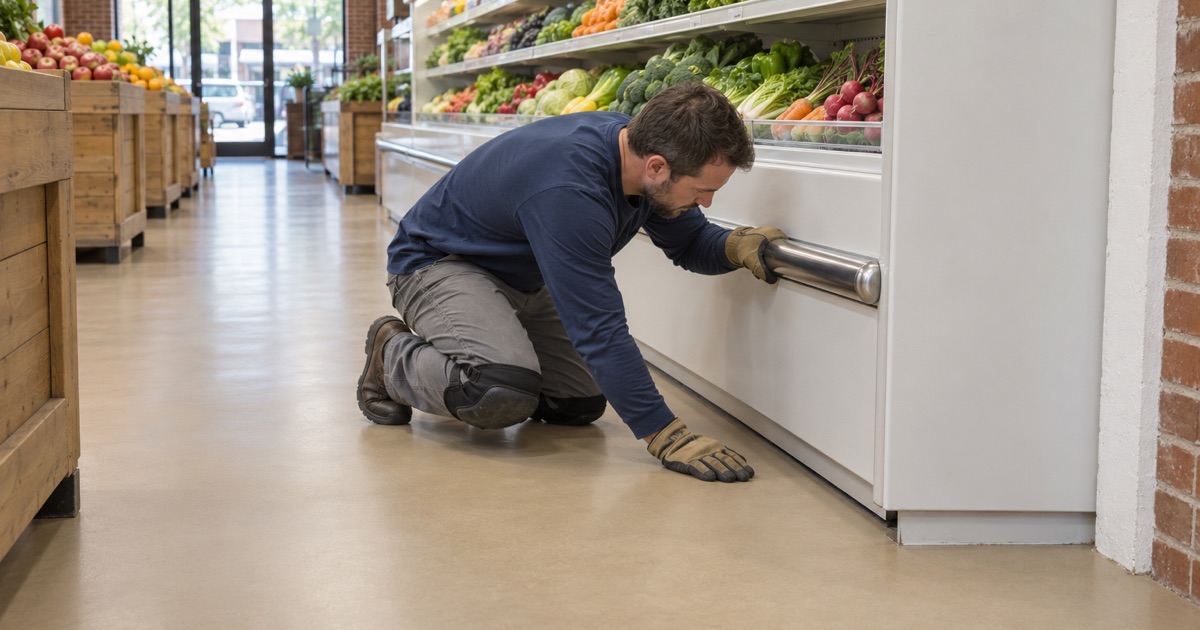
Reaching Under a Display Case: What the Floor Has to Allow
Under a low case there is usually a toe space, a recess near the base where a shopper’s feet go and a cleaning tool has to follow. On an exempt case, that strip is the floor a clean-floor routine must reach, and it is often the least visible floor in the store.
Smooth, Sealed and Continuous
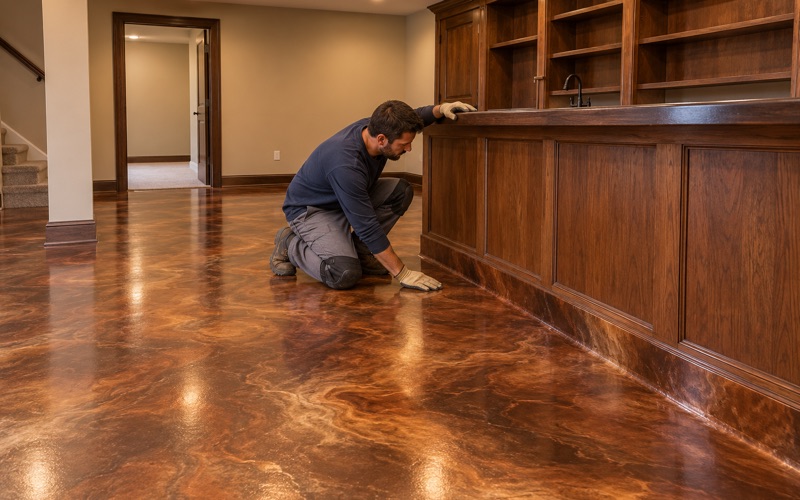
Bare concrete under a case soaks up what drips on it. Meat juice, spilled milk and produce misting water work into the pores and joints, and a mop pushed under the edge only spreads the film. A sealed resin floor keeps those liquids on top, where a flat mop or squeegee can lift them out.
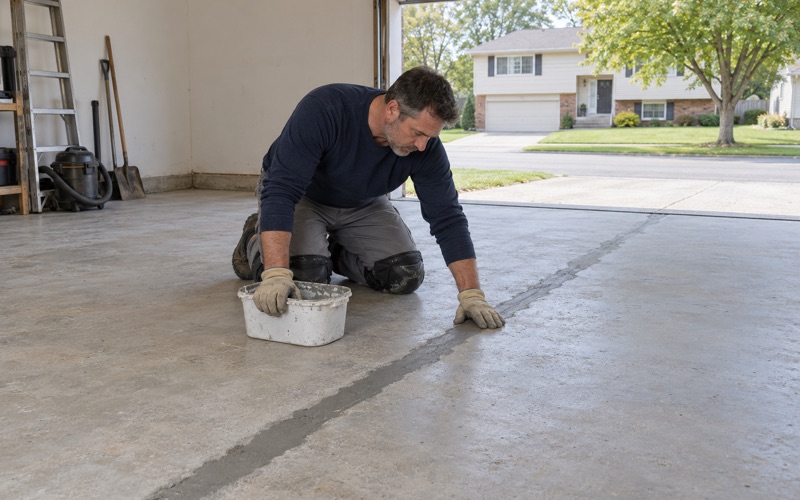
Continuity matters as much as the coating itself. Cracks, open saw joints and worn-through patches under the case line are where liquids pool out of sight, so we fill joints flush, repair cracks before coating, and run the same finish as far under the case line as the space allows.
Texture Where Feet Go, Smoothness Where Mops Go
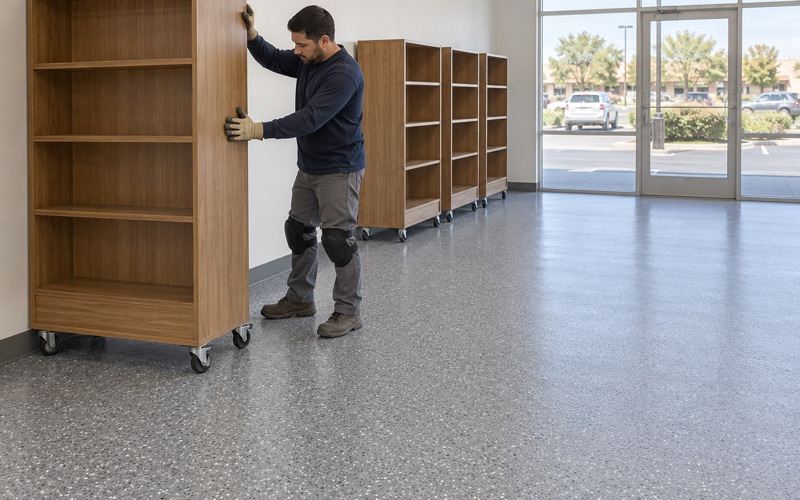
A sales floor needs grip in the aisles, especially near a butcher counter or a refrigerated section where condensation and drips are part of the day. We specify that slip resistance by the broadcast and topcoat, such as a fine quartz aggregate in the walk lanes, rather than promising it as a slogan.
Under the cases the logic flips. Aggressive texture in a toe space holds grime against the mop, so we taper the broadcast toward the case line and leave the strip beneath the fixtures smoother. A shopper’s toes barely touch that strip, but the cleaning tool reaches in on every pass.
A Light Topcoat That Shows What Is Underneath
Color is a cleaning tool too. A dark or heavily flecked floor hides a dried spill under a case as well as it hides scuffs in an aisle, and what nobody can see tends to stay. A lighter topcoat under and along the case line shows a stain the moment a flashlight sweeps under the fixture.
For the topcoat itself we usually compare a 100% solids epoxy body coat with a polyaspartic or polyurea top layer, chosen for stain resistance and for the cleaners the store already uses. Because store floors stay in use, we phase the work around operating hours, with overnight or weekend windows when an aisle cannot close.
Garage Freezers, Pantry Shelving and Working in Franklin Park
The same reasoning follows food home. Most of Franklin Park’s occupied housing is owned, 4,511 of 6,007 units, and 4,304 owner-occupied homes are single-family detached houses, much of the stock built from the 1940s through the 1960s.
The Chest Freezer and the Pantry Rack
A chest freezer or a second refrigerator in the garage sits on the slab the way a display cooler sits on a store floor, low and rarely moved. Condensation, a door left ajar or a thaw during an outage puts water under it, and on an older slab with a tired coating that water works into the cracks.
Pantry shelving in a basement or garage collects the same kind of hidden spill: a leaking jar, a split bag of flour, a can that rusted against the floor. On those older slabs we would rather say a floor needs repair, or replacement, before coating than sell a finish that will lift under the freezer.
Water From Below Is a Different Problem
The village says most of Franklin Park is a combined sewer area, where sanitary sewage and stormwater share the same pipes, and it sends residents with structural flooding or basement seepage to the Engineering Department, (847) 671-8304, for a drainage review. A coating does not stop seepage or a sewer backup through a floor drain.
That is why a moisture test sits in our written scope before the price is final, using methods such as ASTM F1869 calcium chloride testing or ASTM F2170 in-situ relative humidity probes. Moisture is also the first exclusion we name when we explain what a coating warranty leaves out.
The Village Contractor License
Franklin Park requires every contractor working in the village to be licensed, insured and bonded. The village license runs May 1 to April 30, at $100 a year for contractors or $250 for a general contractor, with a $10,000 trade-specific license and permit bond and at least $1,000,000 in liability insurance.
There are no half-year licenses, so timing matters for a spring job. Permit questions go to the Village of Franklin Park Building Department at 9500 Belmont Avenue, (847) 671-8245, and we confirm what applies to a given floor with the village before a job goes on the schedule.
- 20+ Years on Concrete
- Moisture Tested First
- Written Scope and Pricing