
Bartlett Epoxy Flooring provides concrete grinding in Bartlett, IL, serving surrounding cities including Winfield, Warrenville, Wood Dale, Bensenville and Campton Hills. Grinding is the step that decides whether a coating stays bonded, and after more than 20 years of surface preparation we treat it as a trade of its own rather than a chore before the real work.
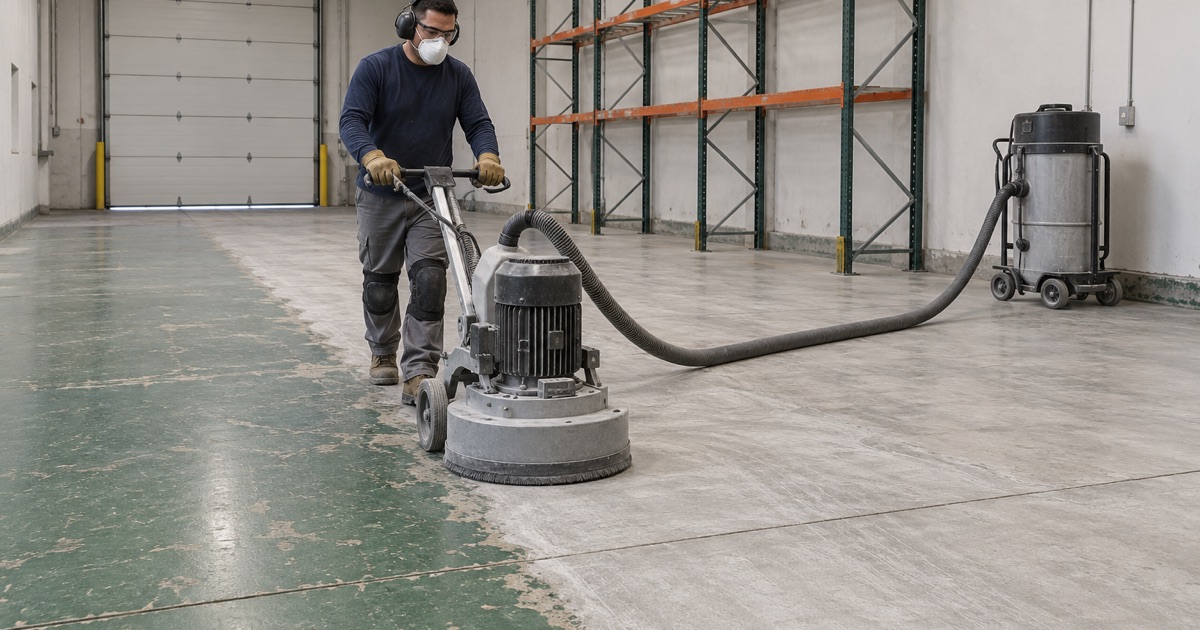
We grind slabs to prepare them for epoxy, polyaspartic and urethane systems, to remove old coatings, glue and paint, to flatten lips and high spots, and as the first stages of polished concrete. Every machine runs into a vacuum, so the dust ends up in a bag instead of across the room or down a drain.
Below are the methods we use, the profile each kind of coating needs, and what grinding reveals about a slab before anything goes on it.
Grinding Versus Other Surface Preparation
Diamond Grinding
Diamond grinding uses rotating heads fitted with metal- or resin-bond diamond tooling to cut away the top of a slab. Coarse tooling removes coatings and opens the surface, while finer tooling smooths it. With edge grinders it reaches right up to walls and leaves a flat, uniform surface.
For most garages, basements and smaller commercial floors, diamond grinding is our standard method. It gives a profile matched to the coating going over it and lets us take down small lips at joints in the same pass.
Shot Blasting
Shot blasting throws steel shot at the slab and recovers it with a vacuum, leaving a rougher, more open surface. It is fast on large open floors such as warehouses and gives the deeper profile that thick systems like urethane cement need. It does not flatten the floor and cannot reach edges, so the perimeter is ground.
On big commercial jobs we often shot blast the open field and diamond grind the edges, columns and drains. The choice between the two comes down to the coating, the slab and the schedule.
Why We Never Acid-Etch
Acid etching with muriatic acid is the shortcut behind most failed do-it-yourself floors. It removes only a thin layer, leaves residue and salts that must be neutralized and rinsed, and does nothing about sealers or oil. The rinse water also carries acid and fines toward floor drains and storm inlets.
Grinding gives a measurable profile and no wastewater, which is why it is the only way we prepare a slab for coating.
Surface Profile and Why It Matters
ICRI Concrete Surface Profiles
The International Concrete Repair Institute describes surface roughness on a scale from CSP 1, nearly flat, to CSP 10, very rough. Thin coatings and sealers need a light profile, while thick mortars and urethane cement need a much deeper one. Matching the profile to the product is how a coating gets the grip its maker designed it for.
After grinding we compare the floor with reference chips. If the product sheet calls for a deeper profile than the first pass produced, we go again rather than hoping it is close enough.
Profile for Epoxy, Polyaspartic and Urethane Cement
Most epoxy and polyaspartic floor systems call for a light-to-medium profile, which diamond grinding produces well. Trowel-applied and self-leveling systems, including urethane cement, need a rougher, more open surface from shot blasting or aggressive tooling. The proposal names the system, so the profile follows from it.
Flattening Lips, Ridges and Trowel Marks
Grinding also corrects small surface defects: lips at control joints, ridges from old patches and trowel marks that would show through a thin or clear coating. Taking them down evens the floor so a coating or polish looks uniform. It cannot fix a slab that has heaved or settled badly, which is a repair or replacement question.
We point out those areas during the walkthrough, so you know where grinding will help and where it will not.
Removing Old Coatings, Glue and Contamination
Old Epoxy, Paint and Sealers
Peeling epoxy, garage floor paint and penetrating or film-forming sealers all have to come off before a new coating goes on. Coarse diamonds or carbide tooling strip them to clean concrete. A new floor laid over an old, failing coating inherits that failure.
Some sealers are invisible until a few drops of water bead on the slab. We test for them during the walkthrough so their removal is in the scope from the start.
Tile Adhesive, Mastic and Asbestos Testing
Carpet glue, tile adhesive and black cutback mastic clog fine tooling and have to be removed with aggressive heads. Old nine-inch tile and black mastic installed decades ago may contain asbestos, so suspect materials are tested before any grinding. If they test positive, removal is abatement work for a licensed contractor, and our work starts after that.
Oil-Soaked Concrete
Oil, hydraulic fluid and grease soak into concrete, and coatings will not bond to a contaminated surface. We degrease and grind the affected areas until clean concrete appears, sometimes repeating the cycle on heavily stained shop floors. Where oil has gone too deep, the section may need to be cut out and patched.
Dust Control and Site Care
Vacuum Capture at the Machine
Every grinder and shot blaster we run is connected to an industrial vacuum with filtration sized for concrete dust. Capturing the dust at the head keeps it out of the air, off the walls and away from the rest of the building. Respirable silica is a real hazard, and capture at the source is the first line of defense.
Grinding dust and slurry are never washed toward a floor drain, a sump or a storm inlet. They are bagged and disposed of as solid waste.
Working in Occupied Homes and Businesses
In an attached garage or a basement, we seal the doors into the living space and set up negative air where needed. In a business, grinding is phased around open hours, often at night or on weekends, so dust and noise stay away from customers and staff.
- 20+ Years on Concrete
- Moisture Tested First
- Written Scope and Pricing