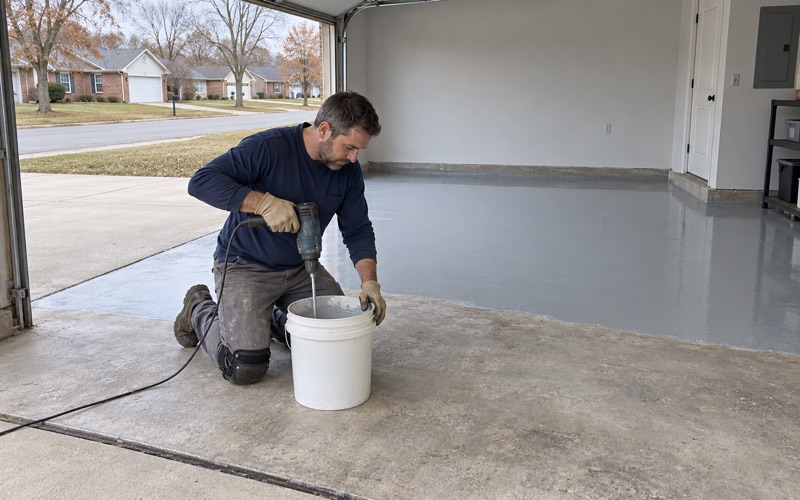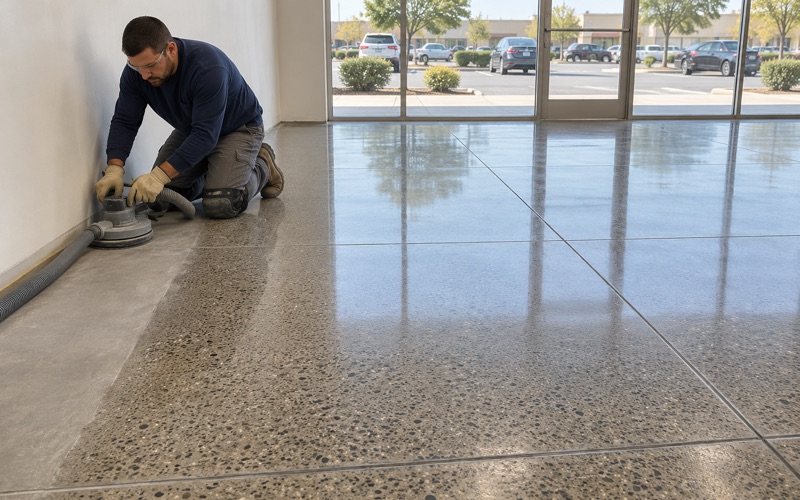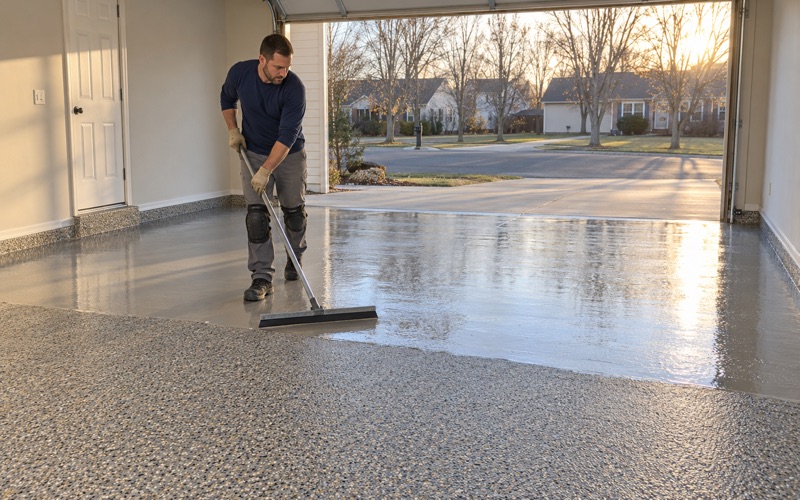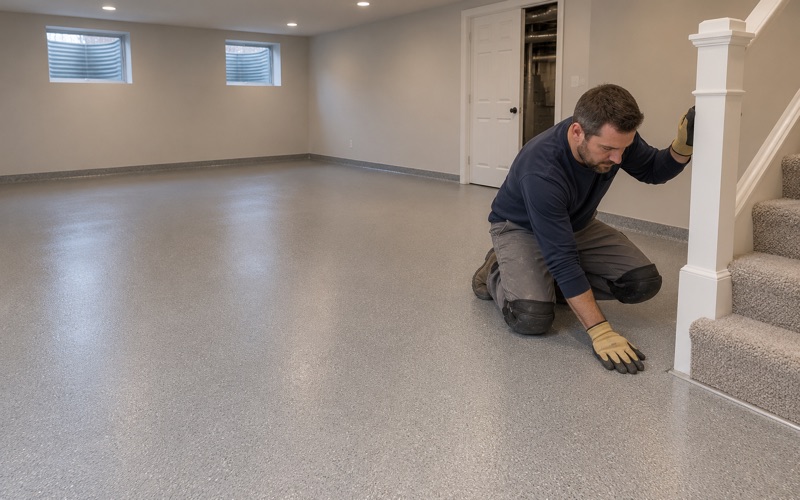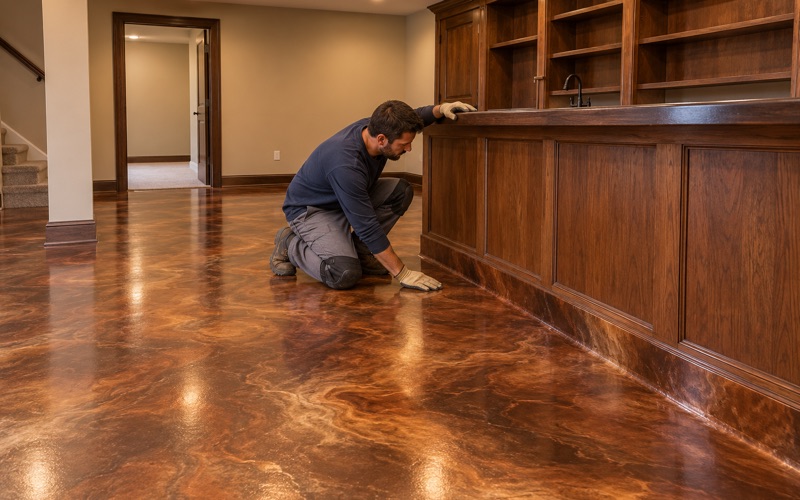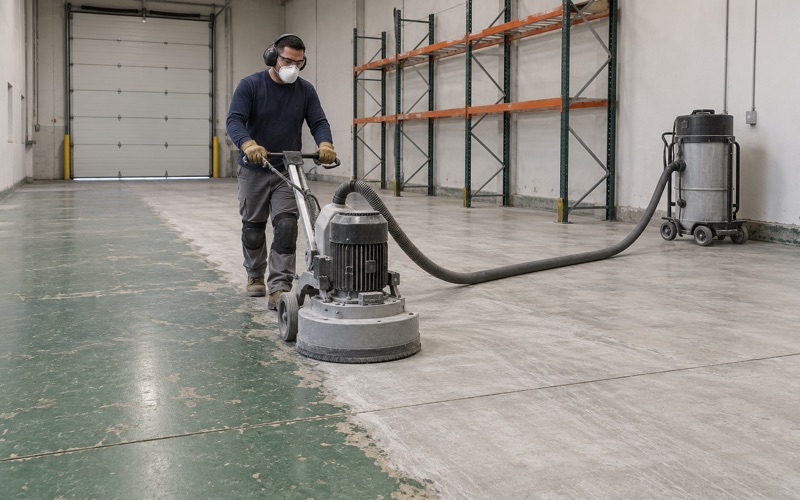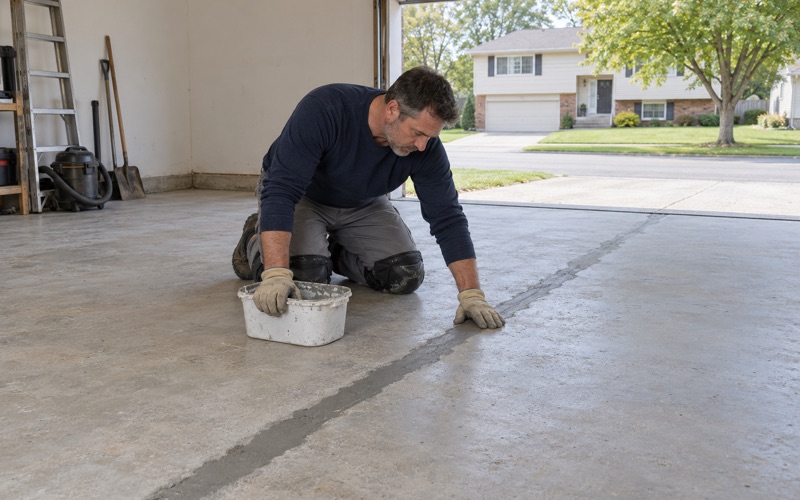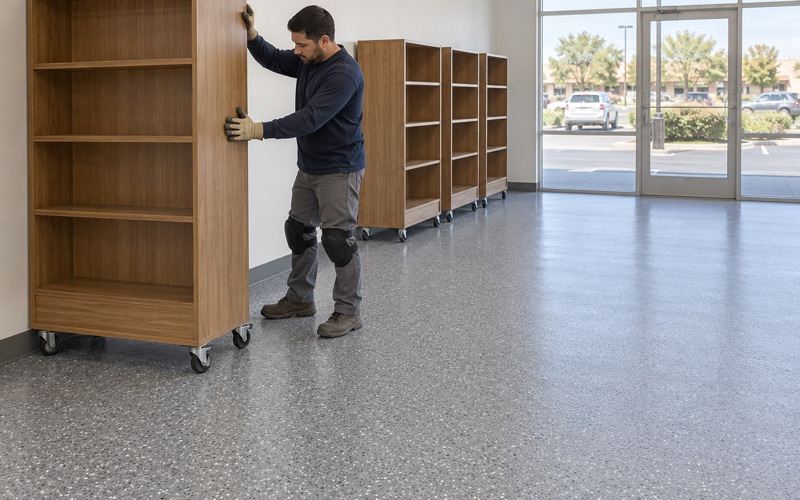
Bartlett Epoxy Flooring has installed epoxy flooring in Cary garages, basements, shops and commercial buildings as part of more than 20 years in the trade, and the habit that carries across all of them is simple: the slab comes first. We open every floor with a diamond grinder or a shot blaster, never an acid etch, so the resin has a measurable profile to bite into. Dust from that grinding is pulled into a vacuum at the machine.
That last detail matters here more than usual. Some floors are judged less by how they look than by how completely they can be cleaned, and a slab that sheds dust or hides it in open pores fails that test no matter what color it is. A sealed, dense surface lets dirt be lifted off rather than dug out.
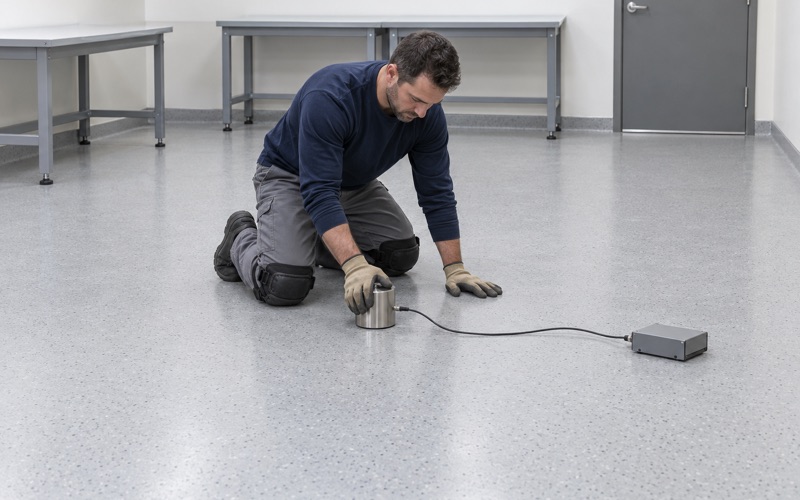
Before a price is final, our written proposal names the product line, the number of coats and the finished thickness, and it includes a moisture test on the slab. Cracks, spalls, open joints and old coatings are mapped first, and we say plainly when a floor needs repair before it should be coated at all.
A Police Training Range on Cary Woods Circle
What Opened in 2024
On May 23, 2024, the McHenry County Sheriff’s Office cut the ribbon on the McHenry County Regional Training Center Firearms Facility on Cary Woods Circle, inside the Village of Cary in Algonquin Township. It is a 10-line, 50-yard indoor range of about 11,000 square feet, run with the Cary, Algonquin, McHenry and Lake in the Hills police departments.
Besides the firing lines, the building holds mechanical targets, a 35-person classroom, a range control room and a firearm cleaning room, plus space to bring vehicles inside for tactical training. It is for officers only and is not open to the public. We have never worked there or seen its floors, but its layout is a clear picture of where lead travels inside a building.
Where Lead Settles on an Indoor Range
Firing a cartridge releases fine lead particles at the firing line, and bullet strikes downrange add more. Much of that dust drifts down and settles on the floor, where boot steps and rolling tires can lift it again. The downrange impact area is its own engineered zone, and nothing on this page is about coating it.
The floors that matter for housekeeping are everywhere else: behind the firing line, in the cleaning room where weapons are broken down, in range control, and along any corridor leading to a classroom or a garage. Those surfaces collect what shoes and equipment carry out of the shooting area, so they are where cleanability decides whether lead stays put or keeps moving.
Why Bare Concrete Holds On to It
Plain concrete is a porous paste full of capillary pores, and a slab that has never been sealed often dusts at the surface as it wears. Fine lead particles settle into those pores, into saw cuts and control joints, and into the rough texture around old patches. A vacuum pulls loose dust off the top; it does not pull much out of the slab itself.
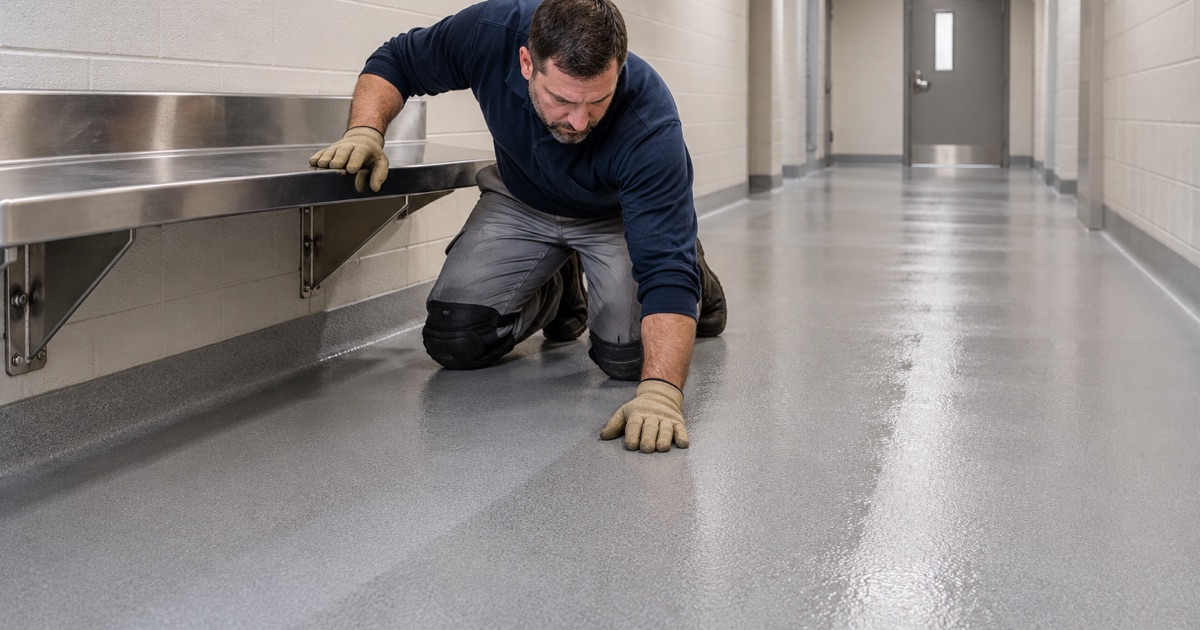
That is the whole case for a sealed floor in a space like this. Dense, seamless resin with few open joints gives lead far fewer places to lodge, so a vacuum or a damp wipe removes it from the surface instead of chasing it into the concrete. A floor coating removes nothing already in a building and is no substitute for a facility’s own lead program; it only gives cleaning a surface that can succeed.
Looking for epoxy-flooring closer to Western Springs? See Epoxy-Flooring in Western Springs.
What OSHA’s Lead Standard Says About Floors
Keeping Surfaces Free of Lead
The federal lead standard for general industry, 29 CFR 1910.1025, has a housekeeping paragraph that reads like a floor specification. Paragraph (h)(1) says all surfaces shall be maintained as free as practicable of accumulations of lead. On a range, the floor is the largest of those surfaces, and gravity keeps adding to it.
The phrase as free as practicable is the part a floor can help or hurt. A smooth, sealed surface can be returned close to clean on each pass, while a dusting slab keeps feeding fine particles back up no matter how often it is cleaned. The rule does not name a floor finish, but the floor decides how much the rule asks of the crew.
No Compressed Air on the Floor
Paragraph (h)(2)(i) is blunt: floors and other surfaces where lead accumulates may not be cleaned with compressed air. Blowing a floor clean only lifts the dust into the air people breathe and lets it settle again somewhere else, often somewhere harder to reach. That rules out the quickest habit in many shops, which is reaching for an air hose at the end of a shift.
For a floor, that means the surface has to come clean by contact methods alone. Rough or open concrete tends to hold dust in its texture, which is exactly what tempts someone toward the air hose. A tight resin surface removes that temptation because a vacuum head and a damp mop can actually reach what is on it.
Vacuum First, Sweep Only When It Fails
Paragraph (h)(2)(ii) allows shoveling, dry or wet sweeping and brushing only where vacuuming or another equally effective method has been tried and found not to work. Paragraph (h)(3) adds that vacuums are used and emptied in a way that minimizes lead reentering the workplace. Vacuuming is the default, and everything else needs a reason.
A vacuum works best on a surface it can seal against. Deep grout lines, unfilled control joints, spalled edges and peeling old coatings all break that contact and leave a strip of dust behind each pass. When we quote a floor for this kind of use, we fill or detail the joints we can and say which ones must stay open to move.
Sealed Floors Past the Firing Line and at the Exit
The Cleaning Room and Range Control
A firearm cleaning room sees solvents, lubricants and fine residue on benches and on the floor below them. NIOSH’s guidance for indoor ranges, Publication No. 2009-136, tells workers to wear gloves when using chemicals to clean weapons or range surfaces, which says something about what lands underfoot. A floor in that room has to resist those cleaners and still wipe down to a clean surface.
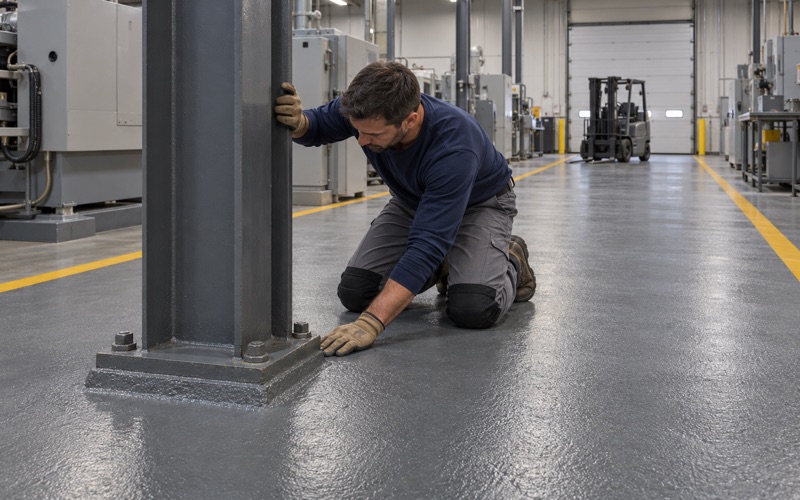
For rooms like that, we usually look at 100% solids epoxy with a chemical-resistant topcoat, checked against the solvents the room actually uses. Range control rooms and corridors see less chemistry and more foot traffic, so a thinner system with a tight, low-texture finish can serve them, kept smooth enough for a vacuum to seal against.
Slip Resistance Without Trapping Dust
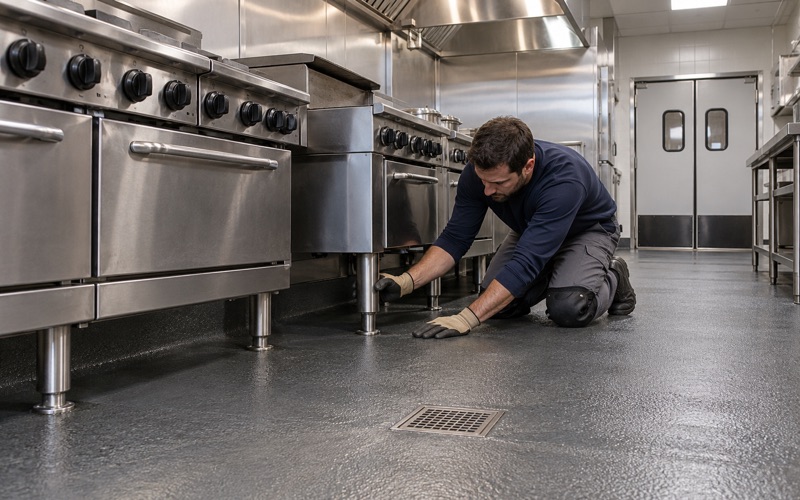
Smooth floors are easy to clean and can be slick when wet, which is the tension in any wet-wiped room. We specify slip resistance by the broadcast and topcoat, not by a promise: a fine quartz aggregate broadcast, locked under enough topcoat to round it over, gives grip without the deep valleys a coarse, open texture leaves behind.
Texture is a trade-off we put in writing. More grit means better footing and more surface for dust to sit in, so the proposal names the aggregate size and the number of topcoats, and the floor can be checked against it after the work is done. Grittier texture at wet benches and a smoother finish along dry corridors is a common split.
Shoes, Mats and Vehicles at the Door
NIOSH’s worker guidance says to change clothes and shoes before leaving firing range facilities, and its employer guidance calls for floor mats and shoe covers where needed to limit lead transfer to clothing. Both point at the same weak spot: the threshold where a shoe that walked the range steps onto a floor that is supposed to stay clean.
A sealed, seamless floor at a change area or exit makes that boundary easy to clean on a schedule, and it gives a mat something flat to sit on. Vehicles are the larger version of the same problem. Tires that roll through a shooting bay can carry dust into a garage, which is one more reason a sealed, vacuumable floor belongs on the other side of the door.
Prep, Sign-Offs and Benches at Home
Prep on a Floor That Has Already Seen Lead
Grinding an existing range-side floor is itself lead work, because the dust the grinder raises is the dust the floor was holding. Our vacuum capture at the grinder helps, but it is no substitute for the facility’s own lead program and protective gear. We hold no lead license or certification, and a coating is never sold as a way of getting lead out of a building.
Moisture still comes first. The test in our scope uses ASTM F2170 in-situ relative humidity probes or ASTM F1869 calcium chloride testing, depending on the floor, because a coating sealed over a damp slab can blister and lift. A lifting coating opens new edges, and new edges are exactly where dust collects.
Who Signs Off in Cary
Inside the village, building questions go to the Village of Cary, while fire protection comes from the Cary Fire Protection District, a separate district at 400 Cary-Algonquin Road rather than a village department. Health questions in the McHenry County portion sit with the McHenry County Department of Health. We confirm permit needs with the village before a job is scheduled.
Cary sits in Algonquin Township in McHenry County, with a portion of the village in Cuba Township in Lake County, so we confirm which county an address falls in rather than assuming. That matters for health-department questions on a commercial space, even when the building permit itself stays with the village.
Cleaning and Reloading Benches at Home
Some homeowners clean firearms or reload ammunition at a bench in the garage or basement, and the same logic applies on a smaller scale. Bench work leaves solvent drips, lubricant and fine residue on the floor below, and bare concrete soaks it up. A sealed resin floor under the bench lets that wipe off instead of staining in.
It also changes how the corner gets cleaned. A smooth, sealed floor can be vacuumed and damp-mopped instead of swept, and it makes it easier to keep shoes from carrying bench residue into the rest of the house. That is a household habit, not a regulated one, but it borrows from the workplace rule that puts the vacuum ahead of the broom.
Garages That See Salt and Tires
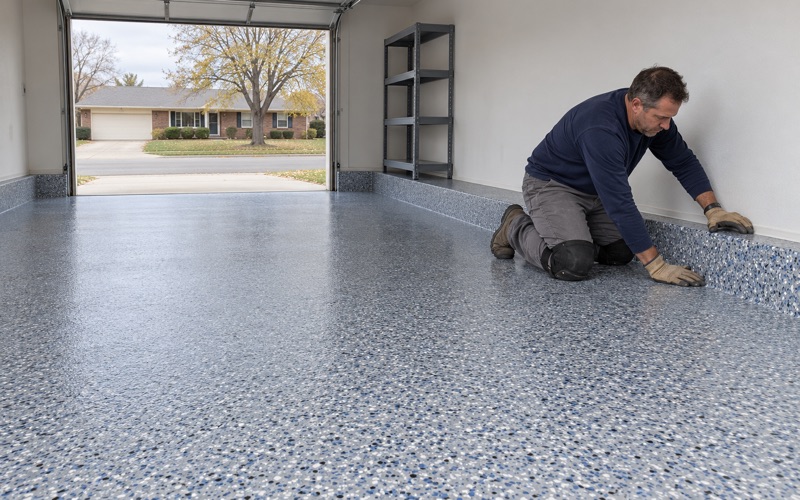
Cary’s housing went up steadily from the 1970s through the 2000s, so a garage slab on one street may be decades older than the one on the next. We read each slab on its own before choosing a system, and we name a polyaspartic or polyurea topcoat where hot tire pickup and winter brine are the bigger risks.
Rock salt and calcium chloride ride in on tires all winter, and a garage system has to hold up to that brine. Cure follows slab temperature and dew point rather than the calendar, so an unheated garage in deep winter is told to wait. The same sealed surface that sheds brine also vacuums clean, so one floor answers both problems.
- 20+ Years on Concrete
- Moisture Tested First
- Written Scope and Pricing