Bartlett Epoxy Flooring has spent more than 20 years on epoxy flooring in Campton Hills and the rest of the area, and the floors that teach us the most here are the ones that sit between a horse and a house. A barn aisle, a tack room and an attached garage often share the same traffic of boots, wheelbarrows and a tractor. What that traffic carries matters more to a coating than most owners expect.
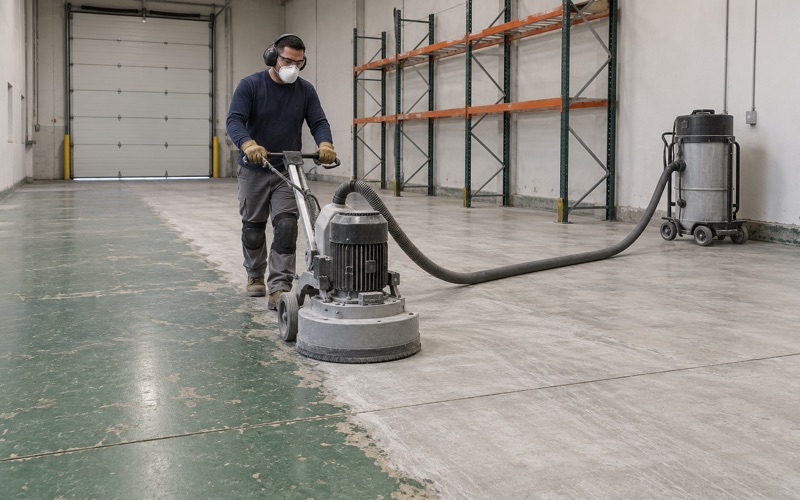
Our work starts with the slab itself. We open every floor with a diamond grinder or a shot blaster rather than an acid etch, map the cracks, spalls and old coatings before pricing, and put a moisture test into the written scope. The proposal names the product line, the number of coats and the finished thickness, so you can check the floor against the quote.
This page is about one specific load on those floors: the magnesium chloride that indoor arenas are often treated with for dust and frost control, and what happens when it leaves the arena on a boot. We explain what the research says, where the salt ends up, and how we set up a floor so it can be kept clean rather than left to soak.
Horse Lots, Indoor Arenas and Why They Get Salted
Estate lots where horses are allowed
Campton Hills is a village of detached, owner-occupied houses, with estate zoning districts that set minimum lots of 4 acres in RE-1, 2 acres in RE-2 and 1.25 acres in RE-3. A Zoning Commission letter from October 2024 states that equines and barnyard animals are permitted from RE-1 through R-1, so keeping horses is a permitted residential use, not only a farm one.
That matters to us because the person who calls about a floor almost always lives on the property. Census figures show 3,595 owner-occupied detached houses and only 48 renter households, so the owner who books the barn aisle is often the same owner who books the garage, and both slabs see the same boots.
Why arena footing gets magnesium chloride
An indoor arena throws dust every time it is ridden and dragged, and in winter its footing can freeze. Equine trade press has covered salt as one answer: a footing consultant quoted by EquiSearch in 2007 recommended magnesium chloride as the least corrosive, and thus best, salt option for arenas, and called salt more of an indoor option because rain can wash it away outdoors.
The same article said it takes only 2 to 4 ounces per square foot to make a difference and noted that salt lowers the freezing temperature of the footing. It also warned that too much can dry out hooves and damage tack, boots and clothing. Those boots are the part that concerns a floor contractor, because they do not stay in the arena.
What we do not know about local arenas
We have not read any record of a Campton Hills arena, stable or owner using magnesium chloride, and we do not assume that any does. The question we ask instead is simple: what goes on your footing? If the answer is magnesium chloride flakes or brine, the floors around that arena are carrying it, and we plan the coating with that in mind.
We are a floor coating company, not an equine or footing consultant, so we do not advise on how much salt an arena should get or whether to use it at all. That decision belongs to the owner and whoever manages the footing. Our part starts at the arena door, where the footing ends and the concrete begins.
Looking for epoxy-flooring closer to Barrington? See Barrington Epoxy-Flooring.
What Concentrated Magnesium Chloride Does to Cement Paste
Chemical attack, not just freezing
Most people think of salt damage on concrete as a winter freeze problem. The research on magnesium chloride points at something else as well. Michigan Tech researchers, in a study plan submitted to the South Dakota DOT, wrote that, based on published research, the most problematic chemicals appear to be the chlorides of magnesium, calcium and sodium.
Their explanation is about the cement paste itself, the binder that holds sand and stone together. Degradation, they wrote, results from a rise in dissolved calcium and magnesium ions in the concrete’s pore water, and free magnesium ions can form expansive or weak products such as brucite or magnesium silicate hydrates. Expansive means it pushes the paste apart; weak means the paste loses strength where they form.
Chloride and the steel inside
The same researchers describe chloride in pore water as a primary cause of scaling and of corrosion in reinforcing steel. Where a slab has wire mesh or rebar in it, that is the steel the salt water is working toward, and joints and edges are where it tends to collect and sit. We look for rust staining and popped surface spalls when we map one.
Their study plan also lists coatings among the factors to test for their effect on deicer getting into concrete. Mixture parameters sit beside coatings on that list, because how the concrete was made matters too. That is a sensible question, not a finished answer, and it is the reason we treat a coating as one layer of protection on a slab that still needs care, not as a shield.
Why the research is not settled
We do not present this as proof that magnesium chloride ruins concrete. A later paper from the same team, in 2006, reported expansion and cracking in mortar immersed in concentrated magnesium and calcium chloride, with brucite in the outer layers. That was mortar soaking in strong solution in a laboratory, which is a different exposure from a boot print on a barn aisle.
The literature is not one-sided. A 2019 WSU study reported no typical visible distress in magnesium chloride samples after 10 accelerated freeze-thaw cycles. The honest reading is that concentrated magnesium salt can attack cement paste under some conditions, and repeated wetting of an uncoated slab is the exposure worth limiting.
Tracked Salt: Arena Door, Barn Aisle, Tack Room, Garage
How the salt travels
Once magnesium chloride is in the footing, everything that crosses the arena picks some up. Boots, hooves, wheelbarrows and the tractor that drags the arena all leave with salted footing on them, and the first hard surface they meet is usually the concrete at the arena door or the barn aisle beyond it. Magnesium chloride draws moisture from the air, so those deposits rarely stay dry for long.
On the concrete it gets wetted again and again, by wash water, by a spilled water bucket, by a mop. Each wetting puts the salt back into solution where it can work into an unsealed surface, and each drying leaves a crust that the next pair of boots grinds in.
Barn aisle and tack room
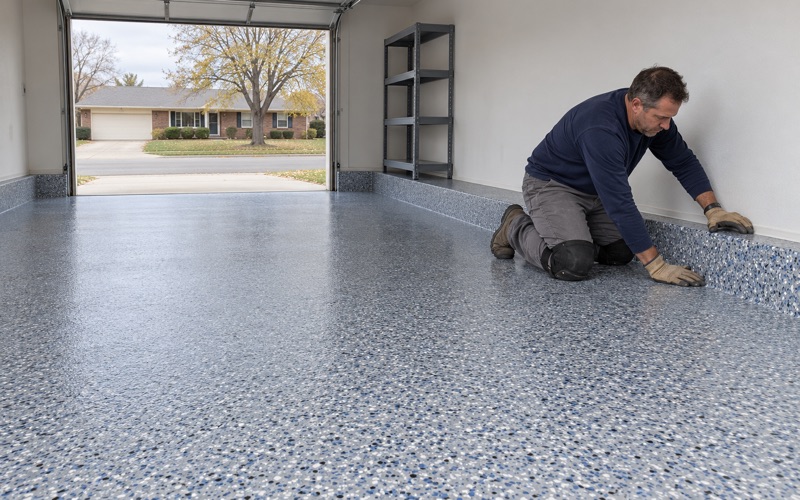
The barn aisle often takes the heaviest share, because in many layouts every trip in and out of the arena crosses it. We look at it as a working corridor that needs a continuous, sealed surface from wall to wall, with joints and cracks treated rather than left as open channels where salty water can sit.
A tack room sees less traffic but more lingering salt, since boots, saddle pads and grooming kits get set down there still dusted with footing. Salt dust on a tack room floor ends up on whatever is set down next, so we want that floor easy to rinse and quick to dry.
The garage slab at the end of the trail
The attached garage can be where the tractor, the truck and the barn boots end up for the night. That puts arena salt on a slab that was poured for cars. Census figures put 2,365 of the village’s housing units in the 1970s through the 1990s and 767 more in the 2000s, so most garage slabs here are 25 to 55 years old.
Slabs that age often carry an earlier sealer or coating, and salt that has worked under a failing film is still in the concrete. When our mapping turns up scaling, spalls or soft paste, we tell you plainly that the slab needs repair or replacement first, because a new coating is not a fix for salt-damaged concrete.
Sealed Concrete, Boot Brushes and Plain-Water Rinsing
A sealed, joint-tight coating
On floors that take arena traffic, we prefer a sealed coating over a bare broom finish, carried tight to the walls and worked into the joints and treated cracks. A 100% solids epoxy base under a polyaspartic or polyurea topcoat is a common build for this kind of floor, since it leaves a continuous film rather than open pores.
We are careful about what that coating can and cannot do. It slows salt water from soaking into the top of the slab, but it does not make concrete immune to salt, and it does not stop salt from reaching the slab through cracks, joints or uncoated edges. Those are the places to watch and touch up over the life of the floor.
A walk-off and boot-brush zone at the arena door
The cheapest protection is keeping salt off the coated floor to begin with. We suggest a defined walk-off zone just outside the arena door, with a boot brush where riders and handlers step off the footing, so most of the salted material stays on the arena side. Footing knocked off there can be swept back into the arena instead of traveling down the aisle.
Where that zone sits on concrete, we coat it with the rest of the floor and plan for it to wear first. Wheelbarrows and the arena tractor cross it too, so we also look at where the tractor is parked and suggest a spot on a surface that can be rinsed down after each drag.
Rinse with plain water, before the crust dries
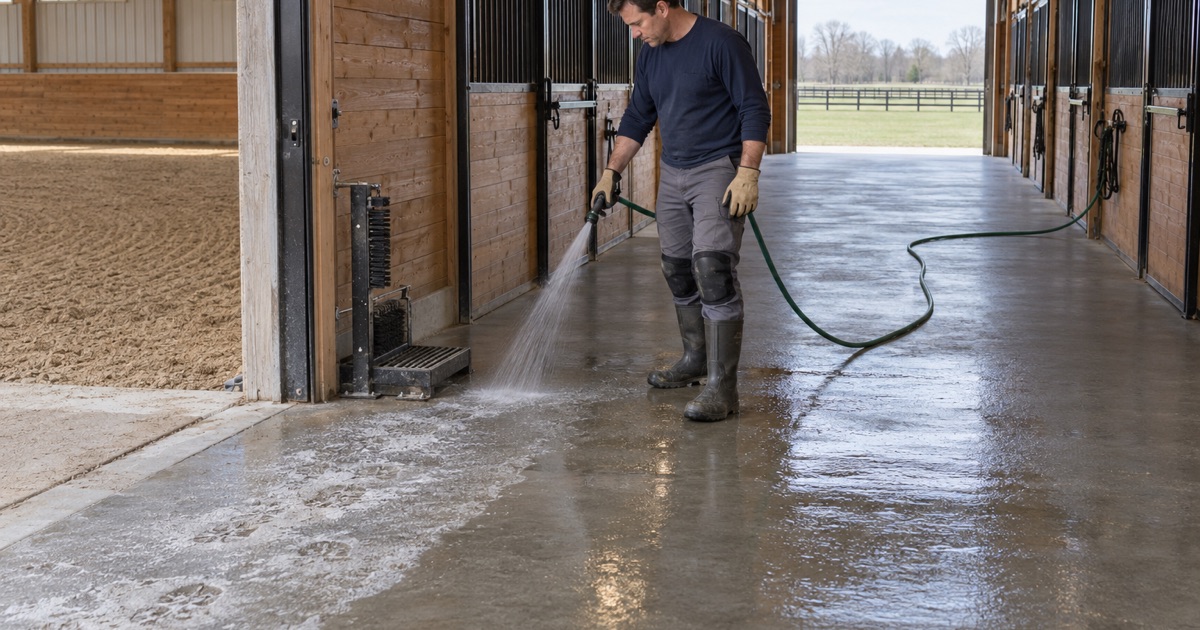
Cleaning is where an owner does the most good. Salt that dries into a crust on a coated floor is picked up and spread by the next boots, so we recommend rinsing the arena door, aisle and garage with plain water on a regular schedule rather than letting deposits sit, and using a mild cleaner only in small amounts.
Squeegee the rinse water out of the building rather than leaving it in low spots, and look the floor over once it is clean. A clean, dry floor tells you far more about its condition than one carrying a white film.
Scheduling the work around a horse property
Coating a barn aisle means the horses and the traffic have to go somewhere else while we work and while the floor cures. Our cure schedules follow slab temperature and dew point rather than the calendar, so an unheated barn or garage in deep winter is told to wait, and we set the timing with you before any grinding starts.
Before the job is sold, we explain what a coating warranty leaves out, starting with moisture. If a barn aisle or garage floor is part of a larger remodel, we check with the Village of Campton Hills Building and Zoning Department on whether a permit is involved. A floor coating alone is not on the village’s permit list, but whether it is part of a permitted remodel is that department’s call.
- 20+ Years on Concrete
- Moisture Tested First
- Written Scope and Pricing