Bartlett Epoxy Flooring handles epoxy flooring in Burr Ridge with more than 20 years in the trade, and many of the requests we hear begin with a floor that already has something on it. The owner wants one seamless resin surface, and the room in question is covered in ceramic or quarry tile.
Our first answer is a question back: does the tile stay or go? Coating over tile can work, but only on conditions the coating makers spell out, and we check each of them on site before a price is written. Where the tile fails that check, we say so plainly and quote removal instead of a shortcut.
The same habits apply whether the floor underneath is tile or bare slab. Surfaces are opened with a diamond grinder or a shot blaster rather than an acid etch, moisture is tested as part of the written scope, and the proposal names the product line, the coat count and the finished thickness so the result can be checked against the quote.
A Tile Showroom Off I-55 and the Tile Already Down
Grant Street and the floors around it
Daltile and Marazzi keep a showroom at 7600 South Grant Street, which the company describes as conveniently located off I-55 and aimed at contractors, designers and custom builders. Mosaics, wood looks, stone finishes and marble-look tiles fill it. We mention it as a place, not a source: the showroom gives no advice on coatings and we have no relationship with it.
It is also a reminder of how much floor area around Burr Ridge is already tile. Kitchens, baths, lobbies and mudrooms were finished that way for good reasons, and when an owner later wants a seamless resin floor, the decision about the tile underneath comes before any talk of color or flake.
Homes and storefronts finished in tile
Most of the village’s housing went up between 1980 and 2009, and about 94 percent of it is owner-occupied, so the tile we meet is often original or one renovation old. Quarry tile turns up in older kitchens and service rooms, glazed ceramic in baths and entries, and larger formats in newer lobbies.
Mudrooms and entries are the other common case. They take wet boots, salt and grit all winter, and an owner tired of scrubbing grout often asks whether a resin floor can replace the grid without a tear-out. The answer depends on the tile, which is where the next section starts.
Commercial floors here turn over with tenants as well. The village logged a record 458 building permit applications in 2023, and each buildout lands on whatever floor the last tenant left, which is sometimes tile that someone would rather coat than demolish.
Why the tile question changes the price
Keeping sound tile saves a demolition day, the disposal and the patching of a scarred slab. Removing failing tile adds those steps back, which is why the hollow spots need finding before the quote rather than once the grinder is running.
It also changes the schedule. A coat-over job moves from cleaning, abrading and grout filling to priming, while a removal job needs the slab assessed for cracks, old adhesive and moisture once the tile is off, and we map those before the floor system is chosen.
Looking for epoxy-flooring closer to Lyons? See Lyons Epoxy-Flooring.
Can Resin Go Over Tile? Only if It Sounds Solid
What the coating makers actually say
A Sherwin-Williams resinous flooring tech tip puts it conditionally. If the existing floor has been sounded out and is well bonded, and the new system is epoxy-based, there is no need to remove it completely. Both conditions carry the weight, and we assume neither from how a floor looks.
The same tip asks installers to talk with the maker about options based on the composition of the tile, and it calls for the maker’s primer with a bond additive over tile. So a glazed porcelain, a ceramic wall-and-floor tile and an unglazed quarry tile are not treated as one surface, and the primer is chosen for the one actually on the floor.
Tapping for a hollow, drummy note
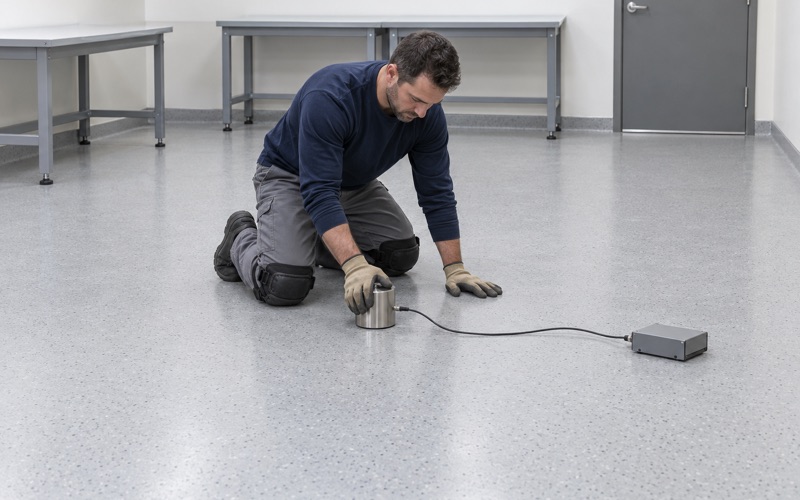
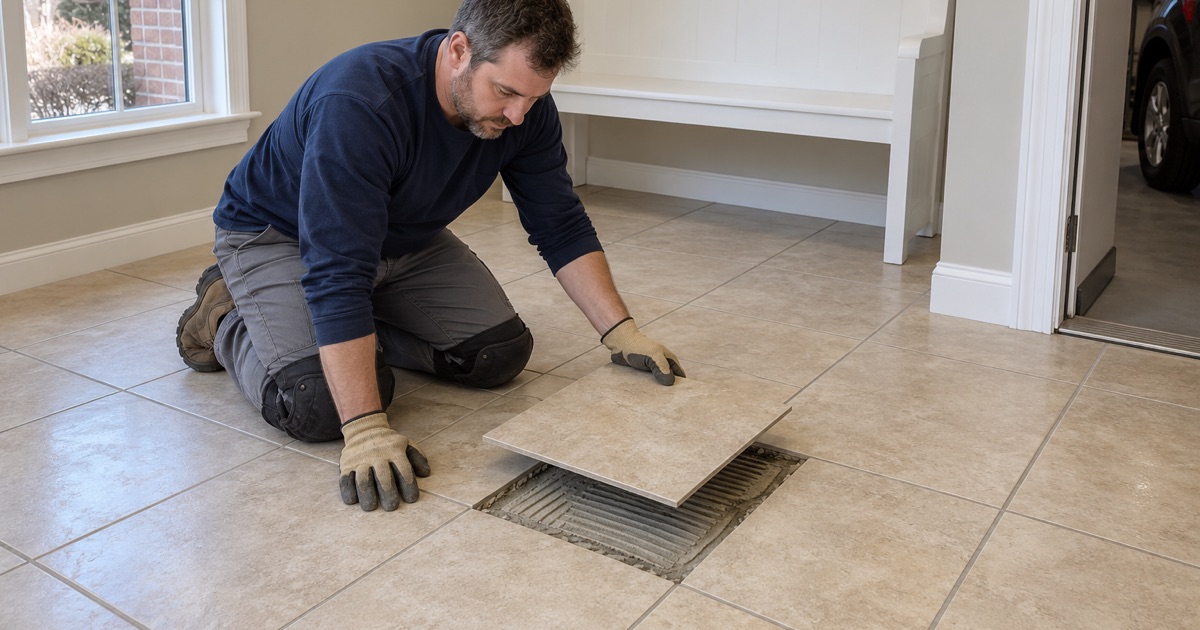
Sounding is simple and slow. We tap or drag a steel tool across the field tile by tile, listening for the hollow note that means the tile has let go of its setting bed. A sound tile rings solid; a drummy one sounds like a box, and we mark each one on the floor and on a sketch.
An ARDEX bulletin written for laying new tile over old puts the substrate standard bluntly: no loose or drummy tiles. It also notes that mechanical preparation will usually highlight unsound tile, so we sound again after the first grinding pass, because a tile that held through tapping can still show itself loose once the glaze is cut.
What a scattered hollow spot means
One or two drummy tiles in a large room are usually a repair: they come out, the bed is cleaned and patched level, and the area is sounded again. When hollow tiles cluster or run along a wall, door or wet area, the bond across the whole floor is in question, and we treat that as a removal job rather than a patch.
A second cause of trouble sits under the tile rather than in it. Basements are read for past water before anything else, and if the tile has been lifting because moisture is moving through the slab, a resin coat over it would only trap the problem. A moisture test stays in the written scope either way.
Gloss Off, Grease Out, Grout Lines Filled
Abrading the glaze completely
A glazed tile is built to shed dirt, which also means it resists a primer. The tech tip calls for mechanical abrading by shot blasting, grinding or sanding to totally remove gloss, and we treat a shiny patch left after grinding as unfinished work, not a cosmetic miss.
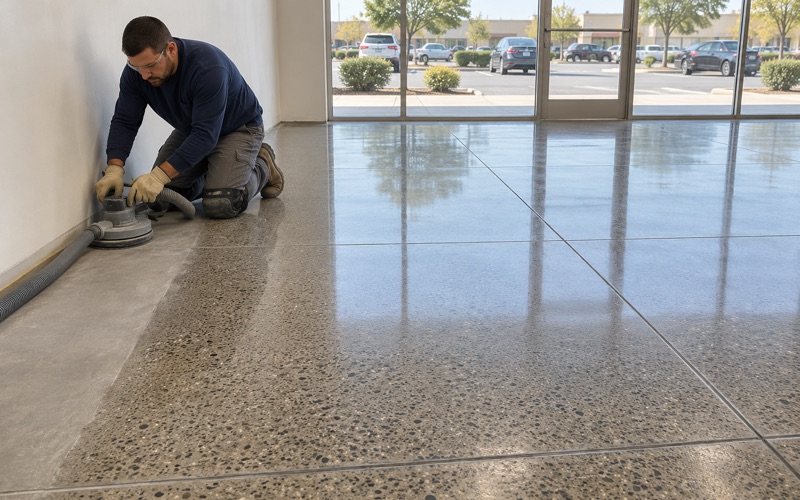
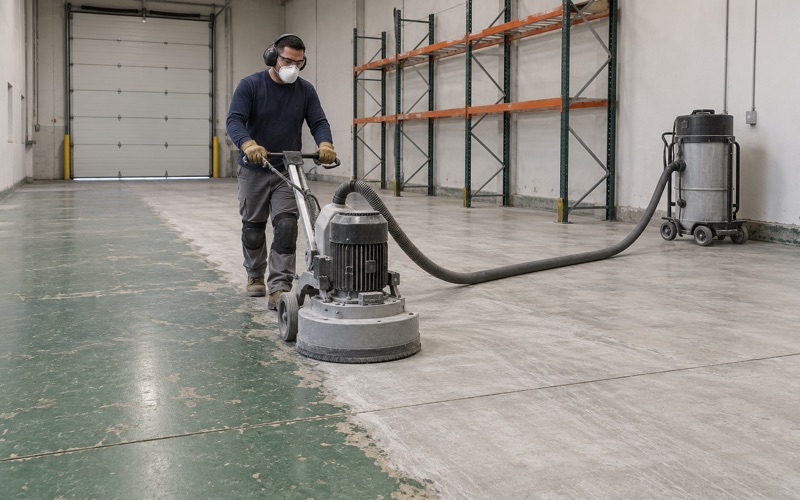
On most tile we use a diamond grinder with vacuum capture at the machine, so the dust goes into a bag rather than toward a floor drain or sump. The ARDEX bulletin’s own benchmark for ground glaze is a minimum of 80 percent of the surface taken to CSP 1, after which the tiles are checked again for bond quality.
Edges and corners get the same attention as the open field. A hand grinder works along walls, cabinet toes and thresholds where the large machine cannot reach, because a glossy strip at the perimeter is where a coating often starts to lift.
Getting grease out of the surface and the grout
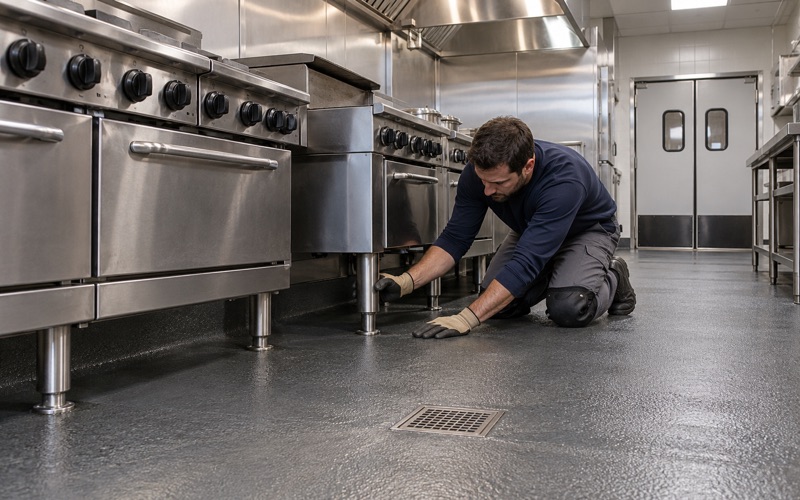
Kitchens are where this step earns its time. The ARDEX bulletin warns that sealers, dirt, grease and other contaminants cost bond, particularly in kitchens and recessed grout lines. Grout is porous and holds what was spilled on it for years, so we degrease before abrading, vacuum, and finish with a solvent tack-wipe before primer goes down.
Quarry tile in an older kitchen is often the hardest case, since its unglazed face and wide joints can soak up cooking fat. If cleaning does not bring the grout back to clean, dry material, that floor joins the removal list.
Skim-filling the grout lines
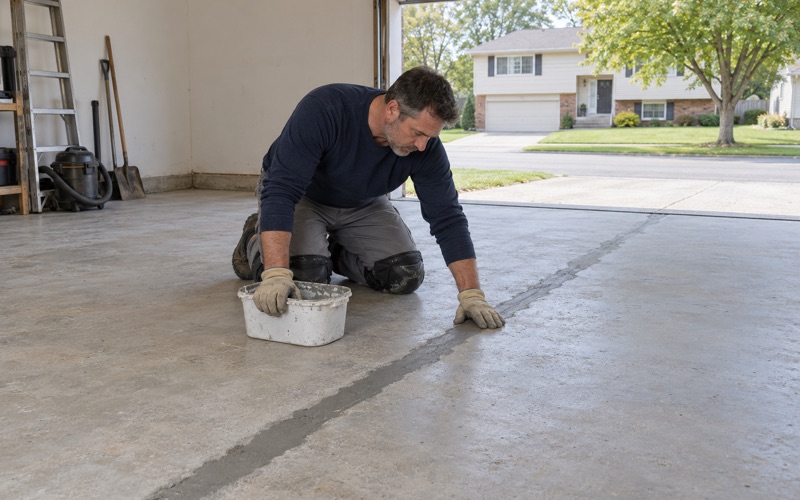
Recessed grout lines are low spots, and a thin resin film follows whatever it is laid on. Left open, the grid shows through the finished floor as a pattern of faint lines. The tech tip calls for a skim coat over grout lines with an appropriate product before the flooring system goes in, and we let that fill cure and sand it flush before priming.
After the fill, primer and body coats go down on a schedule set by slab temperature and the dew point spread at the surface rather than the calendar. A tiled mudroom or porch that stays unheated in deep winter is a reason to wait, and we say so.
The proposal lists that skim coat as its own line, along with the primer, the number of coats and the finished thickness. A buyer comparing quotes can then see which ones left the grout to telegraph.
When the Tile Has to Come Up Instead
Loose tiles come out first
A coating over tile does nothing for a tile that has already lost its bond. It cannot reattach it, and the new floor is only as sound as the layer beneath it, so a hollow tile left in place can become a crack or a blister in the resin later. Loose tiles are removed and the gaps patched level before any coat-over work proceeds.
Once enough tiles are hollow that patching turns into a partial tear-out, full removal is usually the cleaner answer. We grind off the old setting material, map cracks and spalls in the slab, and tell the owner if the concrete itself needs repair before it should be coated.
Removal also opens a question coat-over avoids: what the slab under the tile is doing. Concrete that sat under tile for decades may never have been tested for moisture, and nothing on record says whether a slab of that era sits on a vapor retarder, so we measure moisture rather than assume it.
A coat over tile does not fix a leak
The ARDEX bulletin makes the point about showers: a new layer of tile in a shower recess will not remedy the problem unless the leak itself is addressed. Resin follows the same logic. If water reaches the tile from a failed shower pan, a plumbing line or a damp slab, a coating hides the symptom while the cause keeps working underneath.
So we ask about past leaks, stains and lifted tiles before quoting, and the warranty conversation names moisture vapor and hydrostatic pressure as exclusions up front. A coating is not a repair for water, and we do not sell it as one.
Permits on either side of County Line Road
Burr Ridge straddles the Cook and DuPage line, but the building rules come from one place: Village of Burr Ridge Community Development. Its permit page lists tile replacement among finish work that needs no permit, while work affecting foundations, patios, driveways and garages does, and we confirm the status of a given job with the village before scheduling.
Where a job is permitted, the village requires each contractor and subcontractor on it to hold the village license, backed by a $10,000 bond naming the village and at least $1,000,000 in aggregate liability insurance listing it as additional insured. Illinois itself licenses no flooring or coatings contractor, so that village license is the requirement that binds.
- 20+ Years on Concrete
- Moisture Tested First
- Written Scope and Pricing