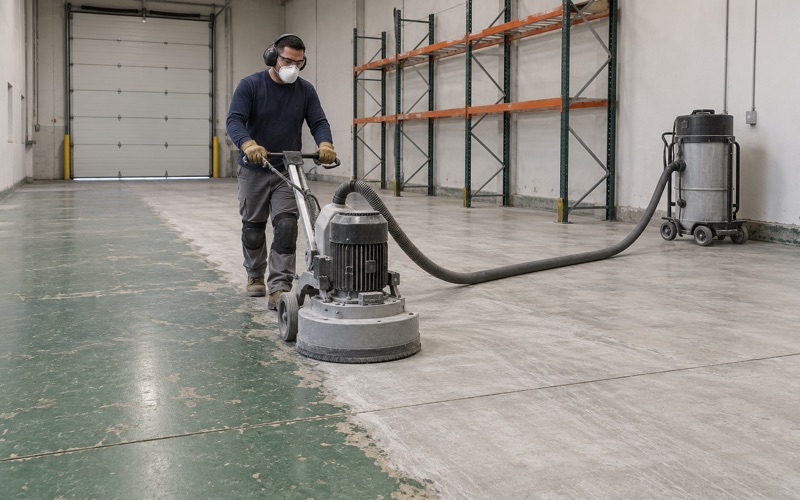
Bartlett Epoxy Flooring has spent more than 20 years on epoxy-flooring in Bensenville and the suburbs around it, and the work always starts at the slab rather than the color chart. Every floor we take on is opened with a diamond grinder or a shot blaster, never an acid etch, because a coating is only as good as the profile it grips.
Before a price is final, we test the slab for moisture and put the result in the written scope. The proposal then names the product line, the number of coats and the finished thickness, so an owner can hold the finished floor up against the quote instead of taking our word for it.
This page looks at a kind of floor most coating contractors never think about: one the state regulates. Not every surface is a weekend recoat, and the reasoning that applies to a regulated room carries over to a shop, a warehouse aisle or a basement here.
A Factory on Green Street That Became a Police Station
From an Unused Plant to a LEED Gold Headquarters
Bensenville’s Police and Emergency Management Headquarters at 345 E. Green Street began as something else entirely. The builder, Camosy Construction, describes the project as the adaptive reuse of an approximately 48,000-square-foot unused manufacturing facility, designed by FGM Architects. The village dedicated the building on June 27, 2015, as a LEED Gold Certified facility.
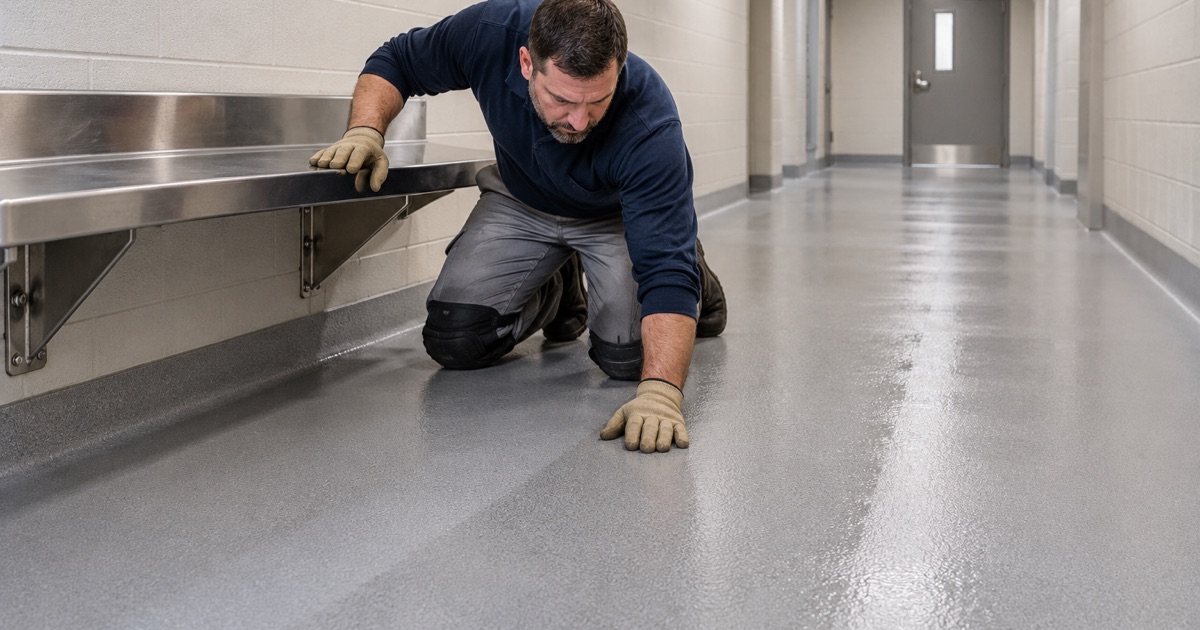
Inside the old plant shell the program is dense: indoor squad parking, two vehicle sallyports, booking, holding and interview rooms, a fitness center, locker rooms, a community room and a detention area with 6 cells. A building like that holds many different floor jobs under one roof, and the cell floor is the one with a rulebook written for it.
What the Village’s Own Cleaning Contract Shows
The village’s 2022 janitorial bid for the headquarters puts numbers on the building: approximately 47,000 square feet, run 24 hours a day, 365 days a year, with about 90 police and emergency management staff. It lists a detention area of 3,175 square feet that a cleaner may enter only with an officer.
The same document lists the floor finishes the cleaners maintain, among them porcelain tile, luxury vinyl tile, carpet tiles, sealed concrete that is broomed, cleaned and hosed per schedule, and poured-in-place epoxy that is dry mopped before wet mopping. It does not say which rooms carry the epoxy, and we do not guess. We had no part in building or maintaining any floor there.
A Building That Never Closes
A police station is not a store with a closing time. The bid describes a building in use every hour of every day, with cleaning products chosen to suit the LEED Gold designation and vacuums fitted with HEPA filters. Any floor work in a building like that is planned around the people who cannot leave it, not around a contractor’s preferred calendar.
That also means the work arrives in pieces. A detention area is not cleared for a week the way a showroom is; a room comes out of service, gets prepared, coated and cured, and goes back before the next one starts. A job like that is honestly priced by the room and the access window, not by the square foot alone.
Looking for epoxy-flooring closer to Campton Hills? See Epoxy-Flooring Services in Campton Hills.
What Illinois’ Lockup Standards Say About Cell Floors
Concrete First, Non-Skid Allowed
Municipal lockups in Illinois fall under the Municipal Jail and Lockup Standards in 20 Ill. Adm. Code 720. Section 720.160(b)(7) is short: cell and cell block floors must be concrete or precast concrete and may have non-skid material. That wording sets the order of things. The structure is concrete, and anything applied on top is a non-skid surface added to it, not a replacement for it.
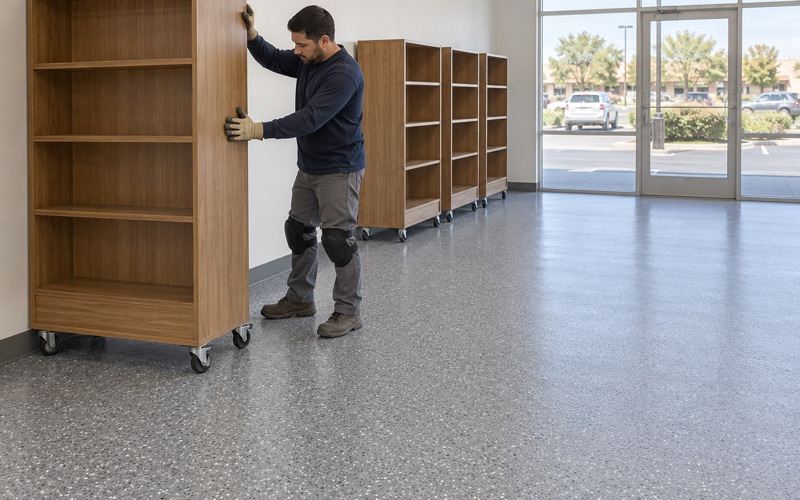
For a coating contractor, that frames the question correctly. A resin system over a cell slab is judged first on whether it bonds to the concrete for good and then on whether its texture stays non-skid. We specify texture by the broadcast and topcoat, typically a quartz aggregate broadcast locked under a sealing coat, rather than calling a floor slip resistant and leaving it there.
Cleaned Daily When Occupied
Section 720.90(a) says that when occupied, cells and detention rooms shall be cleaned daily, and the next paragraph asks that the areas next to the cells stay clean and orderly. A floor in that service sees water, a cleaner and a mop every day it holds anyone, year after year. That is a different wear pattern from a garage that gets hosed down a few times a winter.
The texture that keeps a wet floor non-skid also has to release dirt to a mop, and those two goals pull against each other. Too coarse a broadcast holds grime in its valleys; too fine a one wears smooth under daily wet cleaning. Where a cell fixture is anchored at the wall base, the coating has to stay intact at that joint, because a lifting edge is where water and soil get underneath.
A Remodel Goes to the State First
Section 720.160(a) requires that all plans and specifications for the construction of municipal jails, or for the remodeling or renovation of existing facilities, be approved by the Illinois Department of Corrections. Recoating a cell floor with a new system is a change to a reviewed space, so the decision belongs with the owner and the owner’s architect, who carry it through that approval.
No floor coating makes a lockup compliant on its own, and no coating carries a state approval as a product. Our part in a job like that would be the submittal data the architect asks for: the product line, the number of coats, the finished thickness and the texture. The pitch of the floor and the drains are the architect’s design, and they stay that way.
Working Around Escorts, Restricted Rooms and a 24-Hour Building
Escorted Access and Rooms No Contractor Enters
The headquarters’ cleaning bid names areas no one cleans at all: the gun range, the mechanical room, and evidence processing and storage. It also requires a police escort in the detention areas. A floor crew would work under the same terms, which means the schedule is set by when an officer can stand with the crew, not by how fast the grinder moves.
That shapes the scope before a price exists. In any secured building we walk the rooms with the owner, mark the restricted doors as off limits, and stage materials and equipment so nothing crosses a secured space to reach the work area. A cell taken out of service for coating also has to be one the department can do without for the full cure.
Dust and Odor Where People Work Around the Clock
Grinding concrete makes fine dust, and a coating gives off odor while it cures. We capture grinding dust at the machine with a vacuum rather than washing it toward a drain, and we choose products inside the Illinois VOC limits for floor and industrial coatings under 35 Ill. Adm. Code Part 223, which bind whoever applies them. In an occupied building, both habits matter more than they would in an empty warehouse.
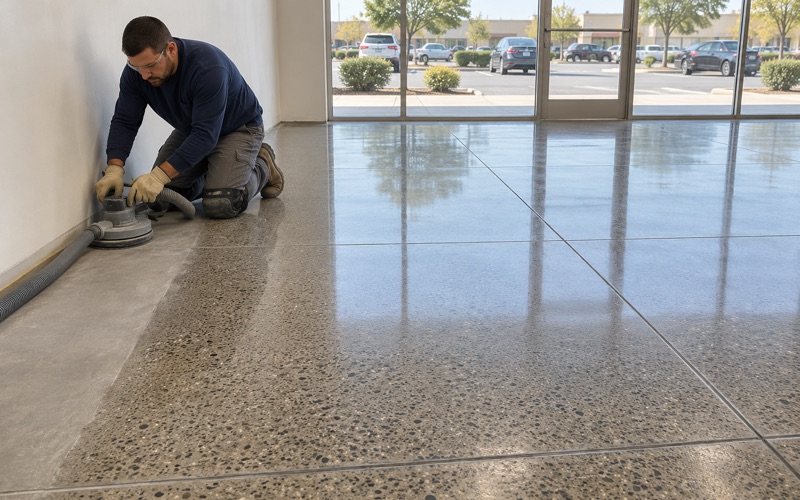
Preparation is the step that decides whether a floor lasts, and it is the one we never shortcut to save time in a secured building. A diamond grinder or shot blaster opens the slab to a measured ICRI concrete surface profile, and cracks, spalls and old coatings are mapped first. If a slab needs repair before it should be coated, we say so in writing.
Curing on the Slab’s Schedule
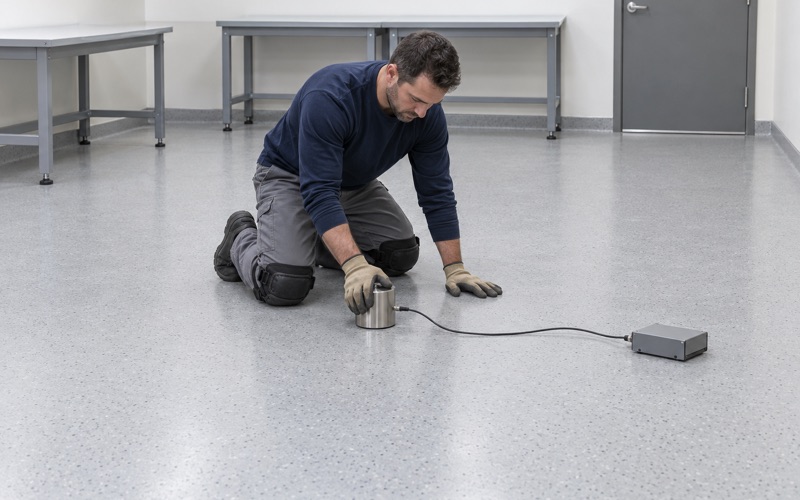
A slab inside a conditioned building may well be warm and dry, but we still read it. A calcium chloride test under ASTM F1869 or relative humidity probes under ASTM F2170 tell us what the concrete is releasing, and the dew point spread at the slab surface tells us whether a coat will cure clean or develop amine blush. The cure schedule follows those numbers, not the work order.
A fast-return topcoat such as a polyaspartic can shorten the time a room is out of service, but only where the slab conditions and the texture requirement allow it. We say what each option costs in downtime before anyone commits to it.
What the Same Logic Means for a Business or a Home
Shops, Warehouses and Food Floors
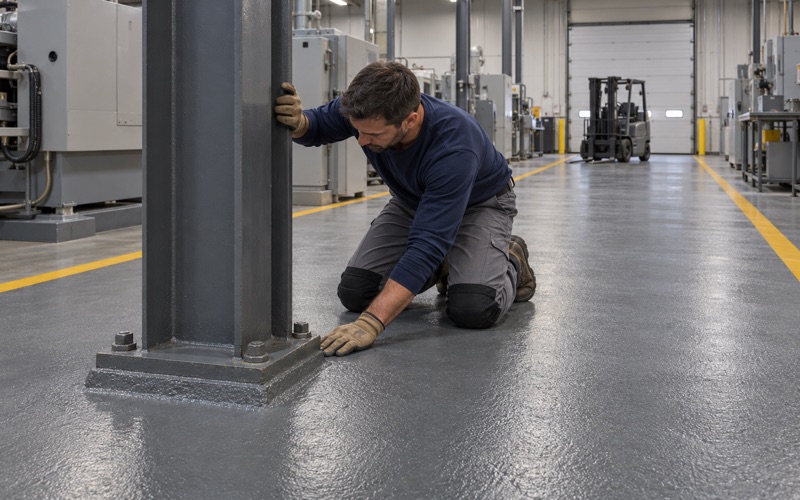
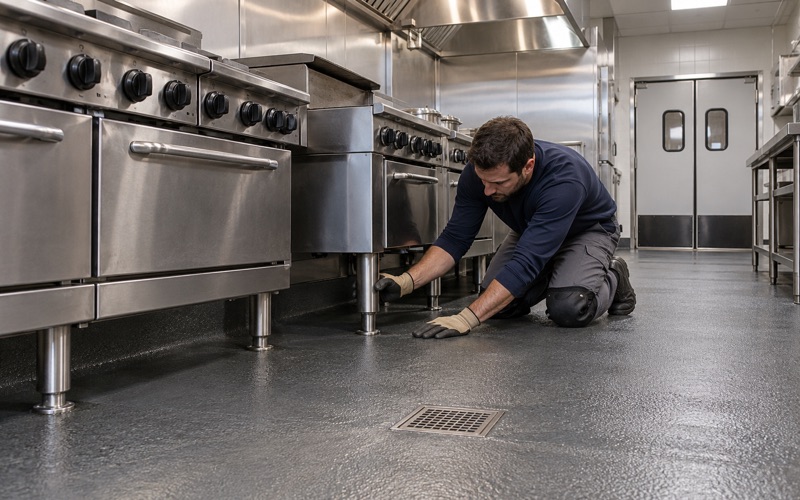
Few owners in Bensenville run a lockup, but many run floors with a rule behind them, whether a federal housekeeping duty or a health inspector’s checklist. The village spans DuPage and Cook counties, so the health authority for a food-handling floor depends on the parcel: the DuPage County Health Department on one side, the Cook County Department of Public Health on the other.
The method is the same as for a cell. Find out who reviews the floor, write the texture and thickness into the scope, and phase the work around operating hours, with overnight and weekend windows when a space cannot close. Where a floor change raises a permit or contractor-license question, we check with the Village of Bensenville Community Development department before the job is scheduled.
Garages That Carry Winter Brine
The village has 3,080 owner-occupied single-family detached homes, a smaller share than its population suggests, since roughly half of occupied homes are rented. For the garages that do exist, the daily-cleaning lesson translates to winter: brine and rock salt ride in on tires every week, and the floor has to take repeated wet scrubbing without the coat lifting at the edges.
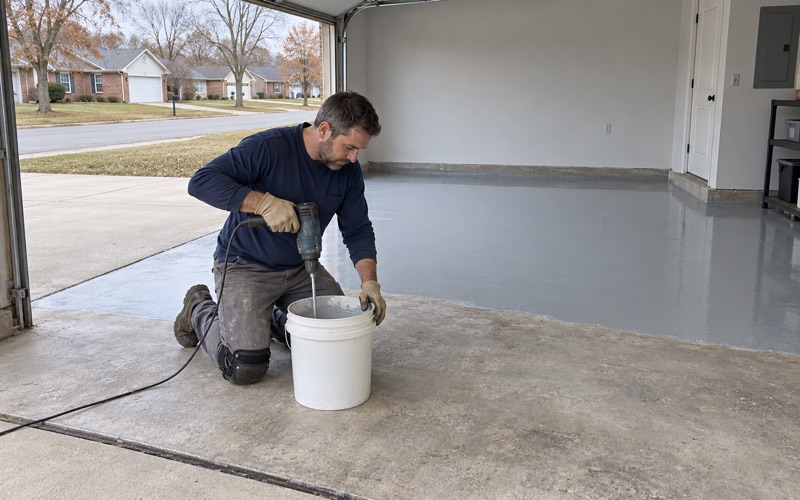
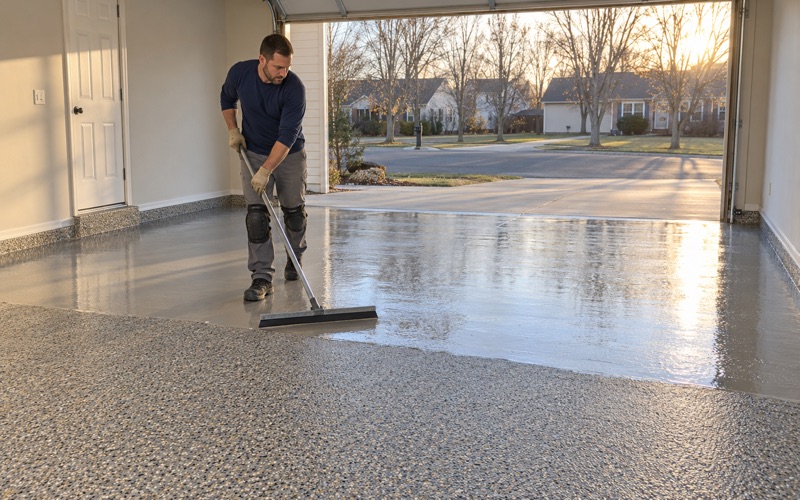
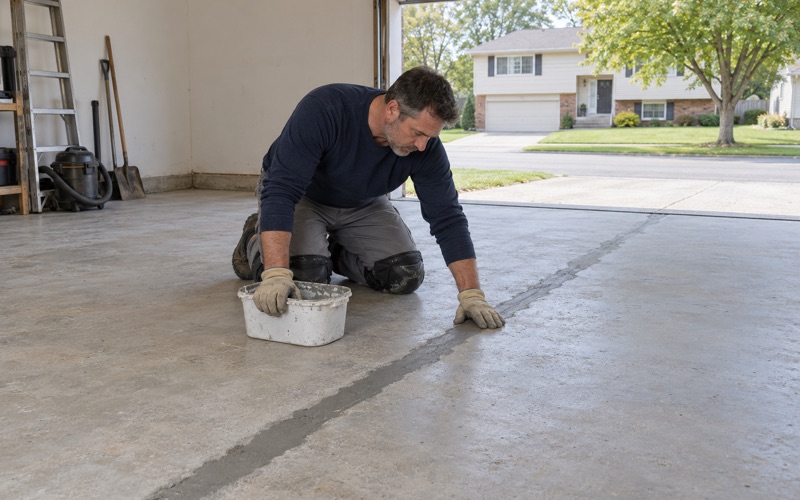
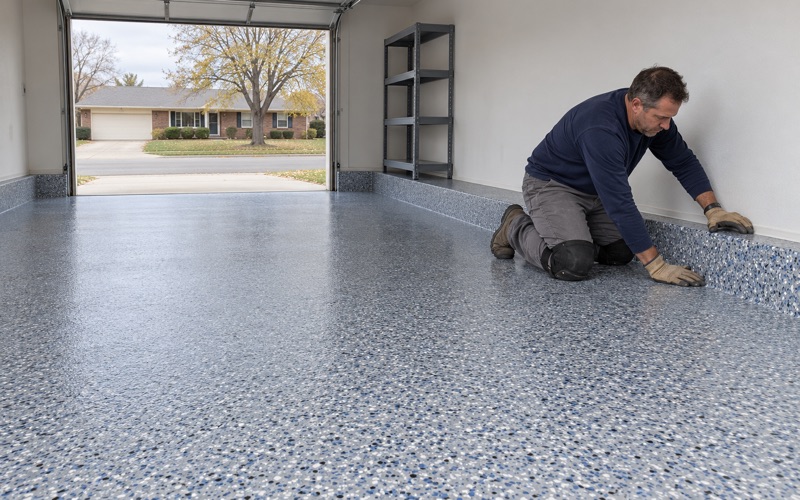
We pick garage systems for that salt load, usually 100% solids epoxy with a vinyl flake broadcast and a polyaspartic or polyurea topcoat that resists hot tire pickup. Cure follows slab temperature and dew point, so an unheated garage in deep winter is told to wait for warmer conditions rather than coated on schedule.
Basements and the Overhead Sewer Program
Bensenville’s floodplain page names three flood sources: Willow Creek, Silver Creek (also called Bensenville Ditch) and Addison Creek with its tributaries. The village’s Overhead Sewer Program reimburses eligible homeowners 75 percent of the cost, up to $7,500, for an overhead sewer, and 75 percent, up to $750, for a backflow prevention device, with village approval, permits and inspections required before work starts.
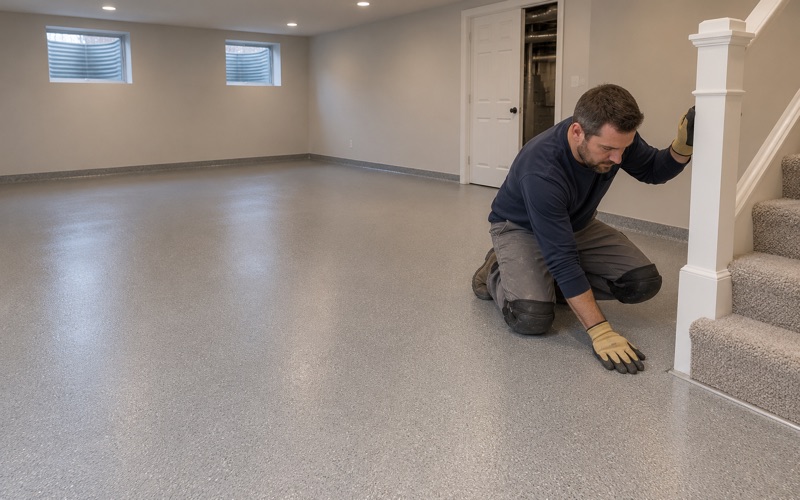
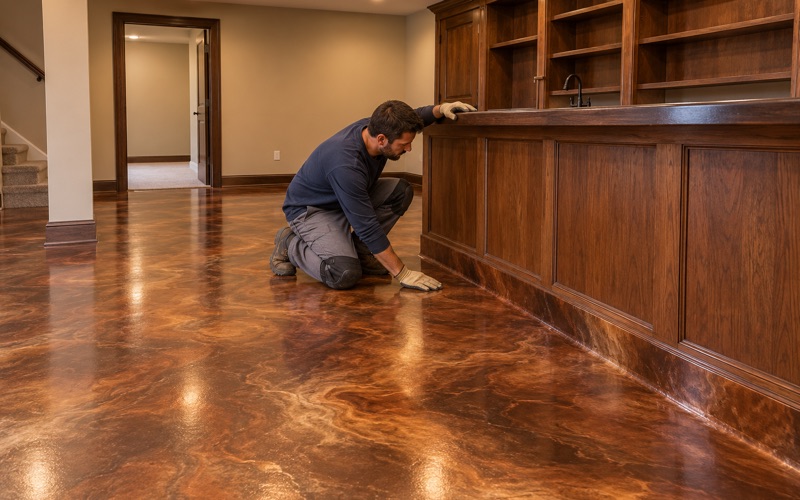
An overhead sewer conversion generally means cutting and patching the basement slab for an ejector pit, so a basement coating belongs after that plumbing and its inspections, not before. We also read every basement for past water first. A coating does not stop seepage or a backup, and moisture is the first warranty exclusion we name before a job is sold.
- 20+ Years on Concrete
- Moisture Tested First
- Written Scope and Pricing